
2026 Advertising Creative Strategies that Will Take Scaling Forward
Let’s be clear about one thing: the days of “hacking” an algorithm have come and gone.
Are you running ads long term? Have you feelen the transition? In 2026, advertising creative has changed advertising in a fundamental way: no longer can micromanaging audience interests and finding one “secret” targeting option to reduce CPA work; platforms such as Meta and TikTok have automated targeting almost entirely; algorithms have now become sophisticated enough to find customers if fed enough advertising creative fuel!
Your creativity needs fuel! Ad Creative Strategies have now become the single greatest driver of profitability, but many marketers continue to view creative as an afterthought and assume “creativity” simply means making things look attractive.
Do Creative Strategies Just Happen Automatically? No they don’t.
A winning Ad Creative Strategy goes well beyond graphic design or aesthetic trends; rather it involves conducting systematic research, hypothesis testing, execution planning and data analytics with an aim of acquiring customers profitably – this makes all the difference between throwing spaghetti against a wall to see what sticks and creating a repeatable growth engine that provides repeatable revenue growth opportunities.
In this guide, we are going beyond simple tips – together we are creating an Ad Creative Strategy to transform cold audiences into loyal buyers by merging art with hard data.
Why You Require Data-Driven Ad Creative Strategy
If your marketing involves simply uploading random images and hoping they hit, this is not marketing–it is gambling! No one likes it when their intuition fails them: spending thousands producing something and it flopping while an equally-priced grainy photo taken with your smartphone gets three times as many views! Unfortunately, relying solely on instinct can quickly burn through budget.
2026 has seen the algorithms on Meta and YouTube become increasingly sophisticated. This is why a proper Meta Ads setup using the Andromeda framework is essential to ensure your creative signals are being read correctly by the AI. No longer merely responding to what users request as targets; now these platforms measure who actually stops scrolling your ad instead – in effect creative is now the new targeting. A small group will view your creative, and when someone engages, more similar individuals may appear within that small group – should your creative not instantly catch someone interested then your costs increase significantly!
An effective Ad Creative Strategy should never be compromised on.
Data-driven creative isn’t about killing creativity – it’s about channeling it. By shifting focus away from “I think this looks cool” towards “This angle works”, data can demonstrate creative impact’s contribution up to 70% of campaign performance; outweighing budget allocation or audience selection in its impactful measure. Without a plan in place, creative fatigue quickly sets in. Your ROAS (Return on Ad Spend) plummets, while CPA increases. And all too soon you find yourself wondering whether the platform has collapsed underneath you- it hasn’t. Just that your ammunition ran dry!
Structured Ad Creative Strategy offers the solution by turning failures into data points that you can then analyze to reduce acquisition costs and extend the longevity of winning ads.
A 5-Step Ad Creative Strategy Framework.
How could a house be constructed without blueprints, yet many marketers build ads without one? For successful scaling in 2026, repeatable workflow is key for success. Here is the Ad Creative Strategy framework employed by top performance teams to consistently create winners.
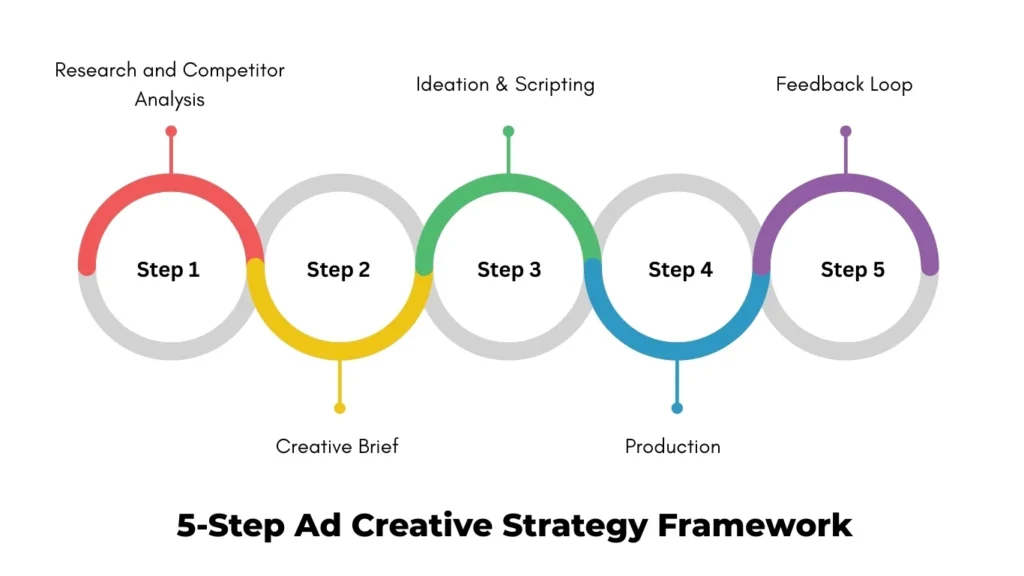
Step 1:Research and Competitor Analysis is Complete
Before opening any design tools, it’s crucial to become an Ad Creative Strategist and do research. Your Ad Creative Strategy starts by understanding what works in the market today.
An Ad Library Deep Dive: Head over to Facebook Ad Library or TikTok Creative Center and observe what ads your competitors are running; look also at how long these have been active if any have been running for more than 3 months; analyze any such ad by looking for hooks or angles of attack that stand out.
Review Mining: To uncover this opportunity, browse Amazon or your competitors’ reviews and look for specific phrases customers use to describe their pain points. For instance, if five customers mention how greasy other lotions felt, your new advertisement headline should read as such: “The only lotion that doesn’t feel greasy.”
Step 2: The Creative Brief
Information means nothing if it can’t reach its audience, which means your Ad Creative Strategy requires a standard brief to bring everyone involved on board and ensure a cohesive creative strategy for ads that span media buyers and designers.
Context Is Key: Don’t simply say, “Create a video,” explain who this video will target instead – for instance: Target stressed moms aged 30-45 who prioritize convenience over luxury.”
Aim: Define the central idea. Is this an “Us vs. Them” battleground, an anecdotal story, scientific proof or another angle altogether?
Step 3: Ideation & Scripting
As soon as we know who our customer is and the goals they wish to pursue, then comes creativity. But keep this in mind; you are writing a sales pitch not an art film!
Create an Engaging Script: In 2026, attention spans have shrunk considerably; for maximum retention your script needs to be engaging and punchy. Use artificial intelligence tools like ChatGPT to come up with 10 potential hooks (opening lines) for one core concept.
Visual Planning: Deliberate on how you will visually communicate value – for instance, will it be through an engaging green-screen reaction video, ASMR unboxing experience or high-paced montage.
Step 4: Production (The “Visual” Strategy).
Your Ad Creative Strategy comes to life here.
Format is Essential: When shooting for Reels/TikTok, be sure to shoot 9:16 (vertically). When creating website banners or other wide content pieces, go wide instead.
UGC Vs Polish: Don’t be seduced by expensive cinema-quality cameras alone; in many instances a video made using an iPhone feels more natural to its platform, creating trust among viewers and increasing conversion rate.
Step 5: Feedback Loop
Launch isn’t about arriving; it’s all about taking off.
Data Feedback: Once the budget has been spent on advertising, take note of its metrics: did its hook fail (low 3-second view rate), did customers click but do not purchase (bad offer), etc.?
Iterate: Take the winner, change one variable (such as first three seconds of ads running for example), and run them again – this cycle forms the backbone of an effective Ad Creative Strategy.
Anatomy of a Successful Ad: “3-Second Strategy”
Have the greatest product, most persuasive script, and irresistible offer imaginable; yet if your audience scrolls away within three seconds of viewing your presentation – none of that matters.
Your Ad Creative Strategy rests upon one harsh reality: your battle for attention in an endless feed designed to distract is real and must be treated as such. A high-performing ad’s composition doesn’t remain mysterious – its formula was created specifically to stop scrolling.
1. The Hook (0-3 Seconds): An Interrupter for Pattern Interference.
Your video’s hook rate (the percentage of viewers who stop and watch), is of critical importance; failing to capture attention here could spell disaster for any brand’s video campaign. A solid Ad Creative Strategy prioritizes Hook Rate over other metrics – to increase it further use pattern interrupts–visual or audio cues which interrupt viewers scrolling rhythm.
Visual Shock: Any sudden movement, bizarre image or high contrast color split is enough to cause visual shock.
TikTok Text Overlays: Intimidating questions like, “Stop Doing This If You Want Clear Skin!” or, “Can’t Believe I Found This.!” can create buzz on TikTok and quickly expand user engagement with their brand.
Visuals play an essential part of making advertisements effective. Consider this: does your ad appear as just another boring commercial, or more like something their friend posted online?
2. The Body (3-15 Seconds): Establish Your Value Proposition
Once you have captured their interest, the next step should be earning their time. Here is where Ad Creative Strategy needs to change from “shock” to “substance.” Here, the core Value Proposition must be presented: Don’t just list features; create problems which require solutions like your product!
Show, Don’t Just Tell: To demonstrate what a product can do for its intended use, show its results directly: cleaning products should show grime dissipating from surfaces while software should demonstrate how its dashboard can save time.
Pacing: Be fast. Skip any breath, pause or “um”.
3. Call to Action (CTA): Closing Statement
Don’t leave viewers hanging without guidance – use an effective call to action (CTA) message that tells users exactly what action to take next.
Be Specific: Instead of offering generic information about learning more, try saying: “Get Your Free Sample”, “Shop Our Sale”, or “Take Our Quiz”.
Visual Cues: Add visual indicators like button graphics or an arrow that point towards the actual link within UI.
By mastering its three-part anatomy, Ad Creative Strategy moves away from guesswork towards actual engineering of performance.
Creative Strategies Target Platform-Specific Ad Creatives
One size definitely does not fit all.
Your video could go viral on Facebook but bomb completely when uploaded to TikTok due to user expectations being different on each app. A powerful Ad Creative Strategy doesn’t involve copy-pasting assets from one platform into another – instead it adapts your message so it resonates effectively on every platform.
Here is how you can tailor your strategy specifically to the big three.
Meta (Facebook and Instagram) Strategy
Meta is one of the more advanced platforms. By 2026, its algorithm had become so advanced that broad targeting without interests or lookalikes often outperformed narrow segmentation; hence your Ad Creative Strategy for Meta must do most of the heavy-lifting when qualifying target audiences.
Format Flexibility: When designing stories/reels, be flexible about using 4:5 vertical images for Feed, while strictly 9:16 images should be used on Stories.
Pattern Interrupt is Key: On Facebook, users scroll past baby photos and news headlines while reading your creative. Your piece must fit right in while still standing out – high contrast static images with bold headlines can work especially well here.
Carousels Tell Stories: Don’t underestimate the carousel! It enables you to lead users along an “Issue -> Solution -> Testimonial” path before they even click!
TikTok and Reels Strategy
Your advertising on TikTok should look different. A golden rule to remember for developing effective Creative Ad Strategies on this platform should be “Make TikToks, Not Ads.”
Lo-Fi & Authentic: Slick studio shots may fail here due to being recognized by viewers as commercial advertisements; therefore it would be more appropriate to use an iPhone and keep its camera shaking deliberately in order to create the feel that someone from within your circle was suggesting your product/service to you!
TikTok Requires Sound: Unlike Facebook where most videos are watched mutely, TikTok requires sound. Use trending audio (carefully!), voiceovers or direct-to-camera speech for better engagement with viewers.
Trend-Jacking: Being on top of things quickly is essential; adapt any viral meme format quickly within 48 hours to your brand and capitalize on any popularity boost it may bring.
LinkedIn Strategy
Although LinkedIn has outgrown its traditional “stiff corporate” image, your Ad Creative Strategy must still focus on authority, trust and education for maximum effect.
Text-Heavy Visuals: Images that incorporate text (stats, quotes, graphs) perform exceptionally well because users tend to be in an “reading” frame of mind when engaging with such images.
Document Ads: Uploading PDF files as carousels (also called sliders) can be an effective strategy, enabling users to gain value (like checklists or industry reports) without leaving their feeds.
“Professional” Hook: To be memorable and effective at engaging professionals or businesspeople immediately with career or business pain points quickly, make your presentation relevant by immediately connecting it to their issues in terms of a professional “hook”.
How to Assess Ad Creative Strategies with Scientific Method
Measured data allows organizations to improve. Without measuring it, improvements cannot be made.
Marketers’ greatest mistake lies not in poor design but in ineffective testing. Too often they launch five ads, see one become successful but have no clue as to why: headline, video hook or background color were factors?
To be effective in 2026, your Ad Creative Strategy needs to act like a science lab. When testing these variables, it is crucial to know when to use ABO or CBO budget strategies to ensure your tests get enough spend to reach statistical significance.
The three, two and two methods (the “3:2:2” Method), is considered the gold standard for testing creative variables without overloading an algorithm.
3 Creatives: Three distinct visual variations (for instance, three video hooks for one product).
Two Primary Texts: From different angles in the caption (for instance, short and punchy or long and storytelling).
2 Headlines: Two different calls-to-action related to this link are given here.
By structuring your ad set in this way, you give the platform enough options to find winners, without exhausting all available funds – the cornerstone of an efficient Ad Creative Strategy.
Dynamic Creative Testing (DCT).
On platforms such as Meta, Dynamic Creative Testing can help. After uploading assets (images, videos, headlines and descriptions), an algorithm mixes and matches these real-time to find the optimal combination for every individual user.
Pro Tip: Use Dynamic Creative Tester (DCT) to identify an attractive creative element (like an image or style of design), then launch it as its own “scaling” campaign.
Metrics That Matter
Instead of obsessively following vanity metrics such as likes, your Ad Creative Strategy should be evaluated on three specific data points.
Hook Rate (Thumb-Stop Rate):
Formula: 3-Second Video Plays and Impressions)
Goal: Your aim should be at or beyond 30%; otherwise, your hook may be boring to an extent where people didn’t give you any chance at all to impress them with it.
Hold Rate Formula (ThruPlays / 3-Second Video Plays)
Goal: Strive for >25-50% body content. If it falls below this mark, that indicates weak body composition – you managed to hook them but couldn’t hold onto them for long!
CTR (Link Click-Through Rate):
Goal: >1% (Cold Traffic). If people are viewing but not clicking through to your offer or CTA page, your Call to Action may not be compelling enough for people.
By evaluating these metrics, you stop guessing: instead you know exactly which part of your video needs revision – making this feedback loop the distinction between an ineffective campaign and an Ad Creative Strategy with true depth and breadth.
Automating Your Ad Creative Strategy with Software Tools
There’s no disputing it: manually scrolling through feeds in search of inspiration or creating each asset from scratch can quickly lead to fatigue and dissatisfaction.
To effectively implement an Ad Creative Strategy in 2026, it will require an efficient tech stack that works just as hard for you. Automation shouldn’t replace human creativity; rather, its purpose should be removing friction so you can focus on big ideas more freely.
Spy Tools: Research Phase
Your Ad Creative Strategy relies on market insight.
Facebook Ad Library: Use this free and essential service to monitor active ads from competitors.
Foreplay.co: This revolutionary platform for organizing research can transform chaotic research into a well-managed library. Allowing you to permanently save ads (even after they’ve been turned off), build swipe files and share storyboards across teams; it transforms chaotic research into structured libraries!
Design & Production: The “Build” Phase
Speed is of the utmost importance!
Canva and CapCut: Adobe Premiere may not always be necessary, especially for quick iterations of static images and viral-style Reels. These tools often offer more convenient editing solutions with customizable templates that perform better natively than Adobe Premiere does.
Midjourney & ChatGPT: AI can be your partner. Use Midjourney to generate unique background assets or product settings without the need for photoshoots; utilize ChatGPT’s scripting functionality to script 10 variations of your hook within seconds!
Analytics: The “Learn” Phase
Most platforms provide basic data; to truly develop an Ad Creative Strategy, however, depth is required.
Motion: This tool serves to facilitate communication between media buyers and creative teams. By visually representing data (e.g. “This specific hook retention is 40% higher than average”) it helps designers quickly grasp why an ad succeeded or failed.
By employing these tools, you can avoid guessing and instead develop a comprehensive Ad Creative Strategy backed by data.
Uncommon Pitfalls in Ad Creative Strategy
But even experienced marketers make mistakes. Scaling an effective ad requires not simply discovering what works but avoiding potential traps that reduce performance.
Here are three mistakes that frequently derail an otherwise strong Ad Creative Strategy.
Mistake 1: Focusing Too Hard on Appearance Instead of Profitability
At Apple and Nike, their brands look iconic – yet early-on their polished aesthetic may actually hurt you more than help them.
Trap: Dismissing “ugly” ads.
Your Ad Creative Strategy must prioritize performance over perfection. A raw video shot on a phone often feels more authentic and trustworthy than studio productions – don’t allow your ego get in the way of realizing ROAS.
Mistake #2: Ignoring Creative Fatigue
Silent killer of successful advertising. Once you find something promising and scale your budget accordingly, two weeks later your results crater because too often people saw your ad and nothing changed for them.
“Set and forget.” The Trap
Fix: With an effective Ad Creative Strategy in place, fatigue should never occur. By regularly testing new variations (hooks and thumbnails), so as soon as efficiency begins waning you have backup plans ready to launch when efficiency goes down.
Mistake 3: Testing Too Many Variables at Once
Change everything at the same time and nothing new emerges from that experience.
Trap: “Spaghetti Method.”
Fix: Determine Your Variables. A scientific Ad Creative Strategy may alter one element at a time (for instance, test three hooks on the exact same video body). That way you know exactly which elements moved the needle.
Conclusion: Future Proof Your Ad Creative Strategy
As we’ve covered much ground here, one message stands out clearly: the algorithm has altered the game of finance.
2026 will no longer allow advertisers to “hack their way to profitability”, instead, the only remaining tool is what your customer sees and experience; having a robust data-driven Ad Creative Strategy in place could make all of the difference between running an unsuccessful campaign and one which scales rapidly.
At AdTest Labs, our 5-step framework covers deep research and writing an effective brief through to testing with real audiences using a “3-second rule.” Our mission here is not just making ads that look nice; this process creates predictable engines of growth. Brands who emerge victorious this year won’t necessarily be those with the biggest budgets; rather, those that treat creative like an empirical science. By testing, iterating, and adapting more quickly than anyone else.
Stop guessing; start developing an Ad Creative Strategy today to dominate your market! If you want a team that treats creative like an empirical science, explore our Meta Ads Management Services and let us build your growth engine for you.
Frequent Questions About Ad Creative Strategy
1.What is the difference between brand strategy and creative strategy?
Brand strategy defines your identity, values, and long-term positioning. Creative strategy turns that identity into ads, visuals, and messages designed to drive immediate engagement and sales.
2.How often should advertising creatives be updated?
Review your overall creative strategy every quarter, but refresh ad creatives weekly or bi-weekly to avoid ad fatigue and maintain performance.
3: Which metrics matter most for creative strategy?
Key metrics include ROAS, Hook Rate, and Click-Through Rate (CTR). These show how well your creative captures attention and drives people to take action.
4: Do I need professional designers for ad creatives?
Not always. Authentic content like UGC-style videos or simple designs often performs well. Tools like Canva or CapCut can be enough for many campaigns.
5: Can AI help with advertising creative strategy?
Yes. AI can help generate ideas, scripts, or visuals faster. However, human insight is still important to understand customer behavior and create effective messaging.
