
A Guide to Cost Per Result vs Cost Per Acquisition (CPR vs CPA)

Introduction
We’ve all been there. You open your marketing dashboard, coffee in hand, ready to check on your latest campaign. You look at the column labeled Cost Per Result and see a number that looks surprisingly low. You think, “Great! We’re crushing it.” But then you open your bank account or your CRM, and the math doesn’t seem to add up. You spent a few thousand dollars, but you only have a handful of new paying customers to show for it.
Welcome to the confusion of CPR vs CPA.
In the world of digital marketing, acronyms are thrown around like confetti, but mixing up Cost Per Result vs Cost Per Acquisition is one of the most expensive mistakes you can make. While they sound similar, they tell two very different stories about your business. One tells you how good your ad is; the other tells you if your business is actually making money. In this guide, we will settle the CPR vs CPA debate once and for all. We’ll break down exactly what each metric means, how to calculate them, and why understanding the nuance between them is the difference between chasing vanity metrics and building actual profit.
What is Cost Per Result (CPR)?
To understand Cost Per Result, you first need to look at where this term usually lives: inside your ad platform, specifically Meta Ads Manager (Facebook and Instagram). Cost Per Result is a dynamic, platform-specific metric. The key word here is “Result.” Unlike other metrics that are set in stone, the “Result” in CPR changes entirely based on what you asked the algorithm to do. Think of it like hiring a contractor. If you pay them to paint a wall, the “result” is a painted wall. If you pay them to fix a leak, the “result” is a dry floor.
In marketing terms, if your campaign objective is “Traffic,” your result is a Link Click. If your objective is “Video Views,” your result is a 3-second view. Therefore, your Cost Per Result is simply how much you paid for that specific action.
The Formula: It’s a simple calculation: Total Ad Spend / Total Number of Results
So, when you are analyzing CPR vs CPA, remember that CPR is a measure of efficiency. It tells you how well the algorithm is delivering the specific action you requested. However, just because you have a low Facebook ads cost per result doesn’t mean you are making sales. It just means you are getting cheap clicks or cheap views.
What is Cost Per Acquisition (CPA)?
If CPR is about efficiency, Cost Per Acquisition (CPA) is about profitability. It is your financial “North Star.” Cost Per Acquisition measures the aggregate cost to acquire a paying customer (or a qualified lead, depending on your business model). In the context of the CPR vs CPA comparison, CPA is the adult in the room. It doesn’t care about clicks, likes, or shares. It only cares about the final conversion event—the moment money changes hands or a contract is signed.
The Formula: To calculate this, you look at the big picture: Total Marketing Spend / Total Conversions
For example, if you spent $1,000 on ads and got 10 new customers, your CPA is $100. Why is this the superior metric for business health? Because it directly correlates to your bottom line. A low Facebook ads cost per result (like $0.50 per click) means nothing if those clicks don’t turn into buyers. If you are paying $100 to acquire a customer (CPA) but that customer only spends $80 with you (LTV), you are losing money on every single sale.
In the CPR vs CPA battle, CPA is what keeps the lights on. It helps you answer the most important question in business: “Can I afford to buy customers at this price?”
CPR vs CPA: The Key Differences Explained
Now that we have defined the players, let’s put them head-to-head. The biggest mistake marketers make when evaluating CPR vs CPA is treating them as equals. They aren’t. Think of Cost Per Result as a micro-metric and Cost Per Acquisition as a macro-metric. One zooms in on a specific action, while the other zooms out to the entire business model.
Here is a quick breakdown of how they differ:
| Feature | Cost Per Result (CPR) | Cost Per Acquisition (CPA) |
| Scope | Platform Level (Meta, TikTok, etc.) | Business Level (Bottom Line) |
| Flexibility | Highly Variable (Changes by objective) | Static (Always implies a conversion) |
| Goal | Ad Efficiency (Are the ads working?) | Profitability (Is the business growing?) |
| Formula | Spend / Specific Action (Click, View, Like) | Spend / New Customer (or Lead) |
The “Subset” Nuance
Here is where it gets a little tricky. Technically, Cost Per Acquisition is often a type of Cost Per Result. If you go into Meta Ads Manager and set your campaign objective to “Sales” or “Conversions,” your “Result” becomes a purchase. in this specific scenario, your Facebook ads cost per result is your CPA.
However, the confusion happens when your objective is not sales. If you run a “Traffic” campaign, your Cost Per Result might be $0.50 (per click). A rookie marketer might report this to their boss, saying, “Our cost is only 50 cents!” But the boss, thinking about Cost Per Acquisition, assumes they are getting customers for 50 cents. When the real CPA turns out to be $50, nobody is happy.
Platform Differences
It’s also worth noting how different platforms label these. Facebook/Meta explicitly uses the term “Cost Per Result.” Google Ads, on the other hand, typically uses “Cost / Conv.” (Cost Per Conversion). While the wording changes, the battle of CPR vs CPA remains the same: Are you paying for activity, or are you paying for results that pay the bills?
When to Focus on Cost Per Result
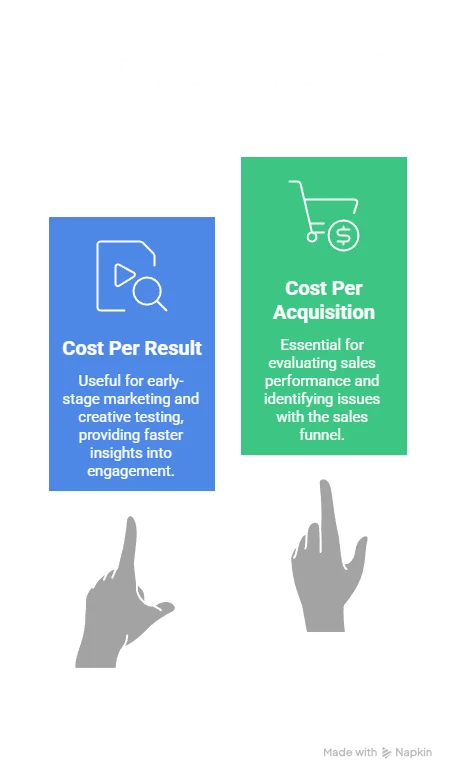
If CPA is the “ultimate” metric, you might be wondering: Why should I ever care about CPR? The answer is simple: You can’t optimize what you can’t control day-to-day. Cost Per Result is your best friend when you are in the trenches of campaign management, specifically in three scenarios:
1. Top-of-Funnel (ToFu) Strategies
When you are introducing your brand to cold audiences, you aren’t always asking for a sale immediately. You might just want them to watch a video or visit your blog. In this stage, measuring CPA is impossible because no sale has happened yet. Instead, you look at Cost Per Result. If you can get video views for $0.01 instead of $0.05, you are filling your funnel 5x faster for the same budget.
2. Creative A/B Testing
Let’s say you want to test two different ad images: one with a person’s face and one with just the product.
If you wait for sales (CPA) to come in, you might have to spend hundreds of dollars to get statistically significant data. But if you look at CPR (specifically Cost Per Click), you can see much faster which image stops the scroll. If Image A has a Cost Per Result of $0.80 and Image B is $1.50, you know Image A is the winner for engagement.
3. Troubleshooting
If your sales tank, Cost Per Acquisition tells you that there is a problem, but Cost Per Result tells you where it is.
- Is CPR high? Your ads are expensive or your audience is bored.
- Is CPR low but CPA high? Your ads are fine, but your landing page is broken.
In the CPR vs CPA debate, think of CPR as your early warning system. It helps you pivot before you blow your entire budget.
When to Focus on Cost Per Acquisition
While Cost Per Result helps you tweak the knobs and dials of your ad account, Cost Per Acquisition is what determines if the machine is actually worth running.
You should shift your focus entirely to CPA in three critical situations:
1. Scaling Your Budget This is the golden rule of paid traffic: Never scale based on CPR alone. You might find a campaign that gets you incredibly cheap clicks ($0.10 Facebook ads cost per result). It’s tempting to dump $10,000 into it. But if those cheap clicks are coming from “click-happy” bots or unqualified leads who never buy, you are just scaling your losses. Only increase spend when your Cost Per Acquisition proves you are profitable.
2. Bottom-of-Funnel (BoFu) Strategy When you are running conversion campaigns—like retargeting people who abandoned their carts—you don’t care about “engagement.” You don’t care if they “like” the ad. You only care if they buy. In this stage, a high Cost Per Result (e.g., a $5.00 click) is perfectly acceptable if it leads to a $20 Cost Per Acquisition on a $100 product.
3. Reporting to Stakeholders If you are presenting to a CEO or a client, do not bore them with click-through rates or impression costs. They want to know the ROI. When discussing CPR vs CPA with leadership, always lead with CPA. It answers the only question that matters: “For every dollar we put in, how much business did we get back?”
Real-World Scenarios: CPR vs CPA in Action
To truly grasp the battle of Cost Per Result vs Cost Per Acquisition, let’s look at two realistic scenarios. These examples highlight why judging a campaign solely by its cover (CPR) can be dangerous.
Scenario A: The “Vanity Metric” Trap
- Campaign: Facebook Traffic Ad (Broad Audience)
- Cost Per Result (Link Click): $0.20 (Very Cheap!)
- Total Spend: $1,000
- Total Traffic: 5,000 visitors
- Total Sales: 5
- Cost Per Acquisition: $200
Analysis: On the surface, a $0.20 CPR looks amazing. You might pat yourself on the back. But if you are selling a $50 product, you are losing massive amounts of money. Your CPA ($200) is four times your revenue. This illustrates the danger of prioritizing Cost Per Result over Cost Per Acquisition.
Scenario B: The “High Cost” Win
- Campaign: Google Search Ad (High Intent Keyword)
- Cost Per Result (Click): $5.00 (Expensive!)
- Total Spend: $1,000
- Total Traffic: 200 visitors
- Total Sales: 40
- Cost Per Acquisition: $25
Analysis: Paying $5.00 for a single click might feel painful when you are used to Facebook prices. However, because these visitors had high intent, they converted at a massive 20% rate. Even though the Cost Per Result was 25x higher than Scenario A, the Cost Per Acquisition was 8x lower.
The Takeaway: These scenarios illustrate why Cost Per Result vs Cost Per Acquisition analysis is vital. A low CPR can mask a failing campaign, while a high CPR might actually be the gateway to a healthy, profitable CPA. Don’t fear expensive clicks; fear expensive customers.
How to Lower Both Metrics
The dream scenario, of course, is to have your cake and eat it too: a low Cost Per Result feeding into a low Cost Per Acquisition. While they are distinct metrics, they are connected. To win the CPR vs CPA game, you need alignment across your entire funnel. Here is how to drive both numbers down:
1. Improve Your Creative (Lowers CPR) Your Cost Per Result is largely determined by how relevant and engaging your ad is. If your ad is boring, platforms like Meta and Google will charge you more to show it.
- The Fix: Test better “hooks” in the first 3 seconds of your videos. Use thumb-stopping images. Higher engagement rates (CTR) signal to the algorithm that your ad is good, which automatically lowers your CPR.
2. Optimize Your Landing Page (Lowers CPA) This is the hidden lever. You can have the best ad in the world with a tiny Facebook ads cost per result, but if your website takes 10 seconds to load or has a confusing checkout process, your Cost Per Acquisition will skyrocket.
- The Fix: Ensure your landing page matches the promise made in the ad. If the ad says “50% Off,” the page better scream “50% Off.” Improving your conversion rate from 1% to 2% literally cuts your CPA in half without you spending a penny more on ads.
3. Refine Your Targeting (Lowers Both) Showing your ad to everyone is the fastest way to burn cash.
- The Fix: Use “Lookalike Audiences” or high-intent keywords. By narrowing your focus to people who actually want your product, you increase engagement (lowering CPR) and increase sales probability (lowering CPA).
Frequently Asked Questions (FAQ)
Is Cost Per Result the same as Cost Per Acquisition?
No. In the CPR vs CPA breakdown, the difference lies in the goal. Cost Per Result measures the cost of the action you told the ad platform to optimize for (clicks, views, likes). Cost Per Acquisition measures the cost of getting a paying customer. They only mean the same thing if your specific campaign objective is set to “Purchase.”
Which is more important: CPR vs CPA?
For overall business profitability, Cost Per Acquisition is the king. It tells you if you are making money. However, Cost Per Result is a vital leading indicator. If your CPR (e.g., Cost Per Click) doubles overnight, your CPA will almost certainly follow. You need to monitor Cost Per Result vs Cost Per Acquisition together to get the full picture.
How do I calculate Cost Per Acquisition?
The CPA formula is straightforward: Take your Total Ad Spend and divide it by the Total Number of Conversions.
Example: If you spent RS.5,000 and acquired 50 new customers, your CPA is Rs.100.
Why is my Facebook Cost Per Result so high?
A high Facebook ads cost per result is usually caused by “Ad Fatigue” (your audience has seen the ad too many times), poor targeting (the wrong people are seeing it), or low-quality creative (it looks like an ad, not content).
Conclusion
At the end of the day, the battle of CPR vs CPA isn’t about choosing one side. It’s about using the right tool for the job. Think of Cost Per Result as your mechanic’s diagnostic tool—it tells you if the engine is running smoothly. Think of Cost Per Acquisition as your bank statement—it tells you if the trip was worth the gas money. To succeed in 2024 and beyond, you need to look at both. specific Use CPR to test your ads and keep your costs down day-to-day, but let CPA be the metric that decides your strategy, your budget, and your future.
Ready to get your ad spend under control? Don’t guess at your profitability.
