
Master Meta Ad Budgets: ABO or CBO — Which Wins Big?
Introduction: Defining the Budgeting Debate
If you’ve spent any time running ads on Facebook or Instagram (what Meta now calls Meta Ads), you know that getting the creative right is only half the battle. The other, often more challenging half, is deciding where the money actually goes. Budgeting is, without question, the single most critical factor that dictates whether your campaign soars or sinks. It affects your profitability, your Learning Phase duration, and your ultimate ability to scale.
The core of this budgeting challenge boils down to one simple-looking choice you have to make right at the start: ABO vs CBO in Meta Ads.
At a high level, the distinction is about control.
- CBO (Campaign Budget Optimization): This is where you set one lump sum budget at the Campaign layer. You hand the reins over to Meta’s robust machine-learning algorithm and let it dynamically decide which Ad Set deserves the most spend. It’s an automated approach designed for efficiency.
- ABO (Ad Set Budget Optimization): This is the manual, hands-on approach. You set a fixed, guaranteed budget for each Ad Set. That budget is protected, meaning you have granular control over exactly how much money is spent on specific audiences or creatives.
So, which one wins? Is it the set-it-and-forget-it automation of CBO, or the precision of ABO? The truth is, there is no “better” option. The ultimate goal isn’t to pick a favorite, but to know exactly which strategy is the most appropriate for your campaign’s immediate objective—whether that’s audience testing or aggressive profit scaling. Let’s dive into the mechanics of both so you can make that choice with confidence.
Deep Dive: Understanding Campaign Budget Optimization (CBO)
Mechanism of CBO (Advantage Campaign Budget)
If you’ve heard the term CBO and wondered if it’s still relevant, the short answer is yes—it’s just been rebranded. CBO (Campaign Budget Optimization) is now officially called Advantage Campaign Budget in the Meta Ads Manager, signaling Meta’s strong push toward automation. With CBO enabled, you set one single budget for the whole campaign, which the algorithm then distributes across all your internal Ad Sets. The core function of CBO is real-time, algorithmic optimization. It constantly monitors performance data (like conversion volume and click-through rates) from every single Ad Set and shifts the budget dynamically. If Ad Set A is delivering conversions at a lower Cost Per Result (CPR) than Ad Set B, CBO will automatically push more money to A, often hour-by-hour, ensuring your total spend is allocated to the most profitable opportunities.
Key Advantages for Scaling
Advertisers primarily choose Campaign Budget Optimization (CBO) for its ability to scale seamlessly. Here is a breakdown of why it is preferred over Ad Set Budget Optimization (ABO):
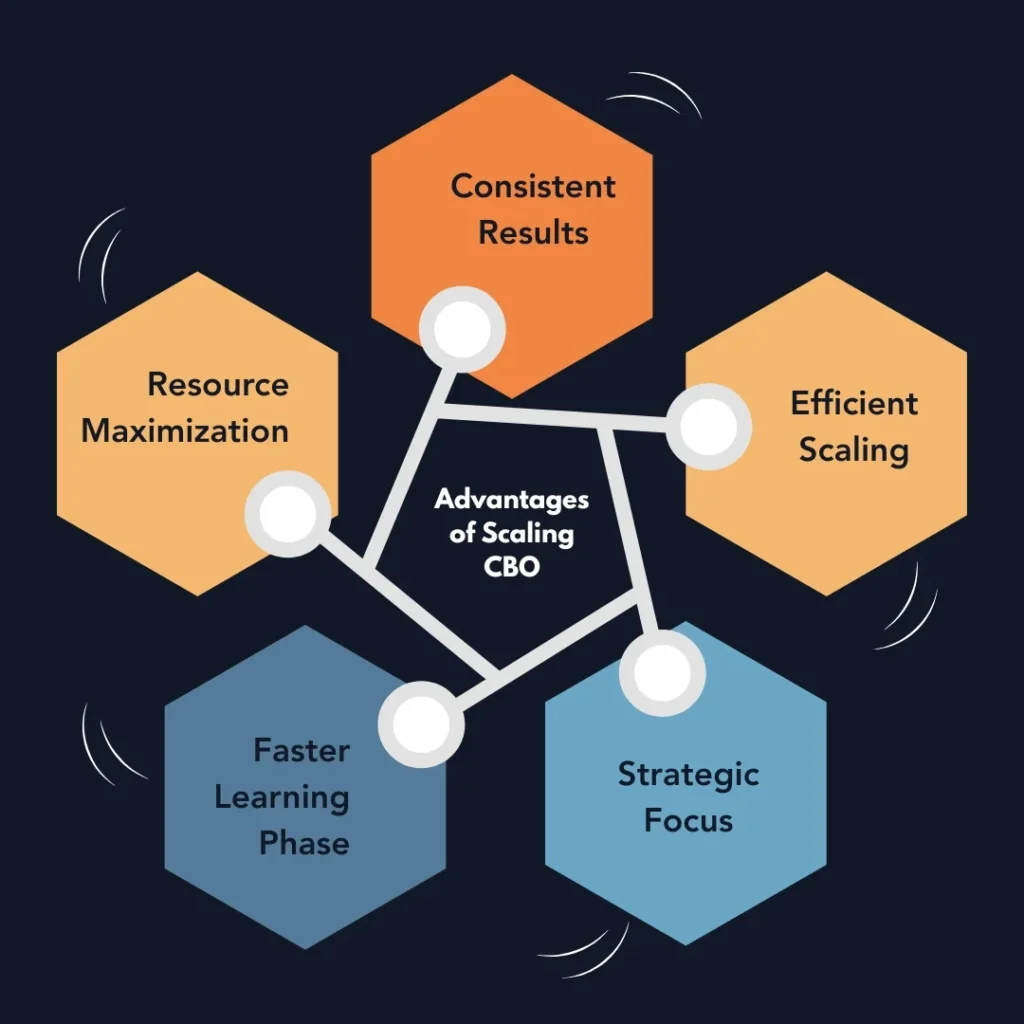
Consistent Results: The holistic data approach unlocks more cost-efficient performance compared to managing budgets at the individual Ad Set level.
Efficient Scaling: The algorithm automates budget allocation, allowing you to transition to larger daily budgets more smoothly.
Strategic Focus: Automation handles manual budget shuffling, freeing up your time for creative development and high-level strategy.
Faster Learning Phase: By pooling data from all Ad Sets under a single budget, the campaign reaches the required 50 weekly optimization events much quicker.
Resource Maximization: CBO leverages real-time data across multiple Ad Sets to find hidden efficiencies, ensuring you get the most out of every dollar spent.
Drawbacks and Loss of Granular Control
While the efficiency of CBO is a major draw, the primary trade-off is a significant loss of granular control. Here are the key drawbacks to consider:
Shift in Monitoring: Advertisers are forced to focus on macro-metrics like Campaign-level CPA and ROAS rather than analyzing and optimizing individual Ad Set performance.
Algorithmic Reliance: You must trust the algorithm entirely, which can be challenging if you have specific strategic spend requirements for certain segments.
Bias Toward Volume: The system often favors large, “cold” audiences because they provide more data, potentially neglecting smaller, high-value segments like niche retargeting lists.
Budget “Starvation”: Promising new Ad Sets may not receive enough budget to exit the Learning Phase, while low-performing but high-volume sets might capture too much spend.
Unpredictable Allocation: The lack of manual control over individual Ad Set spending can lead to inconsistent distribution across your target audiences.
Deep Dive: Understanding Ad Set Budget Optimization (ABO)
Mechanism of ABO (Manual Control)
ABO (Ad Set Budget Optimization) is the classic, manual budgeting approach. Unlike CBO, which pools the budget, ABO requires the advertiser to assign a fixed, daily, or lifetime budget to each Ad Set. For example, if you have a campaign with three Ad Sets and a total daily budget of $150, you might assign $50 to Audience A, $50 to Audience B, and $50 to Audience C. The key feature here is control; Meta’s algorithm is restricted from spending more than the specified amount on any given Ad Set, regardless of how well (or poorly) it performs. This makes each Ad Set an independent testing cell, whose performance is not influenced by the performance or budget of its neighbors.
Ideal Use Case: Precise Testing and Fair Exposure
The primary strength of Ad Set Budget Optimization (ABO) is the absolute control it provides during the testing phase. Here is how it ensures precise data collection:
Strategic Data Collection: It allows you to force spend into specific niches to prove their potential, bypassing the high-volume favoritism of automated systems.
Guaranteed Fair Exposure: Unlike CBO, ABO ensures every variable—whether it’s a new audience, creative, or placement—receives a non-negotiable budget for a “clean” comparison.
Elimination of Algorithmic Bias: It prevents the system from prematurely dumping 90% of the budget into an early “winner,” which often starves other Ad Sets of the data needed to exit the Learning Phase.
Apples-to-Apples Testing: By maintaining consistent spend across sets, you can accurately identify which specific elements truly drive performance before moving them into a scaling campaign.
Manual Budget Protection: ABO is ideal for running audiences of vastly different sizes together, such as a massive cold audience alongside a tiny, high-value retargeting list, ensuring the smaller segment isn’t ignored.
Challenges: Manual Monitoring and Optimization Overhead
Managing Ad Set Budget Optimization (ABO) places a significant manual burden on the advertiser. Here are the primary challenges associated with this high-control approach:
Operational Complexity: Juggling dozens of Ad Sets simultaneously increases the likelihood of human error and significantly drains time that could be spent on higher-level strategy.
Heavy Optimization Overhead: Since there is no automatic redistribution of funds, the advertiser effectively “becomes the algorithm,” requiring constant, hands-on management.
Manual Monitoring of KPIs: You must stay tethered to your dashboard to analyze your Meta Ads data and monitor ROAS, CPA, and CPR for every individual Ad Set to ensure performance stays on track.
Risk of Wasted Spend: Unlike CBO, which shifts money away from underperformers, ABO keeps spending on poor Ad Sets until you manually pause them or decrease their budget.
Missed Opportunities: If a specific Ad Set begins performing exceptionally well, you must manually increase its budget to capture those conversions, or risk leaving profitable sales on the table.
Scaling Instability: Rapid manual budget changes in ABO can easily trigger a reset of the Learning Phase or cause performance fluctuations, necessitating slow, incremental adjustments.
The Decision Matrix: When to Choose ABO vs CBO
Choosing the proper optimization method depends entirely on your campaign’s objective and current stage in the marketing funnel. Use the table below as a quick guide for strategic decision-making.
| Factor | Use CBO (Advantage Campaign Budget) | Use ABO (Ad Set Budget Optimization) |
| Campaign Goal | Scaling proven winners for maximum volume. | Testing new audiences and creatives. |
| Optimization Focus | Campaign-level ROAS and maximum efficiency. | Ad Set-level data, ensuring fair exposure for every variable. |
| Audience Structure | Homogeneous audiences of similar size (e.g., all cold or all lookalikes). | Audiences of widely varying sizes (e.g., small retargeting alongside large cold). |
| Budget Size | Large budgets where the algorithm has plenty of room to optimize. | Small budgets that need specific, protected allocation for testing. |
| Advertiser Control | Low control, high trust in the algorithm. | High control, demanding constant manual monitoring. |
| Risk Tolerance | High, as the algorithm might spend aggressively on initial winners. | Low, as you set fixed caps on maximum spend per test. |
The Golden Rule of Budgeting:
The most common and effective strategy for modern Meta advertisers is a Hybrid Approach:
- Start with ABO: Use ABO for the initial testing phase to isolate and identify winning audiences and high-performing creatives. This gives every variable a fair shot.
- Scale with CBO: Once you have identified your winning Ad Sets from the ABO test, duplicate them and move them into a new CBO campaign. CBO will take these proven winners and scale them efficiently, dynamically allocating the budget where it generates the highest ROAS.
Advanced Strategies: The Testing and Scaling Blueprint
Best Practices for ABO Testing
Since ABO is the best environment for testing, precision is key.
- Equal Budgets & Time: Ensure all testing Ad Sets have the same daily budget (e.g., $20/day) and run for the same duration (minimum 3-5 days) to ensure all tests exit the Learning Phase with statistically relevant data.
- One Variable Per Ad Set: Only test one variable at a time within an Ad Set. For example, if you are testing three different audiences, use the same creative set across all three Ad Sets. If you are testing three different creatives, use the same audience across all three Ad Sets.
- Set Clear Thresholds: Before launching, define your Kill Criteria (e.g., “If the Cost Per Result is 20% higher than my target CPA after $100 spend, I will pause the Ad Set”). Stick to these rules rigorously to prevent budget waste.
Mastering CBO for Efficient Scaling
When you move your proven winners into a CBO campaign, your goal shifts from discovery to volume and stability.
- Group Homogeneous Winners: Only group similar-performing or similarly-sized Ad Sets (e.g., all cold traffic winners) into one CBO. Avoid mixing high-priority retargeting with large cold audiences unless you use Ad Set Spend Limits (Minimum/Maximum), though this is generally discouraged as it restricts the algorithm.
- Gradual Scaling: To avoid resetting the crucial Learning Phase, increase your CBO campaign budget incrementally—no more than 10-20% every 48 hours. Aggressive scaling can shock the algorithm and cause unstable performance swings.
- Horizontal Scaling: Instead of constantly raising the budget of a single winning CBO, a more stable approach is to duplicate the successful CBO campaign and launch the copy as a new campaign. This is called horizontal scaling and allows the algorithm to start fresh with a proven structure, often leading to better long-term stability.
Utilizing Ad Set Spend Limits (CBO Guardrails)
While the core advantage of CBO is complete algorithmic control, Meta allows you to set guardrails: Ad Set Minimum/Maximum Spend Limits.
- Minimum Spend: Use this sparingly. The main use case is ensuring small, high-value audiences (like a small custom retargeting list) receive a non-zero budget, preventing the CBO algorithm from completely ignoring them in favor of larger, cheaper cold audiences.
- Maximum Spend: This is useful if you have a tight internal budget cap for a specific audience or test, but it is highly recommended to avoid maximum limits as they directly restrict the algorithm’s ability to optimize spend to the highest-performing areas.
By strategically using ABO for data collection and transitioning to CBO for efficient scaling, you establish a robust and profitable advertising framework.
Conclusion
The debate between ABO and CBO isn’t about picking a winner; it’s about choosing the right tool for the right job.
- ABO is your essential tool for the Discovery Phase—the laboratory where you gain the reliable data needed to make informed decisions. It guarantees a fair fight for all your audiences and creative concepts.
- CBO (Advantage Campaign Budget) is your essential tool for the Growth Phase—the scaling machine that takes those proven concepts and maximizes their efficiency across your total budget. It ensures that every dollar is dynamically moved to the highest-performing Ad Set in real-time.
By adopting the Hybrid Approach—testing manually with ABO and scaling automatically with CBO—you combine the precision of human control with the immense power of Meta’s machine learning, ultimately leading to a more stable, scalable, and profitable advertising system.
