Google Ads Checklist 2026 | Step-by-Step Optimization
Introduction: Why You Need a Google Ads Checklist 2026
Let’s be real—managing client campaigns across multiple platforms is a juggling act. When you’re balancing Google Ads alongside Meta Ads and trying to pull together cohesive performance reports that actually impress, you need a system you can rely on. That’s exactly why you need a strict Google Ads Checklist 2026. The search landscape today leans heavily on machine learning. But “automated” doesn’t mean you can just set it and forget it. If you leave Google’s algorithms completely unchecked, budgets will quickly drain into irrelevant clicks. Knowing how to optimize Google Ads for AI bidding is the difference between a campaign that thrives and one that just hemorrhages money.
This guide isn’t just theory. It’s a practical, step-by-step framework designed to help you reduce Google Ads wasted spend, improve your overall Quality Scores, and drive the high-intent traffic your clients actually care about. (And if you ever decide you’d rather have an expert handle the heavy lifting, you can always check out our Google Ads management services). Let’s dive into the foundation.
1. Audit Campaign Structure & Budget Pacing
Before you start tweaking ad copy or pulling search terms, you have to look at the foundation. A messy account architecture makes everything else harder. Instead of clumping all your client’s products or services into one massive, broad campaign, structure the account logically. Break things down by specific business objectives, product lines, or regional targets. For instance, if you are running campaigns for an international market like Malaysia, keeping that budget strictly isolated ensures the algorithm doesn’t cannibalize your local spend. Next, keep a close eye on your budget pacing. You’ve probably seen that frustrating “Limited by budget” warning or worse, found your ads are eligible but getting zero impressions. When your campaigns hit their daily caps too early in the day, it actively disrupts Google’s algorithmic learning. If you’re using Smart Bidding strategies, the AI needs a consistent, steady data flow to figure out what works. Artificially choking the budget means the system simply can’t optimize effectively.
As the first technical step in this Google Ads Checklist 2026, evaluate where the money is actually going. Check your network settings. For most standard Search campaigns, you’ll want to ensure they are strictly isolated to the Search Network. Take a hard look at the Search Partners network, too. If your historical data shows that Search Partners are dragging down your conversion rates, don’t hesitate to toggle it off. Keep the budget focused right where it has the highest impact.
2. Keyword Strategy & Search Term Refinement
Let’s talk about the lifeblood of your campaigns: your keywords. You can have the absolute best bidding strategy in place, but if your ads are showing up for garbage searches, you’re just throwing your client’s budget out the window.
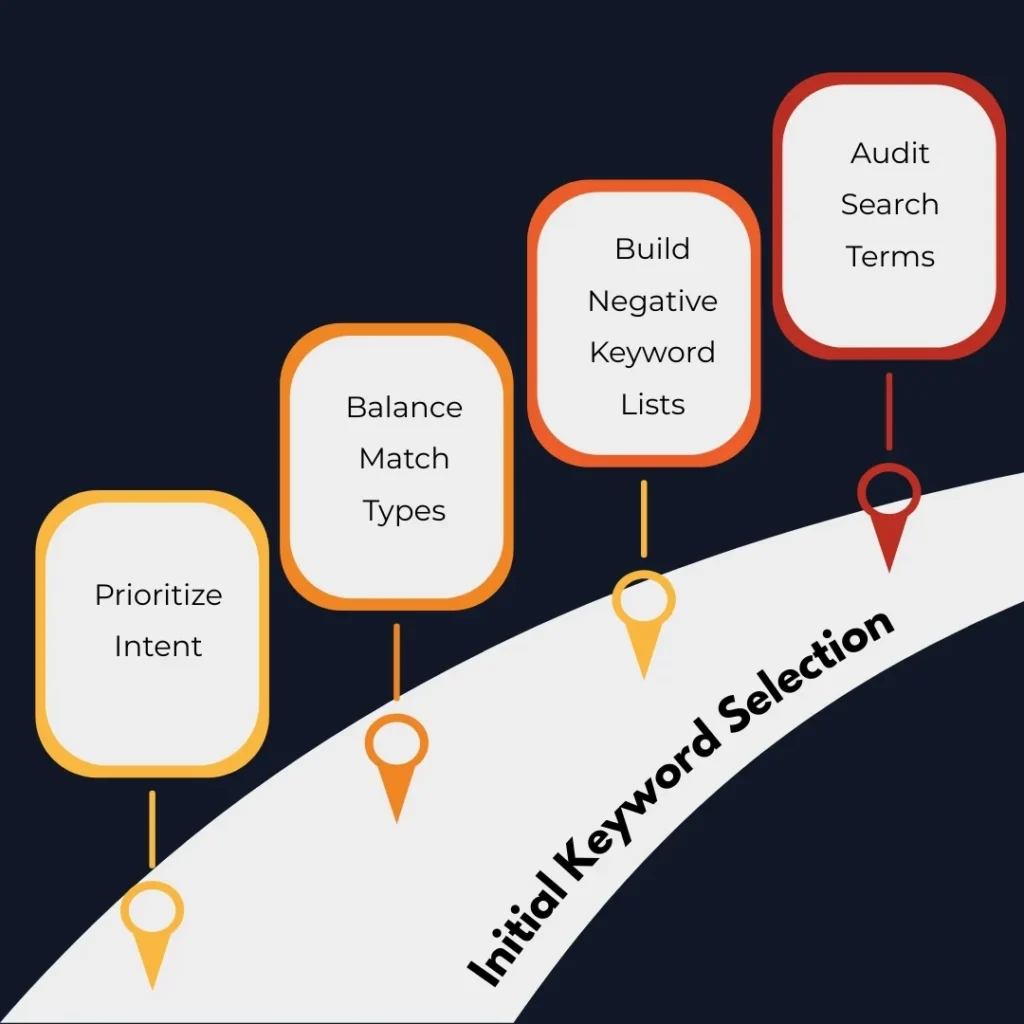
To guarantee your ads only show to people ready to buy, follow these core steps:
- Audit your search terms weekly: Make it a non-negotiable habit to dig into your data. Finding negative keywords in the search terms report is crucial for stopping wasted spend on queries that eat up impressions but yield zero conversions.
- Build robust negative keyword lists: Don’t just block bad searches at the campaign level. Create comprehensive, account-level lists for terms you know you’ll never want to target, like “cheap,” “free,” or entirely unrelated industries.
- Balance exact match vs. broad match: The dynamic between these match types has shifted. In the past, broad match blew budgets fast. Today, pairing broad match with AI bidding can actually uncover profitable, high-intent queries you might never have thought of. However, keep exact and phrase match in the mix to maintain tight control over your core terms.
- Prioritize intent over volume: The goal isn’t to capture every possible search; it’s to optimize Google Ads for conversions. Focus your efforts entirely on targeting high-intent keywords rather than sheer search volume.
| Match Type | Control | Discovery Power | Risk Level |
| Exact | High | Low | Low |
| Phrase | Medium | Medium | Medium |
| Broad + AI | Lower | High | Controlled by negatives |
As you work through this Google Ads Checklist 2026, remember that keyword strategy isn’t a one-and-done deal. It requires constant pruning. The algorithm is smart, but it still needs you to set the boundaries.
3. Ad Copy & Creative Performance Optimization
Once you’ve nailed down who you’re targeting, it’s time to look at what you’re actually saying to them. In 2026, creating highly relevant, engaging ad copy is all about giving the machine the right raw materials.
To get the absolute best performance out of your Responsive Search Ads (RSA), follow these best practices:
Focus on Quality Score improvement: The more space your ad takes up on the screen, the higher your click-through rate (eCTR) will climb. This isn’t just a vanity metric; a strong CTR signals to Google that users find your ad useful, which directly drives up your Quality Score. Better Quality Scores ultimately mean cheaper clicks and better margins for your clients.
Maximize your inputs: Aim to provide 10 to 15 unique headlines and all four descriptions for every single ad group so Google can mix and match to find the winning combinations.
Stop over-pinning headlines: While it’s tempting to force a specific message into position one, over-pinning restricts the AI’s ability to test and optimize. Reserve pinning strictly for brand compliance or mandatory legal disclaimers. Giving the system room to breathe naturally leads to better Ad Strength and higher ad relevance.
Maximize your digital real estate: A major part of this Google Ads Checklist 2026 is using every relevant ad asset available. Add sitelinks to direct users to specific product pages, use callouts to highlight unique selling points, and implement structured snippets or lead forms.
4. Master AI-Powered Bidding & Audience Targeting
Let’s move to the engine room of your campaigns: bidding and audiences. If you’re still clinging to manual CPC across the board, it’s time to let go. A massive part of any modern Google Ads Checklist 2026 is successfully transitioning from manual bidding to automated bidding. (For a deep dive into this, check out our AI Bidding and Profit Playbook. But you can’t just flip the switch on day one and expect magic.
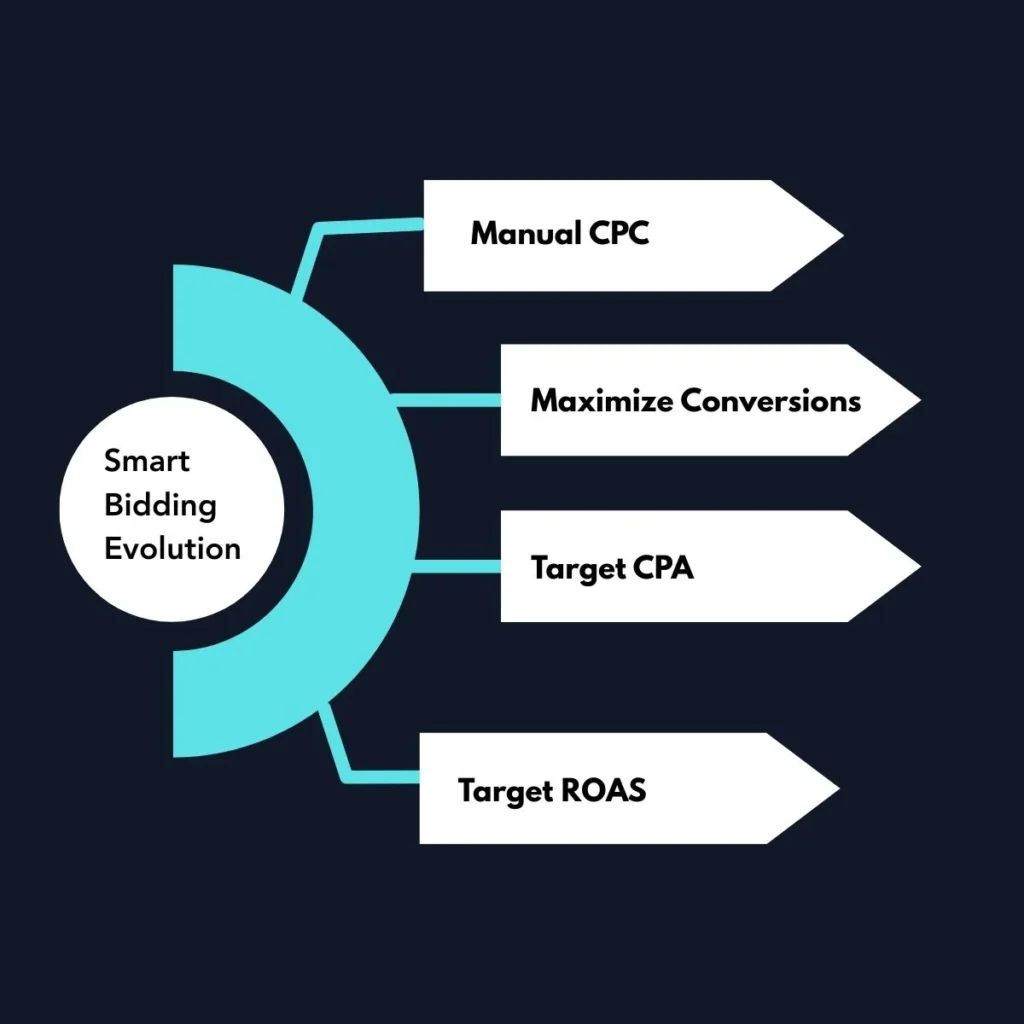
To give your smart bidding algorithms the data they need to make profitable decisions, follow this progression:
Steer the algorithm: While Smart Bidding handles the heavy mathematical lifting, you still need to review historical data. Guiding the algorithm toward high-performing devices, schedules, and locations still gives your clients a serious competitive edge.
Build a solid conversion baseline: If you launch a brand new campaign, it often helps to start with a strategy like Maximize Conversions to gather initial data.
Scale up to advanced bidding: Once you hit a solid threshold—usually around 30 to 50 conversions in a month—you can safely transition to Target ROAS or Value-Based Bidding. This tells Google to go after the users who aren’t just likely to convert, but likely to spend the most money or generate the highest lifetime value.
Prioritize first-party data: In a privacy-centric landscape, relying on third-party tracking is a losing battle. Make it a priority to upload and regularly refresh Customer Match lists. Feeding these high-quality, known customer lists back into the system gives the algorithm a perfect blueprint of what your ideal buyers look like.
Layer your audience segments: Don’t forget about your audiences just because bidding is automated. Use Remarketing Lists for Search Ads (RLSA) to bid more aggressively when past site visitors search for your core terms again.
5. Landing Page & Conversion Tracking Alignment
You can build the most optimized, highly targeted search campaign in the world, but if the landing page drops the ball, you won’t see a single lead. That brings us to a crucial, often-overlooked checkpoint in our Google Ads Checklist 2026: landing page experience and tracking alignment.
First, check your message match. When a user clicks an ad promising a specific solution or a limited-time offer, that exact phrasing needs to be the first thing they see on the landing page. If there’s a disconnect, they will bounce immediately. Alongside the messaging, audit the technical user experience. Your pages need sub-2-second load times and flawless mobile optimization. Make sure the primary call-to-action (CTA) is clear and sits above the fold. If you’re generating B2B leads for a client you need to implement strong CRO best practices, test shorter form lengths or progressive profiling so you aren’t scaring users away with too many required fields upfront.
Of course, none of this matters if you can’t prove the campaign is working. Accurate tracking is non-negotiable, especially when you need to pull those numbers into your monthly performance reports. Dedicate time to setting up privacy-first conversion tracking in Google Ads. Verify that your GA4 integration is seamless and that server-side tracking is capturing the data that standard browser pixels miss. If your clients close deals over the phone or in person, ensure offline conversions are being properly imported back into the platform so the algorithm gets the full picture of what’s actually driving revenue.
6. Performance Monitoring & Cross-Channel Reporting
Now that your campaigns are structured, targeted, and tracking properly, how do you keep them running smoothly? The final step in this Google Ads Checklist 2026 is establishing a rock-solid routine for performance monitoring. When you are managing multiple accounts and building out those end-of-month performance reports for your clients, you need a clear optimization cadence.
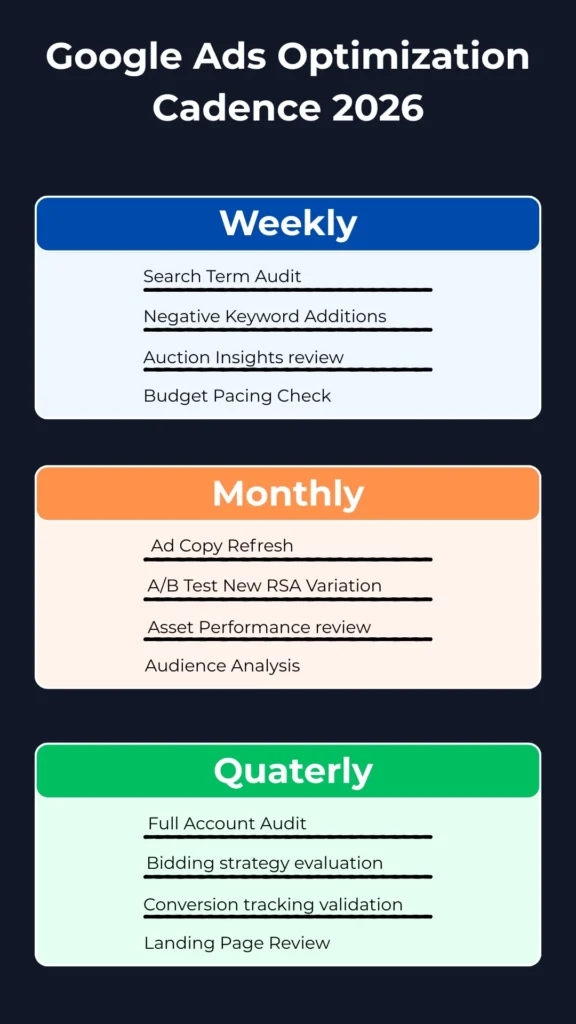
To keep your campaigns performing at their peak without disrupting the algorithm, follow this routine:
Monitor the competition: Keep a close eye on who you’re up against. Use the Auction Insights tool regularly to see who is suddenly outranking you or aggressively bidding on your core terms. If a competitor launches a massive new offer, this data lets you quickly pivot your own messaging to stay competitive.
Stop the daily micro-adjustments: You don’t need to be in the account every single day. Tinkering too often actually resets the AI’s learning phase and actively hurts your performance.
Pace your optimizations: Break your tasks down logically. Dive into your search term audits on a weekly basis. Monthly, refresh your ad copy and run A/B tests on your creatives. Quarterly, do a deep dive into your bid strategies and run a full Google Ads audit checklist to ensure nothing is slipping through the cracks.
Build cross-channel reports: Your clients don’t operate in a vacuum, and neither should your data. Pull your search metrics into comprehensive reports, comparing your Google Ads performance directly alongside your Meta Ads campaigns. This gives you a much better, holistic view of your blended Return on Ad Spend (ROAS) and overall user acquisition costs.
How long does it take to see results from Google Ads?
You can see traffic immediately, but meaningful conversion data usually takes 2–6 weeks. Smart bidding strategies need time to learn before performance stabilizes.
What budget should I start with?
Start with enough budget to generate at least 30–50 conversions per month per campaign. Too small a budget limits the algorithm’s ability to optimize effectively.
Are negative keywords really that important?
Yes. A strong negative keyword list protects your budget from irrelevant traffic and improves overall conversion rates by focusing only on high-intent searches.
Should I focus more on CTR or conversions?
Conversions. A high CTR means nothing if users don’t take action. Always prioritize conversion rate, cost per acquisition (CPA), and return on ad spend (ROAS).
Do I need conversion tracking before launching campaigns?
Absolutely. Without accurate tracking in place, automated bidding cannot optimize properly, and you risk spending money without measurable business impact.
Conclusion & Next Steps
Winning at paid search in 2026 isn’t about outsmarting the algorithm; it’s about partnering with it to drive real business growth. By feeding the system high-quality data, keeping a tight grip on your search terms, and aligning your landing pages with user intent, you set your campaigns up for sustainable success.
Remember, optimization is a continuous cycle of tracking, testing, and tweaking. Bookmark this Google Ads Checklist 2026 and use it as your baseline whenever you launch a new client campaign or need to diagnose a dip in performance.
