
How to Create an SEO Content Outline That Ranks

Introduction
Let’s be honest: there is nothing more frustrating than pouring your heart into a blog post, hitting publish, and watching it flatline. You check your analytics day after day, but the traffic never comes. The problem usually isn’t your writing talent—it’s your structure. Most writers skip the planning phase and dive straight into drafting, but in 2025, that is the fastest way to get ignored by search engines.
If you want to rank on Google, you can’t just “wing it.” You need a plan. You need an SEO content outline.
An SEO content outline is the antidote to writer’s block and the secret weapon of high-ranking websites. It bridges the gap between raw data and a finished article. By mapping out your headers, keywords, and user intent before you write a single sentence, you ensure your content satisfies the algorithms and your readers. In this guide, we will cover the exact step-by-step process to build an SEO content outline that cuts your writing time in half and doubles your organic traffic.
What is an SEO Content Outline?
At its core, an SEO content outline is a strategic blueprint for your article. It is far more than just a bulleted list of random ideas or a vague content brief. A true SEO content outline tells you exactly what to write, where to write it, and which keywords to use to satisfy the search engines.
Think of it like building a house. You wouldn’t start laying bricks without looking at the architectural drawings, right? Writing a blog post without an SEO content outline is just as risky. Without that roadmap, you risk wandering off-topic or missing crucial sub-topics that your competitors are already covering.
While a creative writing outline focuses on flow and narrative, an SEO content outline focuses on data. It organizes your heading tags (H1, H2, H3) based on search volume and competition. It dictates your content strategy on a page-by-page level, ensuring that by the time you finish writing, the piece is already optimized. Essentially, the outline does the heavy lifting so the writer can focus on creativity.
Why Every Blog Post Needs an SEO Outline
You might be thinking, “This sounds like a lot of extra work. Can’t I just write naturally?” You can, but you will likely miss out on massive opportunities for traffic. Creating a detailed SEO content outline is the most efficient way to build topical authority. When you structure your content based on data, you prove to Google that you are an expert who covers a topic comprehensively.
Here are three critical reasons why you shouldn’t skip this step:
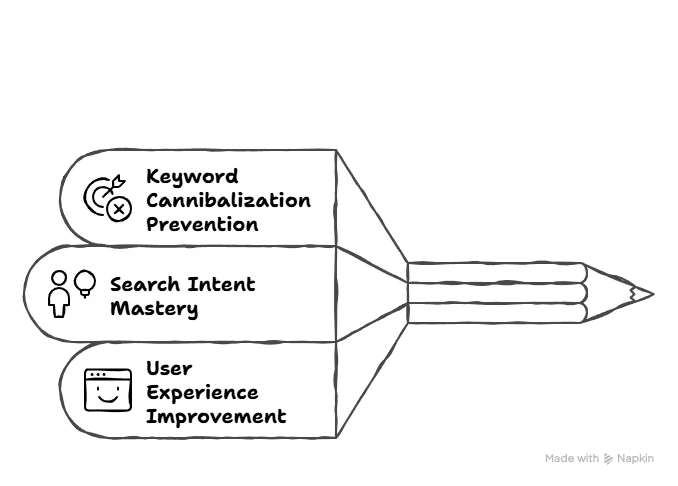
- Prevent Keyword Cannibalization: Without a plan, it is easy to accidentally write about the same topic twice using different words. An SEO content outline defines your specific angle, ensuring you don’t compete against your own existing pages—a common issue known as keyword cannibalization.
- Master Search Intent: It’s not enough to use keywords; you must match the user’s goal. An outline forces you to analyze search intent (the “why” behind the search) before you write, ensuring you don’t write a “how-to” guide when the user actually wants a product review.
- Better User Experience (UX): Internet readers are skimmers. A strong outline creates a logical hierarchy with clear headers, improving the user experience (UX). When readers can easily find what they need, they stay on the page longer, signaling to Google that your content is valuable.
Step 1: Analyze Search Intent & Competitors
Before you type a single header for your SEO content outline, you need to put on your detective hat. Many writers skip this step, assuming they already know what their audience wants. But in the world of SEO, assumptions are dangerous. If you want your SEO content outline to actually drive traffic, you have to ground it in data, not guesswork. This starts with understanding search intent.
Search intent is simply the “why” behind a user’s query. When someone types a keyword into Google, what are they looking for? Are they trying to buy something, or are they just looking for information? If your SEO content outline targets a keyword like “best running shoes” but you structure the post as a history of shoemaking, you will never rank. Google’s algorithm is smart enough to know that users searching for that term have commercial intent—they want reviews and prices, not a history lesson. Conversely, if you are targeting “how to tie shoes,” the user has informational intent. Your SEO content outline must reflect that by prioritizing clear instructions over sales pitches.
Once you’ve nailed down the intent, it’s time for some SERP analysis. This is the manual legwork that separates the pros from the amateurs. Open up Google in “Incognito Mode” (to avoid personalized results) and search for your target keyword. Open the top five results. These pages are your benchmarks. Google is literally showing you what it prefers.
As you scan these competitors, ask yourself: What headers are they using? What questions are they answering? Your goal here isn’t to copy them; it’s to find the content gap. Maybe the top-ranking post is five years old and has outdated statistics. Maybe it’s a wall of text that’s hard to read. Your SEO content outline should include everything the competitors have plus the things they missed.
For example, if all five competitors are writing 1,000-word articles, your SEO content outline should probably aim for 1,500 words to cover the topic more thoroughly. If they lack images or examples, make a note to include those in your brief. By identifying these gaps early, you ensure your SEO content outline isn’t just matching the competition—it’s designed to beat it.
Step 2: Build Your Keyword List & Topic Clusters
Now that you know what your competitors are doing, it’s time to decide exactly what vocabulary your SEO content outline will use. This isn’t just about stuffing the phrase “best pizza” into your text fifty times. That tactic died in 2010. Today, modern search engines rely on semantic SEO, which means they look for context and relationships between words, not just exact matches.
To build a robust SEO content outline, you need to start with your primary keywords. These are the high-level terms with significant search volume that describe your main topic. But if you stop there, your content will feel thin. You need to expand your view into topic clusters. These are groups of related terms that support your main idea. For instance, if your main keyword is “home office setup,” your cluster should include “ergonomic chairs,” “standing desks,” and “monitor lighting.” Grouping these concepts ensures your SEO content outline covers the subject comprehensively rather than just scratching the surface.
This is where LSI keywords (Latent Semantic Indexing) come into play. Think of these as “context clues.” If you are writing about “Apple,” Google doesn’t know if you mean the fruit or the tech giant. If you include LSI keywords like “pie,” “orchard,” and “nutrition,” the algorithm understands you mean the fruit. If you use “iPhone,” “Mac,” and “Cook,” it knows you mean the brand. Your SEO content outline should list these specific terms so the writer knows exactly which flavor of the topic to target.
Finally, don’t ignore NLP keywords (Natural Language Processing). These are specific entities—names, places, or events—that Google associates with your topic. Using tools like Clearscope or SurferSEO can help you find these, but you can also find them manually by looking at the bolded terms in search descriptions. Including these in your SEO content outline helps bridge the gap between human language and machine understanding. When you layer primary keywords, topic clusters, and NLP keywords into your brief, you are essentially speaking Google’s native language.
Step 3: Structure Your Headings (H1, H2, H3)
This is the core of the entire process. If the keyword research is the foundation, the headings are the frame of the house. A well-constructed SEO content outline relies entirely on a logical hierarchy of header tags. You cannot simply throw text onto a page and hope for the best; you have to structure a blog post in a way that guides both the reader and the search engine algorithms through your argument step-by-step.
The first rule of your SEO content outline is simple: you get one H1. That’s it. Your H1 is your title, and it is the most critical signal to Google about what your page is about. It must include your primary keyword near the front, but it also needs to be clickable for humans. While your meta title captures the click from the search results, the H1 confirms to the user that they landed in the right place.
Next come your H2s. In your SEO content outline, H2s function as the main chapters of your story. These should cover the broad sub-topics you identified during your competitor analysis. This is the perfect place to use those secondary keywords we discussed earlier. For example, if you are writing about “Coffee,” your H2s might be “History of Coffee,” “Types of Beans,” and “Brewing Methods.” These headers are crucial for skimmability. Most users don’t read every word; they scan the headers to find the specific information they need. If your SEO content outline lacks descriptive H2s, users will bounce, and your rankings will tank.
Finally, use H3s (and H4s) to break down complex ideas. No section of text should look like a “wall of words.” If an H2 section is running long (over 300 words), your SEO content outline should break it up with H3 sub-headers. This is an excellent spot to answer specific questions from the “People Also Ask” box. By drilling down into these details, you make your content more digestible. Remember, a great SEO content outline doesn’t just list what to write; it visually maps out the structure so the final post is easy to read on mobile devices and easy for Google bots to crawl.
Step 4: Optimizing for Featured Snippets
You don’t just want to rank on Page 1; you want to be the very first thing a user sees. That spot at the absolute top of the search results—above the ads and the first organic link—is called Position Zero, or a featured snippet. It is the holy grail of modern search, and your SEO content outline is the tool that gets you there.
Winning a snippet isn’t about luck; it is about answer engine optimization. Google is constantly hunting for concise, direct answers to user questions to display directly on the results page. If your content is buried in long, winding paragraphs, Google will pass you by. To capture this traffic, your SEO content outline needs to explicitly instruct the writer on formatting.
Here is the secret formula: immediately after a “What is…” or “Definition” H2 header, you must provide a direct answer. It should be objective, factual, and roughly 40 to 50 words long. In your SEO content outline, adding a note like [Write a 50-word definition here] ensures the writer doesn’t bury the lead. This bite-sized chunk of text is exactly what Google’s algorithm loves to grab.
Furthermore, Google loves structure. If you are targeting a “How-to” or “Best of” keyword, your SEO content outline should mandate the use of numbered lists, bullet points, or comparison tables. A wall of text is hard for a bot to parse, but a clean list is easy to extract and display. By baking these formatting requirements into your SEO content outline from the start, you aren’t just writing an article; you are engineering your content to steal the spotlight from competitors who might have higher domain authority but weaker structure.
Step 5: Briefing the Writer (or AI)
You have done the research, mapped the keywords, and built the structure. Now comes the moment of truth: handing it off. Whether you are delegating this task to a freelance writer, a team member, or an AI tool like ChatGPT, your SEO content outline is only as good as the instructions that accompany it. A list of headers isn’t enough; you need to provide the context.
If you are working with a human writer, your SEO content outline must clearly define the target audience and the tone of voice. Are you speaking to C-suite executives who want data-heavy, formal analysis? Or are you talking to beginners who need a friendly, encouraging hand-holder? Without these notes, a writer might hit all the keywords but miss the vibe entirely, resulting in content that feels disjointed or “off-brand.” Additionally, don’t forget to include instructions for internal linking. Explicitly list which of your existing blog posts should be linked within the new article. This strengthens your site structure and keeps users clicking.
If you are using AI to generate your draft, the SEO content outline becomes your “super-prompt.” We’ve all heard the phrase “garbage in, garbage out.” If you ask an AI to “write a blog post about SEO,” you will get generic fluff. But if you feed it a detailed SEO content outline—complete with specific headers, required LSI keywords, and formatting constraints—the output will be exponentially better. In this sense, the outline serves as the guardrails that keep the AI on track, preventing hallucinations and ensuring the final output is actually usable.
Ultimately, whether the writer is biological or digital, the SEO content outline is the contract. It sets the standard. The more detailed your brief is today, the less editing work you will have to do tomorrow.
Free SEO Content Outline Template
Theory is great, but execution is what counts. To help you get started immediately, we have put together a “plug-and-play” SEO content brief template. You can copy and paste this structure into Google Docs, Trello, or your project management tool of choice.
Using a standardized content outline example like this ensures consistency across your entire blog. Whether you are writing it yourself or hiring a freelancer, this format guarantees that no crucial SEO element gets left behind.
Here is the exact SEO content outline structure we recommend:
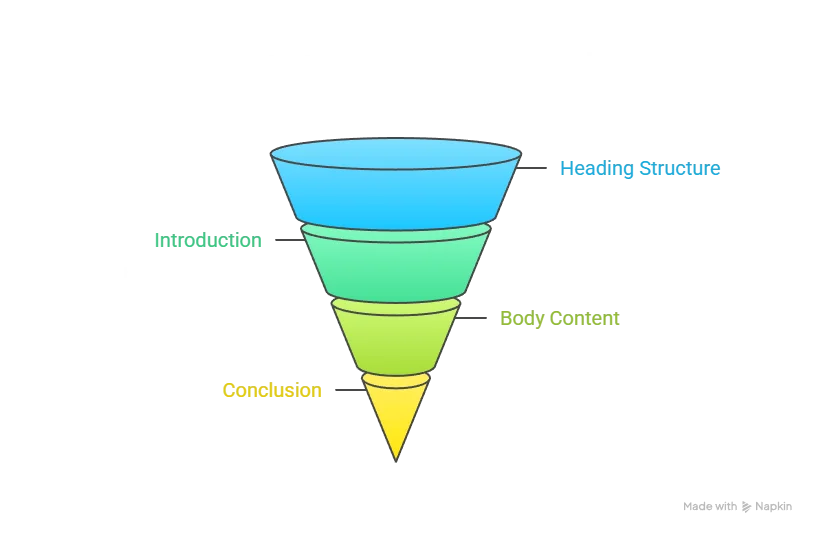
1. Logistics & Strategy
- Target Primary Keyword: [Insert Main Keyword]
- Search Intent: [Informational / Commercial / Transactional]
- Target Word Count: [e.g., 1,500 – 2,000 words]
- Competitor Links: [Paste top 3 URLs here]
2. The Heading Structure
- H1 (Title): [Must include Primary Keyword + Power Word]
- Meta Description: [155 characters max, include Call to Action]
3. The Body Content
- Introduction:
- Hook: Identify the pain point.
- Thesis: clearly state what the reader will learn.
- H2 [Main Point 1]:
- Keywords to use: [List Secondary Keywords]
- Key Takeaway: What is the main value here?
- H2 [Main Point 2]:
- Formatting: [Note: Use a bulleted list here for the featured snippet]
- H2 [Main Point 3 – The “How To” section]:
- H3 Step 1:
- H3 Step 2:
- Conclusion:
- Summary: Recap main points.
- CTA: [Link to product or newsletter]
By filling out this SEO content outline before you write, you stop guessing and start engineering your success.
Frequently Asked Questions (FAQ)
Still have a few questions about how this all fits together? You aren’t alone. Mastering the art of the SEO content outline takes practice, and there is often confusion about tools, timing, and terminology. Here are the answers to the most common questions we hear from writers and marketers.
What exactly should be included in an SEO content outline?
At a minimum, an effective SEO content outline must include your target primary keyword, a list of secondary and LSI keywords, your H1 title, and your H2/H3 subheadings. However, the best outlines go deeper: they include specific notes on search intent, target word count, internal linking opportunities, and links to competitor articles so the writer knows the benchmark they need to beat.
How long does it take to create a content outline?
If you are doing it manually for the first time, expect to spend about 30 to 60 minutes on deep research. However, once you get comfortable with keyword research tools and the process, you can churn out a high-quality SEO content outline in about 15–20 minutes. It is time well spent—that 20 minutes of planning usually saves an hour of aimless writing later.
Can I use ChatGPT to write an SEO content outline?
Yes, absolutely. AI is a fantastic tool for brainstorming structure. However, you cannot just copy-paste the result. An AI-generated outline often misses the nuance of specific search intent or lacks the most up-to-date keyword data. Use AI to get a rough draft, but manually refine it to ensure your SEO content outline is accurate and competitive.
How does an outline actually improve SEO rankings?
Google loves organization. An SEO content outline ensures your content covers a topic comprehensively, which signals topical authority. It also forces you to use proper header tags (H2s, H3s) logically. This structure makes it easier for Google bots to crawl your site and understand exactly what your page is about, leading to higher rankings.
What is the difference between a content brief and a content outline?
These terms are often used interchangeably, but there is a subtle difference. A content brief is usually a high-level summary of the goals, audience, and deadlines. An SEO content outline is the tactical skeleton of the article itself, detailing the specific headers and points to be covered in every section.
Conclusion
Creating high-ranking content doesn’t have to be a guessing game. It is a repeatable engineering process. By now, it should be clear that an SEO content outline is not just an optional administrative step—it is the absolute foundation of a successful content strategy. It is the difference between writing into the void and writing for the top of the search results. We have walked through the five essential steps: analyzing search intent, building topic clusters, structuring your headers for skimmability, optimizing for featured snippets, and briefing your writer with precision. If you follow this roadmap, you will stop wasting time on rewrites and start publishing content that drives real, organic traffic.
Remember, Google’s algorithms are getting smarter every day, but they still rely on structure to understand the web. Your SEO content outline provides that structure. So, before you open a blank document for your next post, stop. Do the research, build the plan, and watch your rankings climb.
Ready to get started? Scroll back up, build your first data-driven brief today.
