Meta Ads Setup 2026: The “Signal-First” Playbook for High ROAS
The landscape of Facebook and Instagram advertising has fundamentally changed. In 2026, we no longer “target” audiences in the traditional sense—we attract them. With the rollout and maturation of Meta’s Andromeda algorithm, the way advertisers approach a Meta ads setup has shifted from manual audience control to signal-driven optimization powered by creative and data. If you are still relying on interest stacking, micro-audiences, or overly complex ad account structures, your Meta ads setup is almost certainly leaking budget. Meta’s AI no longer rewards restriction; it rewards clarity, volume, and signal quality.
This guide is a practical, execution-focused roadmap for building a scalable, resilient Meta ads setup in 2026, designed to drive consistent ROAS even as attribution becomes less transparent and competition increases.
1. The Andromeda Era: How the Algorithm Redefined Meta Ads Setup
Believe it or not, the way most advertisers handled a Meta ads setup just a year ago is already outdated. We’ve officially entered the Andromeda era, signaling the end of manual ads and the rise of agentic marketing. Andromeda is a deep-learning system capable of processing millions of real-time intent signals per second. These signals include:
How long users pause on specific video frames:
- Comment depth and sentiment
- Save, share, and rewatch behavior
- Cross-platform engagement patterns
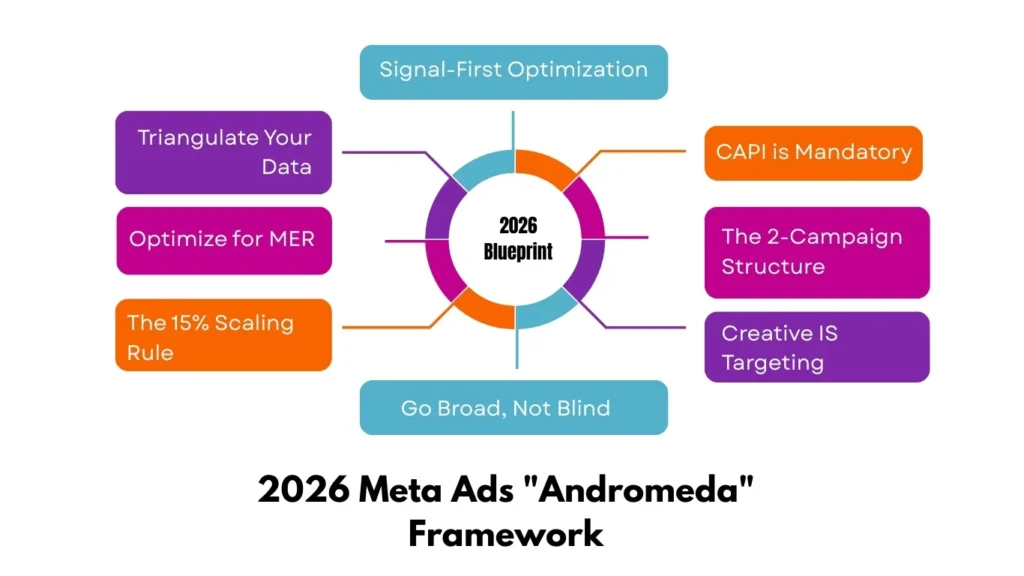
In 2026, a successful Meta ads setup is built on Signal-First Marketing. Instead of telling Meta who to target, you show the algorithm what kind of user should care through your creative and data. This means the role of the advertiser has changed. The heavy lifting of segmentation has moved away from the Audience tab and into your ads themselves. Your Meta ads setup is now a partnership:
You provide the creative “flavor.”
Andromeda finds the right diners.
When advertisers complain that “Meta targeting doesn’t work anymore,” it’s usually because their Meta ads setup hasn’t evolved to this new reality.
2. Technical Foundations: Pixel, CAPI, and Data Integrity
If Andromeda is the engine, data is the fuel. And in 2026, a purely browser-based Meta ads setup is a serious liability. With third-party cookies effectively dead and browser restrictions tightening, relying only on the Meta Pixel can result in 20–30% conversion loss. That missing data weakens optimization, increases CPAs, and slows learning.
A professional Meta ads setup now requires:
Meta Pixel (Client-Side)
Still necessary for:
- Page views
- View content events
- Retargeting pools
- But no longer sufficient on its own.
- Conversions API (CAPI) – Mandatory in 2026
CAPI is a server-to-server connection that sends events directly from your backend to Meta. A properly configured Meta ads setup uses CAPI to:
- Bypass ad blockers and browser restrictions
- Improve Event Match Quality (EMQ)
- Enable more accurate attribution
- Feed higher-quality signals into Andromeda
By sending first-party data (hashed emails, phone numbers, purchase IDs), your Meta ads setup gains predictive strength. The AI becomes better at identifying users whose behavior mirrors your highest-value customers. A weak data foundation will cripple even the best creative. In 2026, no serious Meta ads setup runs without CAPI.
3. The 2-Campaign Account Structure: Simplicity Wins
One of the biggest mistakes advertisers still make is over-engineering their account. To maximize your budget, you must master when to use ABO for testing and CBO for scaling. Too many campaigns, too many ad sets, and too many small budgets slow learning and fragment data.
The most effective Meta ads setup in 2026 follows a simple two-campaign structure:
1. Sandbox Campaign (Testing)
- Budget: ~20% of total spend
- Optimization: ABO (Ad Set Budget Optimization)
- Purpose: Creative testing and experimentation
This is your R&D lab. You test:
- New hooks
- New formats (UGC, static, short-form video)
- New offers or angles
The goal is not ROAS perfection—it’s signal discovery.
2. Scaling Campaign (Evergreen)
- Budget: ~80% of total spend
- Optimization: CBO or Advantage+ Shopping Campaign (ASC)
- Purpose: Revenue at scale
Only proven creatives graduate here. This campaign benefits from:
- Higher conversion volume
- Faster exit from the learning phase
- Stronger algorithmic confidence
A consolidated Meta ads setup exits learning faster and gives Andromeda the volume it needs to stabilize delivery.
4. Creative Strategy: The New Lever for Targeting
In 2026, creative is targeting. If your Meta ads setup includes a video about “luxury anti-aging skincare,” the algorithm will naturally find affluent, beauty-conscious buyers—even with targeting set to Broad. This is why creative diversity is non-negotiable. A high-performing Meta ads setup includes multiple creative archetypes:
- Lo-Fi UGC (Trust Builders)
- Self-shot videos
- Testimonials
- “Before/after” stories
These drive authenticity and social proof.
- High-Fi / Cinematic (Authority Builders)
- Polished visuals
- Brand storytelling
- Aspirational imagery
These elevate perceived value and brand trust.
Us vs. Them / Problem-Solution (Logic Builders)
- Static or carousel ads
- Clear differentiation
- Objection handling
These ads convert analytical buyers.
- Format Rules for 2026
- Vertical-first (9:16) is mandatory
- Optimize for Reels and Stories
- Capture attention in under 2 seconds
If your Meta ads setup doesn’t dominate the full screen, you’re losing the thumb-stop battle before optimization even begins.
5. Audience Strategy: Broad, But Not Blind
Interest targeting isn’t “dead,” but it’s no longer the primary driver of performance. To successfully shift your campaigns from broad audiences to actual buyers, your modern Meta ads setup requires a new approach:
- Broad targeting (Age, Gender, Location) often outperforms narrow stacks
- Interests are best used as secondary signals, not constraints
Why? Because Andromeda learns faster when it has room to explore. Over-restricting your audience starves the algorithm of data.
That said, exclusions still matter:
- Exclude recent purchasers (when appropriate)
- Exclude internal traffic
- Segment by lifecycle only when necessary
- A healthy Meta ads setup balances freedom with guardrails.
6. Budgeting & Scaling: Avoiding the Breakdown Effect
Scaling in 2026 is no longer about doubling budgets overnight. Aggressive changes trigger what many advertisers experience as sudden performance drops—commonly called the Breakdown Effect.
To scale a Meta ads setup safely:
- The 15% Rule
- Increase budgets by 10–20% every 48–72 hours. This preserves learning and avoids resetting delivery.
- Watch CPMr (Cost Per 1,000 Reach)
If CPMr spikes while conversions drop, you’re likely facing creative fatigue. The solution isn’t budget cuts—it’s creative rotation.
Focus on MER, Not Just ROAS
With attribution becoming murky, Marketing Efficiency Ratio (MER) is your true north star:
MER = Total Revenue ÷ Total Ad Spend
A strong Meta ads setup optimizes for business health, not just dashboard metrics.
7. Measurement & Attribution in a Post-Cookie World
In 2026, platform-reported ROAS is directional—not absolute. A robust Meta ads setup uses:
- UTMs standardized across campaigns
- GA4 for blended attribution
- Backend revenue tracking (Shopify, CRM, ERP)
The goal is triangulation. No single tool tells the full story, but together they reveal trend direction and scalability.
8. Common Mistakes That Kill Meta Ads Setup Performance
Even experienced advertisers fall into these traps:
- Too many ad sets with small budgets
- Testing audiences instead of creatives
- Ignoring Event Match Quality
- Letting “learning limited” campaigns run too long
- Refreshing creatives too slowly
A disciplined Meta ads setup avoids complexity and prioritizes signal strength.
Meta Ads Setup Checklist (2026)
Use this checklist to audit your account:
- Meta ads setup includes Pixel + CAPI
- Event Match Quality is “Great” or better
- Two-campaign structure (Sandbox + Scaling)
- Creative diversity across formats
- Vertical-first assets live
- Budgets scaled gradually
- UTMs standardized
- MER tracked weekly
Is interest targeting dead in Meta ads setup?
Not dead, but secondary. Broad targeting usually outperforms narrow interests when creative and data are strong.
How do I know if my Meta ads setup CAPI is working?
Check Events Manager. You want “Great” or “Excellent” Event Match Quality and near-100% deduplication.
How many ads should be in one ad set?
3–6 active creatives. Too many ads dilute spend and slow optimization in your Meta ads setup.
Should I use Advantage+ campaigns?
Yes—for scaling. Test in Sandbox first, then graduate winners.
Conclusion: The Future of Meta Ads Setup
In 2026, Meta advertising is no longer about control—it’s about collaboration with the algorithm. A high-performing Meta ads setup is built on clean data, creative clarity, and strategic simplicity. Advertisers who embrace a signal-first mindset will continue to scale profitably. If you are ready to stop guessing and want a team of experts to build this engine for you, explore our Meta Ads Services to get a custom, high-ROAS setup designed specifically for your brand.
