
E-commerce SEO: Proven Strategies to Increase Organic Traffic and Online Sales
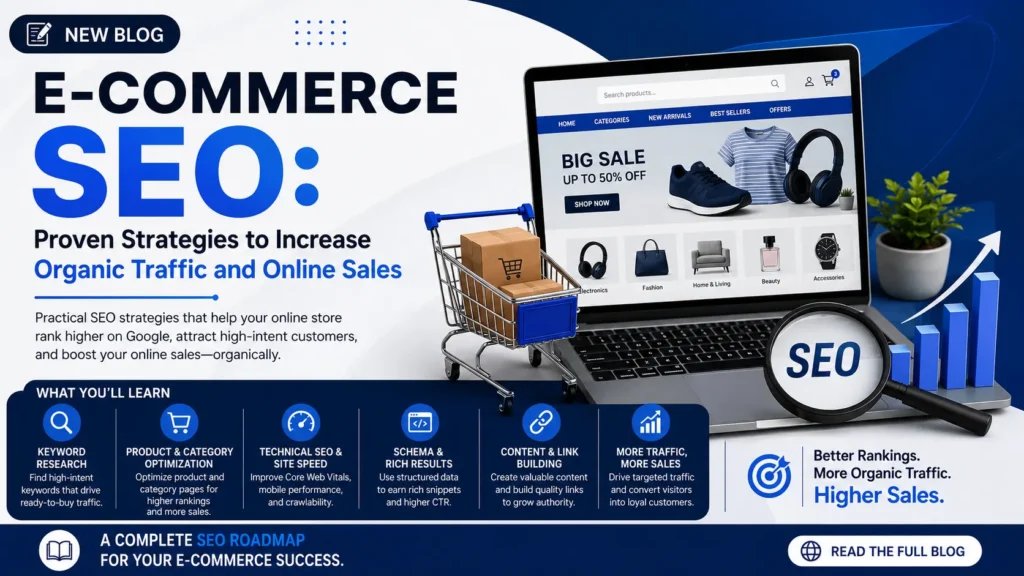
Introduction
The e-commerce industry is growing faster than ever, with millions of customers turning to online stores for everything from fashion and electronics to groceries and home essentials. While this creates enormous opportunities, it also brings intense competition.
Launching an online store is only the first step. The real challenge is attracting qualified visitors who are ready to buy. Without strong online visibility, even the best products can remain unnoticed.
This is where E-commerce SEO becomes a game-changer.
Search Engine Optimization (SEO) helps your online store appear in front of customers who are actively searching for products on Google. Unlike paid advertising, SEO generates sustainable organic traffic, improves brand credibility, and delivers long-term growth.
At Rebootiq, we help e-commerce businesses improve their online visibility through strategic SEO, technical optimization, content marketing, and performance-driven digital marketing solutions. In this guide, we’ll explore proven SEO strategies that can help your online store rank higher, attract qualified visitors, and increase online sales.
What Is E-commerce SEO?
E-commerce SEO is the process of optimizing an online store to improve its visibility on search engines like Google. It involves enhancing product pages, category pages, website structure, technical performance, and content so potential customers can easily find your products through organic search.
A well-optimized e-commerce website not only ranks higher but also provides a better shopping experience, increasing the likelihood of converting visitors into customers.
Why Is SEO Important for E-commerce Businesses?
Most online shopping journeys begin with a search engine. Whether customers are looking for a specific product or comparing options, they often start by searching Google.
A strong SEO strategy helps your business:
- Increase organic website traffic
- Reach customers with high purchase intent
- Improve Google rankings
- Reduce reliance on paid advertising
- Build long-term brand credibility
- Generate consistent online sales
- Improve user experience and website performance
Unlike paid campaigns that stop delivering results once the budget runs out, SEO continues to drive traffic and sales over time.
1. Start with Keyword Research
Successful e-commerce SEO begins with understanding what your customers are searching for.
Focus on keywords that reflect buying intent rather than broad informational terms.
For example:
❌ Shoes
✅ Running shoes for men
❌ Laptop
✅ Best gaming laptop under ₹80,000
Long-tail keywords generally attract visitors who are closer to making a purchase and often have lower competition.
Use a mix of:
- Product keywords
- Category keywords
- Brand keywords
- Location-based keywords (if applicable)
- Question-based keywords for AEO
2. Optimize Product Pages for Search and Sales
Your product pages should do more than display images and prices. They should provide all the information customers need to make informed purchasing decisions.
Every product page should include:
- Unique product titles
- SEO-friendly meta descriptions
- Original product descriptions
- High-quality images
- Descriptive image alt text
- Customer reviews
- Product specifications
- Internal links to related products
- Clear calls-to-action
Avoid copying manufacturer descriptions, as duplicate content can negatively impact search rankings.
3. Create SEO-Friendly Category Pages
Category pages often target high-volume keywords and play an important role in driving organic traffic.
Optimize category pages by including:
- Keyword-rich titles
- Informative introductions
- Easy navigation
- Product filters
- Internal links
- Optimized URLs
Instead of displaying only products, add helpful content that guides shoppers and provides additional context.
4. Build a Strong Website Structure
A well-organized website helps both users and search engines find products quickly. If visitors struggle to navigate your store, they’re more likely to leave without making a purchase.
A simple and logical website structure also makes it easier for search engines to crawl and index your pages.
Recommended Structure:
Home → Category → Subcategory → Product
For example:
Home → Electronics → Smartphones → iPhone 16 Pro
Keep important products within three clicks from the homepage whenever possible.
Best Practices
- Use clear category names.
- Avoid creating unnecessary subcategories.
- Add breadcrumb navigation.
- Link related categories and products.
- Make every important page easy to reach.
A clean website architecture improves user experience and strengthens your SEO performance.
5. Improve Website Speed and Core Web Vitals
Website speed is one of Google’s ranking factors and plays a significant role in user satisfaction. Online shoppers expect pages to load almost instantly, and even a slight delay can increase bounce rates and reduce conversions.
Focus on improving your website’s Core Web Vitals, including:
- Largest Contentful Paint (LCP)
- Interaction to Next Paint (INP)
- Cumulative Layout Shift (CLS)
Ways to Improve Website Speed
- Compress product images without sacrificing quality.
- Use next-generation image formats such as WebP.
- Enable browser caching.
- Minify CSS and JavaScript files.
- Remove unnecessary plugins and scripts.
- Use a reliable hosting provider or CDN.
- Implement lazy loading for images.
A faster website not only ranks better but also creates a smoother shopping experience that encourages customers to complete their purchases.
6. Optimize Your Website for Mobile Users
Today, most online shoppers browse and buy products using their smartphones. Google also uses mobile-first indexing, meaning it primarily evaluates the mobile version of your website when determining rankings.
A mobile-friendly e-commerce website should provide:
- Responsive design
- Fast loading speed
- Simple navigation
- Easy-to-use product filters
- Large tap targets
- Click-to-call and click-to-chat options (where applicable)
- A smooth checkout experience
Test your website regularly across different screen sizes to ensure a consistent user experience.
7. Optimize Product Images for SEO
Images are essential for online shopping, but they should also contribute to your SEO strategy.
Before uploading images:
- Use descriptive file names (e.g.,
wireless-bluetooth-headphones.jpginstead ofIMG001.jpg). - Add meaningful alt text that describes the product.
- Compress image sizes to improve loading speed.
- Use high-quality images from multiple angles.
- Include zoom functionality where appropriate.
Optimized images improve accessibility, page performance, and visibility in Google Images search.
8. Use SEO-Friendly URLs
Your URLs should be short, descriptive, and easy to understand.
Good URL
yourstore.com/mens-running-shoes
Poor URL
yourstore.com/product?id=45897
Include your target keyword naturally in the URL and avoid unnecessary numbers or symbols.
Best Practices
- Keep URLs concise.
- Use hyphens instead of underscores.
- Avoid capital letters.
- Do not include dates unless necessary.
- Keep the URL structure consistent across the website.
9. Add Product Schema Markup
Schema Markup helps search engines better understand your content and can enhance your listings with rich results.
For e-commerce websites, consider implementing:
- Product Schema
- Review Schema
- Organization Schema
- Breadcrumb Schema
- FAQ Schema
- Offer Schema
Rich snippets displaying ratings, prices, availability, and reviews can improve click-through rates and attract more qualified shoppers.
10. Strengthen Internal Linking
Internal links help search engines discover your pages while guiding visitors to related products and categories.
Examples include:
- Linking from blog articles to relevant product pages.
- Connecting similar products through “Related Products.”
- Linking category pages to featured collections.
- Adding links to complementary products.
A strong internal linking strategy improves crawlability, distributes page authority, and encourages users to explore more of your website.
11. Manage Crawlability and Indexing
Not every page on your e-commerce website needs to appear in search results. Pages such as shopping carts, login screens, and internal search results should generally be excluded from indexing.
Regularly review:
- XML sitemap
- Robots.txt file
- Broken links
- Redirect chains
- Duplicate content
- Canonical tags
Submitting an updated XML sitemap through Google Search Console helps search engines discover new products and updated pages more efficiently.
12. Enhance the Shopping Experience
SEO doesn’t stop at attracting visitors—it also supports conversions. A positive user experience encourages customers to stay longer, browse more products, and complete their purchases.
Focus on:
- Clear product information
- Transparent pricing
- Customer reviews
- Multiple payment options
- Secure checkout
- Easy returns and shipping details
- Visible contact information
Search engines increasingly reward websites that provide valuable, user-focused experiences.
What’s Next?
Part 3 will cover the content strategies that help an e-commerce store become an authority, including:
- Content Marketing
- Blog SEO
- Link Building
- EEAT
- AEO (AI Search Optimization)
- Google AI Overviews
- Voice Search
- Common SEO Mistakes
- Advanced ranking strategies
This section is where the blog becomes highly competitive for 2026 SEO and AI-powered search.
13. Create High-Quality Content That Solves Customer Problems
Content is one of the strongest drivers of organic traffic for e-commerce websites. Instead of publishing content solely to promote products, focus on answering your audience’s questions and helping them make informed buying decisions.
Useful, informative content builds trust, attracts qualified visitors, and supports your product and category pages.
Consider publishing blogs such as:
- Buying guides
- Product comparisons
- Gift ideas
- Product care and maintenance tips
- Industry trends
- Frequently asked questions
- Seasonal shopping guides
Helpful content keeps visitors engaged and encourages them to explore your store further.
14. Build High-Quality Backlinks
Backlinks remain an important ranking factor because they signal that other websites trust your content.
Instead of chasing large numbers of links, focus on earning backlinks from reputable and relevant sources.
Some effective strategies include:
- Guest posting on industry websites
- Publishing original research or reports
- Collaborating with influencers and bloggers
- Listing your business in trusted directories
- Creating shareable resources such as checklists or guides
- Promoting valuable content through digital PR
High-quality backlinks improve domain authority and strengthen your search rankings over time.
15. Optimize for Local SEO (If You Have a Physical Store)
If your e-commerce business also has a physical location, Local SEO can help you reach nearby customers.
Make sure to:
- Create and optimize your Google Business Profile.
- Keep your business name, address, and phone number consistent across platforms.
- Encourage satisfied customers to leave reviews.
- Use location-based keywords where relevant.
- Publish local landing pages if you serve multiple cities.
Local SEO increases visibility in Google Maps and local search results, helping customers find your business more easily.
16. Optimize for AI Search (AEO)
Search is evolving beyond traditional search engine results. Today, users also rely on AI-powered platforms like Google AI Overviews, ChatGPT, Gemini, and Microsoft Copilot to discover products and find answers.
To improve visibility in these experiences, your content should be structured for Answer Engine Optimization (AEO).
AEO Best Practices
- Answer questions clearly and directly.
- Use descriptive H2 and H3 headings.
- Include concise FAQ sections.
- Write in simple, conversational language.
- Support claims with accurate and up-to-date information.
- Add structured data, including FAQ and Product Schema.
- Keep paragraphs short and easy to scan.
Content that is helpful, well-organized, and trustworthy has a better chance of appearing in AI-generated answers and summaries.
17. Demonstrate Experience, Expertise, Authority, and Trust (E-E-A-T)
Google values content created by businesses that demonstrate real-world knowledge and credibility.
Strengthen your website’s E-E-A-T by:
- Publishing original, experience-based content.
- Showcasing customer testimonials and reviews.
- Keeping product information accurate.
- Displaying clear contact details.
- Updating outdated content regularly.
- Highlighting your expertise through educational resources.
A trustworthy website is more likely to earn both customer confidence and higher search rankings.
18. Track SEO Performance Regularly
SEO requires ongoing monitoring and refinement. Tracking the right metrics helps you understand what’s working and where improvements are needed.
Key performance indicators include:
- Organic traffic
- Keyword rankings
- Click-through rate (CTR)
- Conversion rate
- Bounce rate
- Average engagement time
- Revenue from organic search
- Indexed pages
Review this data regularly and update your SEO strategy based on performance trends.
Common E-commerce SEO Mistakes to Avoid
Avoid these common mistakes that can limit your website’s visibility and sales potential:
- Copying manufacturer product descriptions
- Ignoring mobile optimization
- Using slow-loading images
- Publishing duplicate content
- Neglecting internal linking
- Missing title tags and meta descriptions
- Forgetting image alt text
- Using complicated URL structures
- Ignoring technical SEO issues
- Failing to update outdated content
Addressing these issues can improve both search performance and the overall shopping experience.
Why E-commerce SEO Is a Long-Term Investment
SEO is not about overnight success. It’s a long-term strategy that builds sustainable growth by attracting customers who are actively searching for your products.
Unlike paid advertising, which stops generating traffic when the budget ends, SEO continues to deliver value over time through consistent visibility and organic traffic.
Businesses that invest in SEO today are better positioned to increase online sales, strengthen their brand, and stay ahead of the competition.
Frequently Asked Questions (FAQs)
What is E-commerce SEO?
E-commerce SEO is the process of optimizing an online store to improve its visibility on search engines, attract organic traffic, and increase online sales.
Why is SEO important for an online store?
SEO helps your products appear in front of customers who are actively searching on Google, resulting in more qualified traffic and better conversion opportunities.
How long does E-commerce SEO take?
Most websites start seeing measurable SEO improvements within 3 to 6 months, depending on competition, website quality, and optimization efforts.
Can SEO increase online sales?
Yes. A strong SEO strategy attracts high-intent visitors who are more likely to purchase, helping increase conversions and long-term revenue.
What is the best SEO strategy for an e-commerce website?
A successful strategy includes keyword research, technical SEO, product page optimization, content marketing, mobile optimization, and high-quality backlinks.
What is AEO?
AEO (Answer Engine Optimization) is the process of creating content that directly answers user questions, making it more likely to appear in Google AI Overviews and AI-powered search platforms like ChatGPT and Gemini.
E-commerce SEO Checklist
Before publishing or updating your online store, make sure you’ve completed these essential SEO tasks:
- ✔️ Perform keyword research with buyer intent
- ✔️ Write unique product descriptions
- ✔️ Optimize product titles and meta descriptions
- ✔️ Improve website speed and Core Web Vitals
- ✔️ Ensure mobile responsiveness
- ✔️ Optimize images with descriptive alt text
- ✔️ Create SEO-friendly URLs
- ✔️ Add Product, FAQ, and Organization Schema
- ✔️ Strengthen internal linking
- ✔️ Publish helpful blog content regularly
- ✔️ Earn high-quality backlinks
- ✔️ Optimize your Google Business Profile (if applicable)
- ✔️ Track SEO performance with analytics tools
- ✔️ Update content regularly
- ✔️ Optimize for AI search (AEO)
Final Thoughts
A successful e-commerce website needs more than attractive products and competitive pricing. It needs a strong SEO foundation that helps customers discover your business when they’re actively searching online.
By investing in keyword research, technical SEO, content marketing, mobile optimization, and AI-ready content, you can improve your search visibility, attract qualified visitors, and build a steady stream of organic sales.
SEO is a long-term investment that continues to deliver value over time. Businesses that prioritize search optimization today are better positioned to grow sustainably, reduce advertising costs, and stay ahead in an increasingly competitive online marketplace.
Grow Your E-commerce Business with Rebootiq
At Rebootiq, we help e-commerce brands transform their online presence with data-driven digital marketing solutions designed for long-term growth.
Our services include:
- E-commerce SEO
- Technical SEO Audits
- Google Ads Management
- Meta Ads Campaigns
- Website Design & Development
- Conversion Rate Optimization (CRO)
- Content Marketing
- Google Business Profile Optimization
- Performance Tracking & Analytics
Whether you’re launching a new online store or looking to scale an established e-commerce business, our team creates customized strategies that drive traffic, increase conversions, and maximize ROI.
Ready to grow your online store?
Visit: https://rebootiq.com/
