How to Rank in GEO

How to Rank in GEO: The Definitive Guide to Generative Engine Optimization 

The way we search has changed forever. We’ve moved past the era of scrolling through ten blue links and into the age of the “synthesis,” where AI models like Gemini and Perplexity do the reading for us. If you want your brand to survive this shift, you must learn how to rank in GEO. Generative Engine Optimization (GEO) isn’t about gaming an algorithm; it’s about becoming the most citable, reliable source of truth in your niche. In 2026, being “searchable” isn’t enough—you need to be “summarizable.” This guide will walk you through the transition from traditional search to AI Search Optimization, ensuring your content doesn’t just exist on the web but powers the answers people receive. To master how to rank in GEO, you must prioritize factual density and E-E-A-T above all else.  What is Generative Engine Optimization and How to Rank in GEO?  If you feel like the SEO goalposts have moved, you’re right. We’ve shifted from a “Library of Links” to a “Conversation with Data.” To understand how to rank in GEO, you first must understand what it is. GEO is the process of optimizing your digital footprint so that Large Language Models (LLMs) choose your content as a primary source for their generated answers. Unlike traditional SEO, which focuses heavily on keywords and backlink counts, how to rank in GEO depends on your citation-led growth. Think of it as Answer Engine Optimization (AEO) on steroids. When a user asks a question, the AI scans the web for a “Ground Truth.” It looks for pages that offer the highest factual density and the clearest structure.  The generative search experience (SGE) creates a “zero-click” environment where the user gets their answer directly on the search page. If you aren’t one of the cited sources in that AI summary, you effectively don’t exist to that user. This is why knowing how to rank in GEO is the most critical skill for digital marketers today. It’s about building a bridge between your expertise and the AI’s need for verifiable information. By focusing on AI Search Optimization, you ensure that your brand becomes an “Entity” rather than just a keyword string. When you master how to rank in GEO, you aren’t just chasing traffic; you are building authority that an AI can trust. This evolution requires a shift in mindset: stop writing for bots that count words, and start writing for models that synthesize ideas.  Top 5 Ranking Factors: Understanding How to Rank in GEO Today  Success in the new search landscape requires a shift from chasing algorithms to satisfying models. To understand how to rank in GEO, you need to look at the specific signals that trigger an AI to cite your page as a “primary source.” These aren’t just technical checkboxes; they are markers of quality that prove your content is worth being the foundation of a synthesized answer.  1. Factual Density: The “Ground Truth” Signal  The single most effective way to learn how to rank in GEO is to increase your factual density. AI models like Gemini and SearchGPT are designed to avoid hallucinations by anchoring their responses in verifiable data. Research shows that adding statistics, quantitative data, and expert citations can boost your visibility in AI Overviews by up to 30%. Instead of saying, “Our software helps teams work faster,” say, “Teams using our platform report a 22% reduction in project turnaround time, according to our 2025 internal audit.” This specific, data-rich language is much easier for an AI to extract and present as a “fact.”  2. Entity-Based Optimization  In 2026, AI doesn’t just see keywords; it sees “Entities”—people, places, brands, and concepts—and the relationships between them. Learning how to rank in GEO involves mapping out these relationships. If your content clearly explains how your brand (Entity A) solves a specific industry problem (Entity B) using a unique methodology (Entity C), the AI’s Knowledge Graph can connect those dots. Use AI Search Optimization tools to identify “entity gaps” in your content where you might be missing these crucial semantic connections.  3. The “Inverted Pyramid” Answer Structure  AI models are efficiency machines. To master how to rank in GEO, you must front-load your value. We call this the “Answer Capsule” approach. Start your page or section with a direct, 50-word answer to the primary query. This makes it incredibly easy for an LLM’s retrieval-augmented generation (RAG) process to grab your text. Following this with deeper context and nuance provides the “reasoning chain” that AI systems love to summarize.  4. E-E-A-T and Citable Authority  The “T” in E-E-A-T (Trustworthiness) is the heavy lifter for how to rank in GEO. AI engines prioritize sources that are mentioned across the web—not just in backlinks, but in co-citations. If your brand is discussed on Reddit, Quora, and high-authority industry journals, AI models see you as a “verified” expert. This citation-led growth is more valuable than 1,000 low-quality backlinks because it signals to the AI that you are a recognized authority in the real world.  5. Semantic Completeness  Shallow content is the enemy of how to rank in GEO. An AI wants to cite a source that covers a topic from every angle—beginner to advanced. By providing topical depth, you ensure that regardless of how a user phrases their prompt, your content has the “semantic similarity” required to be the answer. This is where AI Search Optimization meets traditional long-form content: you aren’t just writing more words; you’re covering more of the “intent space.”  How to Rank in GEO for Gemini, Perplexity, and SearchGPT  While the fundamentals of how to rank in GEO remain consistent, the year 2026 has shown us that AI engines are not a monolith. Each platform has its own “personality” and preferred data sources. To maximize your visibility, you need to tailor your AI Search Optimization strategy to the specific nuances of the big three: Google Gemini, Perplexity, and OpenAI’s SearchGPT.  Google Gemini: The Ecosystem Powerhouse  Because Gemini is natively integrated into the Google ecosystem, it relies heavily on the Google Knowledge Graph. To master how to rank in GEO for Gemini, you must ensure your brand is a recognized entity within Google Business Profiles and the Shopping Graph.  Perplexity: The Real-Time Researcher  Perplexity acts more like a high-speed librarian than a chatbot. It prioritizes content freshness and multiple source attributions. If you want to know how to rank in GEO on Perplexity, you need to cite your sources as clearly as you want Perplexity to cite you.  SearchGPT: The Conversational Authority  OpenAI’s SearchGPT focuses on the “reasoning chain.” It prefers content that doesn’t just give an answer but explains the why behind it. When looking at how to

Meta Ads Audience Targeting

From Broad to Buyers: Meta Ads Audience Targeting in 2026

The landscape of digital advertising has undergone a seismic shift. If you are still trying to “hack” the system by stacking dozens of granular interests, you are likely overpaying for your conversions. In 2026, successful Meta Ads Audience Targeting is no longer about outsmarting the algorithm; it is about feeding it. With the decline of third-party cookies and the rise of privacy-first browsing, we have moved into an era of Signal Loss Mitigation. To maintain a competitive edge, advertisers must pivot toward a hybrid model that blends automated AI discovery with robust first-party data. This guide will show you how to master Meta Ads Audience Targeting by leveraging machine learning and high-quality data signals to drive consistent ROAS. Whether you are scaling a DTC brand or generating B2B leads, understanding the new rules of Meta Ads Audience Targeting is the difference between burning your budget and building a profit engine.  Understanding the Pillars of Meta Ads Audience Targeting  To build a high-performing campaign, you need to understand the three distinct pillars that support modern Meta Ads Audience Targeting. While the platform has become more automated, your ability to provide the right “seeds” determines how quickly the AI can find your ideal customer. The first pillar is Broad Targeting. It might feel counterintuitive to remove all interest filters, but for most accounts, this is the purest form of Meta Ads Audience Targeting. By only defining age, gender, and location, you allow Meta’s liquid bidding system to analyze millions of data points in real-time. This approach often leads to a lower CPA because it prevents the “auction overlap” that happens when you force the system into narrow niches.  The second pillar is Custom Audiences, which remains the gold mine of any account. By utilizing Customer Match Lists—such as your email subscribers or CRM data—you create a foundation of Meta Ads Audience Targeting that is immune to pixel tracking issues. This is where you speak to people who already know, like, and trust your brand. Finally, we have Meta Lookalike Audiences (LAL). In 2026, the strategy for LALs has shifted from volume to quality. Instead of a 1% lookalike of all website visitors, the most effective Meta Ads Audience Targeting involves creating 1% to 10% “Value-Based” lookalikes. By seeding the algorithm with your top 10% of high-LTV customers, you guide the Meta Ads Audience Targeting system to find people who don’t just click but spend. Mastering these three pillars ensures your Meta Ads Audience Targeting is balanced, scalable, and resilient against market shifts.  How Advantage+ Revolutionizes Meta Ads Audience Targeting  In 2026, the engine room of the platform is Advantage+. This AI-powered suite has fundamentally changed Meta Ads Audience Targeting by shifting the workload from the advertiser’s manual input to Meta’s machine learning models. Instead of the “hard rules” of the past, we now work with “Audience Suggestions.” When you provide an interest or a lookalike, the AI uses it as a starting point but retains the freedom to go beyond those borders if it identifies a higher probability of conversion elsewhere. The true power of this automation lies in its ability to conduct AI-Driven Discovery. While a manual setup might keep your ads trapped in a high-CPM “interest bubble,” Advantage+ identifies behavioral patterns across the entire Meta ecosystem that a human might never consider. For example, it might find that people who recently engaged with luxury travel content are actually the best buyers for your high-end kitchenware, even if “Home Decor” was your only manual suggestion. This fluidity in Meta Ads Audience Targeting is what allows campaigns to scale without hitting the dreaded performance plateau.  However, an AI is only as good as the data it consumes. To make this work, you must implement a robust technical foundation. Relying solely on a browser-based Pixel Tracking setup is no longer enough due to increasing privacy restrictions and ad blockers. This is where the Meta Conversions API (CAPI) becomes essential. By feeding Server-Side Signals directly from your website to Meta’s servers, you ensure the algorithm receives a clean, deduplicated stream of data. High-quality signals lead to a higher Event Match Quality (EMQ), which in turn trains the Meta Ads Audience Targeting model to be more precise. In short: if you want the AI to work for you, you must give it the best possible information to learn from.  Advanced Retargeting Strategies Within Meta Ads Audience Targeting  Retargeting is the “closer” of your digital strategy. In 2026, it has evolved from simply following users around the web to a sophisticated, value-driven conversation. Effective Meta Ads Audience Targeting at this stage requires a deep understanding of Retention Windows—the specific timeframe in which a user is most likely to return and convert.  To maximize ROI, we utilize the “Mille-Feuille” approach, layering your audiences by intent. For high-intent users, such as Cart Abandoners, we use a tight 0–3-day window. These users are right on the edge of a purchase, so your Meta Ads Audience Targeting should focus on overcoming final friction with “Urgency” messaging or a limited-time free shipping offer. For Medium Intent users—those who viewed a product page but didn’t add to cart—we expand the window to 7–14 days and shift the creative to “Social Proof,” using customer testimonials to build trust. A cornerstone of e-commerce success in 2026 is the use of Dynamic Product Ads (DPA). This feature automates Meta Ads Audience Targeting by pulling exactly what a user viewed on your site and showing it to them again in a personalized carousel. By pairing DPAs with Engagement-Based Retargeting—targeting users who have saved your Instagram posts or watched 50% of your videos—you create an “omnichannel” feel that keeps your brand top-of-mind.  Finally, the most overlooked aspect of Meta Ads Audience Targeting is the use of Exclusion Lists. To stop wasting spend, you must aggressively exclude anyone who has purchased in the last 30 days from your retargeting sets. This ensures your budget is always focused on “uncapped” opportunities rather than annoying your existing customers with ads for products they already own. By treating retargeting as a precision tool rather than a broadcast, you turn your Meta Ads Audience Targeting into a high-efficiency conversion machine.  Why Creative is the New Meta Ads Audience Targeting  In the earlier days of digital marketing, we spent hours toggling interest buttons and layering demographics. Today, the script has flipped. In the “Andromeda” era of

Meta Ads setup 2026

Meta Ads Setup 2026: The “Signal-First” Playbook for High ROAS 

The landscape of Facebook and Instagram advertising has fundamentally changed. In 2026, we no longer “target” audiences in the traditional sense—we attract them. With the rollout and maturation of Meta’s Andromeda algorithm, the way advertisers approach a Meta ads setup has shifted from manual audience control to signal-driven optimization powered by creative and data. If you are still relying on interest stacking, micro-audiences, or overly complex ad account structures, your Meta ads setup is almost certainly leaking budget. Meta’s AI no longer rewards restriction; it rewards clarity, volume, and signal quality.  This guide is a practical, execution-focused roadmap for building a scalable, resilient Meta ads setup in 2026, designed to drive consistent ROAS even as attribution becomes less transparent and competition increases.  1. The Andromeda Era: How the Algorithm Redefined Meta Ads Setup  Believe it or not, the way most advertisers handled a Meta ads setup just a year ago is already outdated. We’ve officially entered the Andromeda era—named after Meta’s advanced retrieval and ranking algorithm that powers ad delivery across Facebook, Instagram, and Reels. Andromeda is a deep-learning system capable of processing millions of real-time intent signals per second. These signals include:  How long users pause on specific video frames:  In 2026, a successful Meta ads setup is built on Signal-First Marketing. Instead of telling Meta who to target, you show the algorithm what kind of user should care through your creative and data. This means the role of the advertiser has changed. The heavy lifting of segmentation has moved away from the Audience tab and into your ads themselves. Your Meta ads setup is now a partnership:  You provide the creative “flavor.”  Andromeda finds the right diners.  When advertisers complain that “Meta targeting doesn’t work anymore,” it’s usually because their Meta ads setup hasn’t evolved to this new reality.  2. Technical Foundations: Pixel, CAPI, and Data Integrity  If Andromeda is the engine, data is the fuel. And in 2026, a purely browser-based Meta ads setup is a serious liability. With third-party cookies effectively dead and browser restrictions tightening, relying only on the Meta Pixel can result in 20–30% conversion loss. That missing data weakens optimization, increases CPAs, and slows learning.  A professional Meta ads setup now requires:  Meta Pixel (Client-Side)  Still necessary for:  CAPI is a server-to-server connection that sends events directly from your backend to Meta. A properly configured Meta ads setup uses CAPI to:  By sending first-party data (hashed emails, phone numbers, purchase IDs), your Meta ads setup gains predictive strength. The AI becomes better at identifying users whose behavior mirrors your highest-value customers. A weak data foundation will cripple even the best creative. In 2026, no serious Meta ads setup runs without CAPI.  3. The 2-Campaign Account Structure: Simplicity Wins  One of the biggest mistakes advertisers still make is over-engineering their account. Too many campaigns, too many ad sets, and too many small budgets slow learning and fragment data.  The most effective Meta ads setup in 2026 follows a simple two-campaign structure:  1. Sandbox Campaign (Testing)  This is your R&D lab. You test:  The goal is not ROAS perfection—it’s signal discovery.  2. Scaling Campaign (Evergreen)  Only proven creatives graduate here. This campaign benefits from:  A consolidated Meta ads setup exits learning faster and gives Andromeda the volume it needs to stabilize delivery.  4. Creative Strategy: The New Lever for Targeting  In 2026, creative is targeting. If your Meta ads setup includes a video about “luxury anti-aging skincare,” the algorithm will naturally find affluent, beauty-conscious buyers—even with targeting set to Broad. This is why creative diversity is non-negotiable. A high-performing Meta ads setup includes multiple creative archetypes:  These drive authenticity and social proof.  These elevate perceived value and brand trust.  Us vs. Them / Problem-Solution (Logic Builders)  These ads convert analytical buyers.  If your Meta ads setup doesn’t dominate the full screen, you’re losing the thumb-stop battle before optimization even begins.  5. Audience Strategy: Broad, But Not Blind  Interest targeting isn’t “dead,” but it’s no longer the primary driver of performance. In a modern Meta ads setup:  Why? Because Andromeda learns faster when it has room to explore. Over-restricting your audience starves the algorithm of data.  That said, exclusions still matter:  6. Budgeting & Scaling: Avoiding the Breakdown Effect  Scaling in 2026 is no longer about doubling budgets overnight. Aggressive changes trigger what many advertisers experience as sudden performance drops—commonly called the Breakdown Effect.  To scale a Meta ads setup safely:  If CPMr spikes while conversions drop, you’re likely facing creative fatigue. The solution isn’t budget cuts—it’s creative rotation.  Focus on MER, Not Just ROAS  With attribution becoming murky, Marketing Efficiency Ratio (MER) is your true north star:  MER = Total Revenue ÷ Total Ad Spend  A strong Meta ads setup optimizes for business health, not just dashboard metrics.  7. Measurement & Attribution in a Post-Cookie World  In 2026, platform-reported ROAS is directional—not absolute. A robust Meta ads setup uses:  The goal is triangulation. No single tool tells the full story, but together they reveal trend direction and scalability.  8. Common Mistakes That Kill Meta Ads Setup Performance  Even experienced advertisers fall into these traps:  A disciplined Meta ads setup avoids complexity and prioritizes signal strength.  Meta Ads Setup Checklist (2026)  Use this checklist to audit your account:  Conclusion: The Future of Meta Ads Setup  In 2026, Meta advertising is no longer about control—it’s about collaboration with the algorithm. A high-performing Meta ads setup is built on clean data, creative clarity, and strategic simplicity. Advertisers who embrace a signal-first mindset will continue to scale profitably. Those who cling to outdated tactics will struggle, no matter how much budget they throw at the platform. The question isn’t whether Meta ads still work. The question is whether your Meta ads setup is built for how the system works today.

Google search ads 2026

Google Search Ads 2026: AI Bidding, Keywords & Profit Playbook

The landscape of google search ads has shifted significantly this year, moving away from simple keyword bidding toward a sophisticated understanding of user intent signals. If you are looking to scale a business in 2026, realizing that google search ads are no longer just about being “at the top” is the first step toward profitability. Modern google search ads strategy requires a deep synergy between human creativity and algorithmic precision. As AI Overviews become the primary way users consume information, google search ads have adapted to feel less like interruptions and more like helpful solutions. Today, google search ads are integrated directly into generative responses, appearing exactly when a user transitions from “searching” to “buying.” This shift means your google search ads must align with buyer intent, not just keywords. Optimizing Google Search Ads for Maximum Quality Score in 2026 In the current ecosystem of google search ads, your technical setup serves as the bridge between your marketing goals and Google’s machine learning. Achieving a high Quality Score in google search ads is no longer optional—it directly impacts CPC, impression share, and scalability. To maximize the performance of your Google Search Ads, you must fully embrace Responsive Search Ads (RSA). The best practice for Google Search Ads is to provide the maximum variety: 15 headlines and 4 descriptions. This diversity allows the AI to mix and match assets to find the most effective combination for every unique search query. While including an exact match keyword in at least two headlines is vital for ad relevance, your remaining assets should focus on diverse Unique Selling Points (USPs) and clear, action-oriented calls to action.  Value-Based Bidding: Moving Beyond Lead Volume  As we move through 2026, the most significant shift in Google Search Ads is the transition from quantity to quality. While older strategies focused on achieving the lowest possible cost-per-lead, modern AI-driven bidding prioritizes maximizing the actual value of each conversion. By implementing Value-Based Bidding, you allow the Google Search Ads algorithm to distinguish between a casual browser and a high-intent purchaser.This value-first approach becomes even more powerful when Google Search Ads are connected with Google Display Ads and Google Shopping Ads. Display campaigns help train the algorithm by identifying early-stage intent and behavioral patterns, while Shopping Ads provide high-confidence purchase signals through product-level engagement. When these channels work together, Google Search Ads inherit richer intent data, improving bidding accuracy at the moment of search. To make this ecosystem work, you must feed the machine more than basic “conversion” data. Integrating Enhanced Conversions is now non-negotiable for Google Search Ads, especially when paired with Google Shopping Ads, where revenue, product value, and cart behavior provide strong predictive signals. When these hashed signals are shared back into your Google Search Ads account, the AI gains advanced predictive modeling capabilities, allowing it to bid more aggressively on users whose behavior mirrors your most profitable customers across Search, Display, and Shopping. Crafting High-Conversion Copy for Google Search Ads Success in 2026 hinges on the seamless transition from a user’s query to your brand’s solution. High-conversion copy is about “Message Match.” This means the promise made in your Google Search Ads headlines must be immediately fulfilled the moment a user lands on your site. If your Google Search Ads promise a “20% Discount,” that offer should be the first thing the user sees in the H1 of your landing page.  Effective copywriting for Google Search Ads leverages Dynamic Keyword Insertion to make every ad feel personalized. When a user sees their exact search phrase reflected in your headline, the psychological “relevancy trigger” increases the likelihood of a click. To stand out, incorporate first-party data insights into your messaging. If your data shows that your best customers value “reliability” over “price,” pivot your Google Search Ads copy to highlight warranties and longevity.   Auditing and Scaling Your Google Search Ads Campaigns Once your account is live, the work shifts from creation to curation. Scaling Google Search Ads is less about “doubling the budget” and more about “increasing the signal.” To scale effectively, you must regularly prune waste to ensure every dollar spent on Google Search Ads is fueling the machine-learning algorithm with high-quality data. A weekly audit of your Search Terms Report is essential for maintaining the health of your Google Search Ads. Look for queries with high impressions but zero conversions—these are “budget drains” that should be added to your negative keywords list. By systematically filtering out low-intent traffic, you sharpen the focus of your Google Search Ads, allowing the AI to spend more time bidding on users who mirror your successful conversion patterns.  The 2026 Google Search Ads Optimization Checklist   To ensure your Google Search Ads are fully primed, use this checklist as your guide to keep your campaigns lean, relevant, and profitable.  Weekly: Performance & Health Checks  Review Search Term Reports: Add irrelevant terms as negative keywords to prevent Google Search Ads budget wastage.  Monitor Ad Strength: Ensure your Google Search Ads utilize all 15 headlines and 4 descriptions.  Check Budget Pacing: Prevent budget depletion which can disrupt machine learning in Google Search Ads.  Monthly: Strategic Deep Dives  Analyze Impression Share: Determine if your Google Search Ads are losing visibility due to budget or rank.  Refresh Audience Signals: Layering CRM signals into Google Search Ads helps the AI find your “ideal” customer faster.  Test Landing Page Continuity: Verify that your Google Search Ads align with your landing page H1s and offers.  FAQ: Mastering Google Search Ads in 2026  Embracing Generative Engine Optimization (GEO)  As we venture further into 2026, every advertiser must master Generative Engine Optimization (GEO). For Google Search Ads, this means your ad copy shouldn’t just target a keyword—it must provide a definitive “answer” that the AI can easily parse and display. When the AI generates a summarized response, it is more likely to feature your Google Search Ads if your brand is recognized as a trusted authority. In 2026, the brands that are “cited” are the ones that are ” bought.”  Conclusion: The Future of Your Google Search Ads  Ultimately, the goal of Google Search Ads in 2026 is to provide a frictionless path to a solution. Whether a user finds you through a traditional query or a generative response, your Google Ads act as the definitive pointer to your brand. By prioritizing transparency, technical health, and user-centric copy, you ensure that your Google Search Ads remain a profitable and scalable cornerstone of your marketing

Google Ads Conversion Tracking

Google Ads Conversion Tracking: Ultimate 2026 Guide 

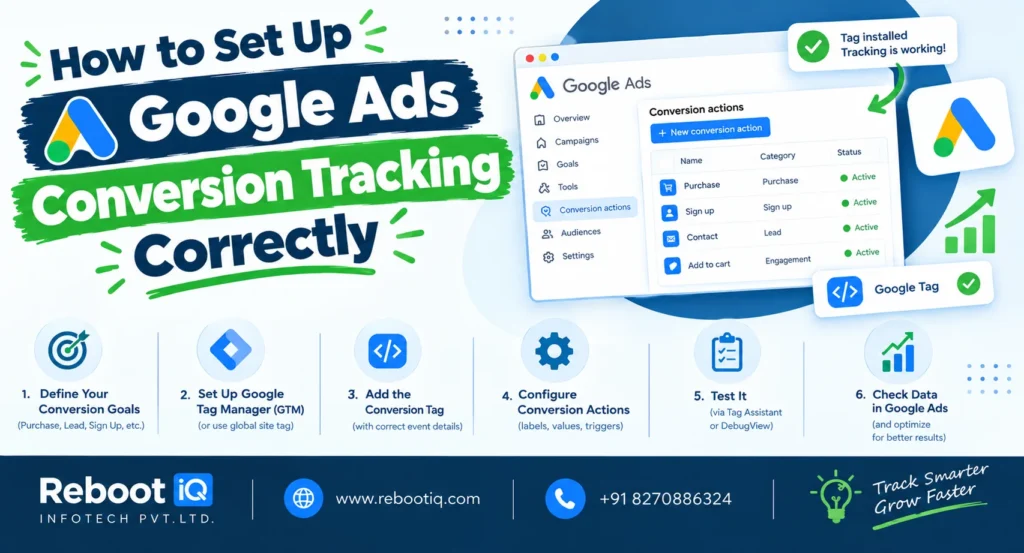
If you are running digital campaigns today, you already know that data is the new currency. However, data without direction is just noise. Google Ads conversion tracking is the essential bridge between a random click and a measurable business outcome. In the landscape of 2026, where privacy regulations are stricter and AI handles the heavy lifting of bidding, your tracking setup isn’t just a “nice-to-have” feature—it is the brain of your entire advertising account. Without a robust Google Ads conversion tracking strategy, you are essentially flying blind. You might see clicks increasing, but without knowing which specific keywords or creative assets led to a sale or a lead, you can’t scale effectively. This guide is designed to move beyond the basics. We will explore how Google Ads conversion tracking has evolved to prioritize high-quality signals, ensuring that Google’s machine-learning algorithms have the “truth” they need to find your next best customer. Whether you are a small business owner or a seasoned performance marketer, mastering this system is the single most important step you can take to move the needle on your ROI.  Why Google Ads Conversion Tracking is Essential for ROI in 2026  In the early days of digital marketing, tracking was a retrospective tool—a way to see what happened yesterday so you could make a guess about tomorrow. In 2026, the role of Google Ads conversion tracking has shifted from a rearview mirror to the high-performance engine of your account. Because modern bidding is almost entirely automated, your Google Ads conversion tracking setup is the primary way you “train” Google’s AI to identify your most profitable customers. The effectiveness of Smart Bidding strategies, such as Target ROAS (Return on Ad Spend) and Target CPA (Cost Per Acquisition), depends entirely on the quality of the signals they receive. If your Google Ads conversion tracking is inaccurate or missing data, the AI makes poor decisions, often chasing “cheap” clicks that never turn into revenue. By providing a clean stream of data through Google Ads conversion tracking, you allow the system to analyse millions of real-time signals—like user intent, device type, and time of day—to place the perfect bid in every auction.  Furthermore, Google Ads conversion tracking helps you distinguish between volume and value. Not every conversion is equal; a newsletter signup carries a different weight than a high-ticket purchase. High-performing advertisers in 2026 use Google Ads conversion tracking to assign specific values to different actions, enabling value-based bidding. This ensures that your budget is dynamically allocated toward the search terms and audiences that drive your ROI, rather than just inflating your conversion count with low-value interactions.  Different Ways to Implement Google Ads Conversion Tracking  When it comes to technical execution, there isn’t a “one-size-fits-all” method for Google Ads conversion tracking. The approach you choose depends on your website’s complexity and how much control you need over your data signals. In 2026, the industry has standardized around three primary paths, each offering distinct advantages for maintaining an accurate Google Ads conversion tracking setup.  The Google Tag (gtag.js)  The most direct method for Google Ads conversion tracking is the native Google Tag. Formerly known as the Global Site Tag, this is a single snippet of code you place in the <head> section of every page on your website. It works by setting new cookies on your domain to store unique identifiers for the ad clicks that lead users to your site. To make Google Ads conversion tracking work with this method, you also install a secondary “event snippet” on your confirmation or thank-you pages. This is often the preferred choice for smaller websites or businesses using simple platforms like Shopify, where the integration is virtually “plug and play.”  Google Tag Manager (GTM)  For most professional marketers, Google Tag Manager is the gold standard for managing Google Ads conversion tracking. GTM acts as a “middleman” or control centre; you install one GTM container on your site and then use its interface to deploy your Google Ads conversion tracking tags without ever touching the website’s source code again. This method provides unparalleled flexibility, allowing you to trigger Google Ads conversion tracking based on complex user behaviours—such as button clicks, video views, or scroll depth. In 2026, GTM also makes it easier to implement server-side tagging, which improves data accuracy by bypassing browser-based tracking limitations.  Importing GA4 Key Events  A third popular option is importing GA4 Key Events directly into your Google Ads conversion tracking dashboard. If you already have your goals defined in Google Analytics 4, you can link your accounts and pull those actions into Google Ads with a few clicks. While this is convenient and ensures consistency between your analytics and advertising data, many experts still recommend using the native Google Ads conversion tracking tag alongside GA4. The native tag often provides faster data processing and supports advanced features like Enhanced Conversions more natively, which are vital for real-time Smart Bidding adjustments.  Mastering Enhanced Conversions and Privacy  In 2026, the biggest challenge to Google Ads conversion tracking isn’t technical—it’s the decline of the third-party cookie. As browsers become more restrictive and privacy laws like GDPR and the DMA tighten, traditional “pixel-based” tracking is often blocked. This is where Enhanced Conversions become a critical part of your Google Ads conversion tracking strategy. Enhanced Conversions work by taking first-party data that your customers voluntarily provide—such as an email address or phone number during checkout—and hashing it using a secure algorithm called SHA-256. This process turns sensitive info into a string of random characters that cannot be reversed. When this hashed data is sent via your Google Ads conversion tracking tag, Google matches it against its own logged-in user database. This allows you to recover conversions that would have otherwise been “lost” due to cross-device behaviour or cookie blocking, often resulting in a 5% to 17% lift in reported conversions.  Furthermore, a compliant Google Ads conversion tracking setup in 2026 requires Consent Mode v2. This framework acts as a communication layer between your website’s cookie banner and Google’s tags. If a user denies consent, Google Ads conversion tracking doesn’t just stop; instead, it sends “cookieless pings.” These anonymous signals allow Google to use conversion modelling to estimate the gaps in your data. This is especially critical for Google Shopping campaigns, where accurate conversion data directly impacts bidding, ROAS, and feed optimization. By combining Enhanced Conversions with Consent Mode, you ensure your Google Ads conversion tracking

CRO Best Practices

The Definitive Guide to CRO Best Practices 2026 

In 2026, Conversion Rate Optimization has reached a turning point. What once revolved around quick fixes and surface-level experiments has evolved into a sophisticated discipline rooted in psychology, performance engineering, data intelligence, and trust-building. CRO best practices 2026 are no longer about manipulating users into clicking buttons; they are about designing experiences that respect intent, remove friction, and guide users naturally toward meaningful action.  As digital competition intensifies, attracting traffic alone is no longer a growth strategy. Brands that succeed today understand that visibility without conversion is wasted potential. While SEO and paid media bring users to your website, it is CRO best practices 2026 that determine whether those users become customers, subscribers, or long-term brand advocates. Modern CRO is holistic. It considers not just what users do, but why they do it. It blends technology with human behavior, ensuring that every interaction feels intuitive, credible, and purposeful. This guide explores how CRO best practices 2026 are reshaping digital growth and how businesses can implement them to build sustainable, scalable conversion systems.  CRO in 2026: From Optimization to Experience Design  In earlier years, CRO was often treated as a tactical layer applied after a website was built. Marketers would tweak headlines, test CTA colors, or adjust layouts in isolation. In contrast, CRO best practices 2026 position conversion optimization as a core business strategy embedded into product design, marketing, and customer experience. Users today are more informed and less tolerant of friction. They compare brands instantly, abandon slow interfaces without hesitation, and expect seamless experiences across devices. As a result, CRO has shifted from persuasion to facilitation. The role of optimization is no longer to convince users, but to remove obstacles that prevent them from acting on their existing intent. This evolution is why CRO best practices 2026 emphasize alignment—between messaging and reality, between user expectations and outcomes, and between brand promises and delivery.  Performance and Core Web Vitals: The First Conversion Barrier  Speed has become one of the most decisive factors in conversion success. No matter how compelling your offer is, users will not wait for a slow website to load. CRO best practices 2026 treat performance optimization as the foundation of every conversion strategy. With Google prioritizing Interaction to Next Paint (INP), responsiveness now plays a central role in how users perceive quality. Delays in interaction—whether clicking a button or opening a menu—create cognitive friction that disrupts trust. In practical terms, a site that feels slow also feels unreliable. To align with CRO best practices 2026, brands must adopt a mobile-first approach to performance. Pages should render primary content in under 1.2 seconds, images must be optimized intelligently, and unnecessary scripts should be eliminated. Performance is not just a technical metric; it is a psychological signal that influences whether users stay, explore, or abandon.  For businesses running paid campaigns, speed is even more critical. A fast-loading landing page ensures that your Google Ads or Display campaigns deliver maximum ROI, turning clicks into conversions rather than lost opportunities. When performance is prioritized, CRO efforts compound: faster websites reduce bounce rates, increase engagement, and create the conditions necessary for conversion to happen naturally. Trust as the Core Conversion Driver  Trust has become the single most powerful factor influencing conversion decisions. In an environment flooded with exaggerated claims and AI-generated content, users have learned to be skeptical. As a result, CRO best practices 2026 focus heavily on authenticity and transparency. Generic testimonials and stock imagery no longer carry weight. Instead, users look for evidence of real human experiences. Brands that succeed replace abstract claims with concrete proof—video testimonials, detailed case studies, authentic reviews, and user-generated content that demonstrates real-world usage.  Equally important is the placement of trust signals. CRO best practices 2026 recommend displaying reassurance precisely where doubt arises. Security badges near payment fields, social proof near CTAs, and guarantees near pricing sections reduce anxiety at critical moments. For e-commerce businesses running shopping campaigns, placing trust elements strategically can directly improve ad performance, ensuring clicks translate into sales rather than abandoned carts. This strategic reinforcement builds confidence without interrupting the user journey. By embedding trust throughout the experience, brands not only increase conversion rates but also strengthen long-term credibility. Ethical Persuasion and Behavioral Psychology  Persuasion still matters, but manipulation does not. One of the defining shifts in CRO best practices 2026 is the move away from artificial urgency and misleading scarcity. Users are increasingly aware of fake countdown timers and exaggerated claims, and these tactics now erode trust rather than enhance it. Instead, ethical persuasion focuses on clarity and relevance. Showing real-time demand, authentic availability, or genuine deadlines can still motivate action when used responsibly. The difference lies in honesty. When urgency reflects reality, it supports decision-making instead of pressuring it. Psychological principles such as loss aversion, social validation, and commitment still apply, but CRO best practices 2026 emphasize using them to help users make confident choices rather than rushed ones.  AI-Driven Personalization and Intent Matching  Personalization has become a defining feature of high-performing websites. Static experiences struggle to convert because they fail to address diverse user motivations. CRO best practices 2026 leverage artificial intelligence to adapt experiences dynamically based on intent, behavior, and context. A visitor arriving from a paid campaign expects different messaging than one arriving from an educational blog. AI-powered systems allow websites to adjust headlines, visuals, offers, and CTAs in real time, creating relevance without manual intervention.  Equally important is how data is collected. CRO best practices 2026 prioritize zero-party data—information users willingly share through quizzes, onboarding flows, and preference selectors. This consent-based approach strengthens trust while enabling meaningful personalization. When personalization is executed well, users feel understood rather than targeted. This emotional alignment increases engagement, improves Average Order Value, and enhances overall conversion performance.  Optimizing High-Intent Conversion Paths  Every unnecessary step in a conversion journey reduces the likelihood of completion. That is why CRO best practices 2026 place strong emphasis on simplifying user flows, especially for high-intent actions such as purchases, signups, or bookings. Clarity is critical. Within seconds of landing on a page, users should understand what is being offered, who it is for, and why it matters. Forms should ask only for essential information, checkout processes should minimize friction, and digital wallets should be integrated wherever possible.  For users not yet ready to

Google Remarketing 2026

Mastering Google Remarketing 2026: The Ultimate Strategy Guide 

Digital advertising has evolved at an incredible pace over the past decade, but one challenge has remained unchanged: most users don’t convert on their first visit. They browse, compare, get distracted, and leave. In the past, remarketing simply meant chasing those users across the internet with repetitive ads until they either converted—or became annoyed.  In Google Remarketing 2026, that approach no longer works.  Today, remarketing is about earning a second chance, not forcing one. It’s about using first-party data responsibly, respecting privacy expectations, and delivering ads that feel like helpful reminders rather than intrusive surveillance. As third-party cookies continue to disappear and consumer awareness around data usage increases, brands must rethink how they reconnect with past visitors.  The businesses that win in Google Remarketing 2026 are not the loudest advertisers. They are the ones that understand intent, timing, and trust—and know how to align those elements using Google’s AI-driven ecosystem. This guide walks through a modern, scalable approach to Google Remarketing 2026, covering everything from technical setup and data infrastructure to advanced audience segmentation, creative strategy, and performance measurement.  Preparing Your Account for Google Remarketing 2026  Before launching any remarketing campaign, your technical foundation must be flawless. In 2026, inaccurate tracking doesn’t just reduce performance—it actively misleads Google’s automation and wastes budget. Remarketing relies entirely on data quality. If your tracking is broken, incomplete, or inconsistent, Google’s algorithms will optimize toward the wrong signals. That’s why preparation is no longer optional—it’s the most critical phase of any remarketing strategy.  Conversion Tracking Accuracy  At the core of Google Remarketing 2026 is reliable conversion tracking. Your Google Ads conversion tags must correctly record every meaningful action on your site, whether that’s a purchase, a lead form submission, a phone call, or another high-value interaction. When conversion tracking is inaccurate or missing, remarketing audiences become distorted. You may end up retargeting users who already converted, excluding users who showed real intent, or training Google’s bidding algorithms with bad data. Over time, this compounds into poor performance and rising costs.  Google Tag Manager and Server-Side Tracking  Google Tag Manager (GTM) remains the standard tool for deploying tracking tags, but 2026 marks a clear shift toward server-side tracking. Unlike traditional browser-based tracking, server-side tagging sends data through your own server before passing it to Google. This approach improves reliability, reduces data loss from ad blockers, and aligns better with modern privacy standards. As browsers continue to limit third-party scripts, server-side tracking ensures your remarketing lists remain accurate and consistently populated.  Consent Mode v3 and Privacy Compliance  Privacy compliance is no longer a checkbox—it’s a performance factor. Consent Mode v3 allows Google to adapt tracking behavior based on a user’s consent choices. When users decline tracking, Google uses conversion modeling to estimate performance without collecting identifiable data. In Google Remarketing 2026, this balance between compliance and performance is essential. Brands that ignore consent signals risk legal issues, data gaps, and reduced campaign effectiveness. Those that implement Consent Mode correctly benefit from more stable optimization while respecting user choices.  First-Party Data Integration  First-party data has become one of the most valuable assets in digital advertising. Integrating your CRM with Google Ads allows you to upload customer lists, lead stages, and lifetime value data directly into the platform. This data helps Google distinguish between low-value visitors and high-intent prospects. In Google Remarketing 2026, first-party data acts as “seed intelligence,” allowing Google’s algorithms to prioritize users who resemble your best customers—not just anyone who visited your site.  Strategic Audience Segmentation in Google Remarketing 2026  One of the most common mistakes in remarketing is treating all visitors the same. In reality, not every user who visits your site has the same intent, awareness level, or readiness to buy. Effective remarketing in 2026 starts with segmentation based on behavior and intent, not just page views. High-intent visitors—those who viewed pricing pages, product pages, or checkout steps—are close to conversion. These users respond well to urgency-driven messaging, reassurance, and clear next steps.  Mid-funnel users, such as blog readers or case study viewers, need a different approach. They are still evaluating options and building trust. Educational ads, testimonials, and comparisons are far more effective than discounts at this stage. Past converters should rarely see acquisition-focused ads. Instead, remarketing for this group should focus on cross-selling, upselling, renewals, or re-engagement. Excluding recent converters from sales campaigns prevents wasted spend and improves user experience. Time-based segmentation adds another layer of sophistication. Users who visited in the last week are far more likely to convert than those who visited three months ago. As time passes, messaging should gradually shift from conversion-focused to brand reinforcement and recall.  Creative Strategy That Converts in 2026  Even the best audience strategy fails if your creative feels repetitive or irrelevant. In Google Remarketing 2026, creative freshness is a performance lever, not a branding exercise. Dynamic remarketing plays a major role here. By automatically showing users the exact products or services they viewed, dynamic ads create relevance at scale. However, these campaigns only perform well when paired with clean product feeds and accurate data. Beyond personalization, message sequencing is critical. Showing the same ad repeatedly leads to fatigue and declining performance. Instead, effective remarketing follows a progression: a reminder first, social proof second, and an incentive or urgency message later. Visually, simplicity wins. Minimalist creatives with a single message and clear call-to-action outperform cluttered designs. Users should immediately understand what you offer and why they should return.  Leveraging GA4 for Smarter Remarketing  Google Analytics 4 is no longer optional—it is the foundation of modern remarketing strategies. GA4’s event-based tracking allows marketers to build audiences based on meaningful engagement rather than shallow metrics. You can segment users by scroll depth, video engagement, session duration, or specific interactions that signal intent. Predictive audiences add another layer of intelligence. GA4 can identify users with a high probability of purchase or churn, allowing you to prioritize budget toward users most likely to convert. GA4’s identity modeling also improves cross-device visibility. Users often switch devices before converting, and GA4 helps maintain consistent remarketing messaging across those touchpoints.  Smart Bidding, Frequency Control, and Measurement  Manual bidding struggles to compete in Google Remarketing 2026. Smart bidding strategies like Target ROAS, Maximize Conversions, and value-based bidding allow Google to adjust bids in real time based on user intent and predicted value. Frequency control is equally important. Overexposure damages brand perception and wastes budget. Rotating creatives,

Google shopping Ads

Google Shopping Ads 2026: Scale with High-Intent Traffic 

Introduction: Why Google Shopping Ads Dominate E-commerce in 2026  The e-commerce landscape in 2026 looks fundamentally different from what it was just a few years ago. Consumers no longer rely on long research cycles or multiple comparison websites before making a purchase. Instead, they expect instant clarity, visual confirmation, transparent pricing, and relevant recommendations at the exact moment they decide to buy. This shift in consumer behavior is the primary reason Google Shopping Ads have emerged as the most dominant force in modern e-commerce advertising. What began as a simple product listing format has evolved into a sophisticated, AI-powered commerce ecosystem. Google Shopping Ads now appear across Google Search, Google Images, YouTube, Discover feeds, and even AI-generated search experiences. These ads no longer just assist shoppers—they actively guide purchasing decisions by placing products directly in front of users who are already displaying strong buying intent.  Unlike traditional text-based search ads, Google Shopping Ads present crucial product information upfront. Shoppers see the product image, price, brand, availability, and often reviews before they even click. This visual-first approach removes uncertainty from the buying process and significantly shortens the path from search to checkout. For e-commerce brands operating in 2026, a well-structured Google Shopping Ads strategy is not optional. It forms the backbone of visibility, competitiveness, and sustainable online revenue. As Google continues to integrate generative AI and conversational search into its platform, Shopping Ads play a critical role in bridging discovery and conversion. Whether a consumer searches using voice, image recognition, or AI-driven product recommendations, Google Shopping Ads ensure that the most relevant products appear at precisely the right moment. At their core, these ads are built around intent. Rather than guessing what users want, brands align their live inventory directly with real-time demand, transforming Google into a continuously converting digital storefront.  How Google Shopping Ads Work in 2026  To fully leverage Google Shopping Ads, it is essential to understand how they operate behind the scenes. Unlike traditional search advertising, which relies heavily on keywords and ad copy, Google Shopping Ads are driven primarily by product data. Google’s system analyzes the information provided in a product feed to determine when, where, and how often products appear in auctions.  In 2026, Google’s AI evaluates a wide range of signals before displaying a Shopping Ad. These signals include the relevance of the product title, the clarity and quality of product images, price competitiveness, historical performance data, and the overall trustworthiness of the website. As a result, success with Google Shopping Ads depends far more on feed accuracy and structure than on creative messaging alone. Shopping Ads appear when Google detects strong commercial intent. This intent may be expressed through traditional purchase-focused queries, visual searches using Google Lens, or AI-assisted product discovery prompts. When such intent is identified, Google prioritizes Shopping Ads over standard text ads because they provide immediate value to the user. This prioritization is what makes Shopping Ads the dominant ad format for e-commerce businesses in 2026.  Setting Up Google Merchant Center for Long-Term Success  Every successful Google Shopping Ads campaign begins with a properly configured Google Merchant Center account. Merchant Center serves as the foundation of the entire Shopping Ads ecosystem. It is where Google stores, validates, and evaluates product data before making it eligible for advertising. The setup process starts with verifying and claiming your website. Google requires confirmation that the advertiser owns and operates a legitimate e-commerce store. This verification can be completed through methods such as HTML tags, Google Analytics, or Google Tag Manager. Once verified, claiming the website ensures that no other Merchant Center account can misuse your domain.  After verification, configuring shipping and tax settings becomes critical. Accuracy in these settings is non-negotiable in 2026. Google cross-checks Merchant Center data against the website experience. Any mismatch between advertised pricing, shipping costs, or delivery timelines can result in reduced visibility or product disapproval. Maintaining alignment between your website and Merchant Center helps build the trust signals that Google’s algorithms increasingly rely on. Linking Google Merchant Center with Google Ads is the next step. This connection allows product data to flow directly into Shopping campaigns and enables the creation of Standard Shopping and Performance Max campaigns. Without this integration, Google Shopping Ads cannot run. One of the most important yet often overlooked areas of Merchant Center is the Diagnostics section. This area highlights feed issues such as price inconsistencies, broken image links, missing attributes, or policy violations. Regularly monitoring diagnostics prevents wasted ad spend and ensures uninterrupted campaign performance.  In 2026, automation plays a major role in maintaining feed accuracy. Features like Automatic Item Updates allow Google to crawl your website and update prices and availability in real time. This automation reduces the risk of poor user experiences and ensures that ads remain accurate even as inventory changes.  Advanced Product Feed Optimization in 2026  Product feed optimization is the single most influential factor in Google Shopping Ads performance. Google relies on feed data to determine relevance, visibility, and competitiveness within auctions. Product titles carry the most weight. Google does not interpret product pages the way humans do; instead, it uses titles as the primary source of context. Well-structured titles that include brand names, product types, and essential attributes significantly improve matching with high-intent search queries. In 2026, vague or generic titles are one of the fastest ways to lose impression share.  Product descriptions further reinforce relevance by providing contextual information. While descriptions do not carry the same weight as titles, they help Google understand product usage, compatibility, and features. Clear, informative descriptions improve both ad eligibility and user confidence. Images have become increasingly important as Shopping Ads expand into visual-first placements. High-resolution images with clean backgrounds and accurate representations of the product dramatically improve click-through rates. Google’s AI now evaluates image clarity and consistency as part of its ranking process.  Accurate categorization also plays a crucial role. Assigning the correct Google Product Category helps Google understand where and when to show products. Custom product types, while not visible to users, enable better internal segmentation and campaign structuring. Pricing strategy directly influences competitiveness. Google Shopping Ads are inherently price-sensitive, and products priced significantly above market averages may receive fewer impressions or higher cost-per-click. In 2026, successful advertisers use pricing intelligence to remain competitive while differentiating through bundles, promotions, or value-added offers. Structuring Google Shopping Campaigns for Scalability   Campaign

Youtube advertising

YouTube Advertising in 2026: Why Serious Brands Can No Longer Ignore Video 

Introduction: The Shift Is Complete  There was a time when video marketing was considered optional—a “nice to have” channel that brands experimented with once their core marketing was in place. That time is over. In 2025, video is not a format; it is the default way people consume information online. And within video, YouTube dominates attention, intent, and discovery in a way no other platform does.  With more than 2.5 billion monthly active users, YouTube is no longer just a content platform. It is the second-largest search engine in the world, deeply integrated into Google’s ecosystem and embedded into daily consumer behavior. People don’t just scroll YouTube casually—they arrive with purpose. They search for reviews before buying, tutorials before learning, and comparisons before making decisions. This behavior makes YouTube advertising uniquely powerful because it captures users at moments of genuine intent.  For businesses, this changes everything. YouTube advertising is no longer about visibility alone; it is about influence. It allows brands to combine the emotional strength of video with Google’s unparalleled data on search behavior, interests, and purchase signals. In 2025, if your brand is not present where people are watching, learning, and deciding, you are not invisible—you are irrelevant.  Why YouTube Advertising Is Fundamentally Different from Social Media Ads  Many businesses lump YouTube ads together with other social media advertising platforms, but this is a strategic mistake. While YouTube shares some surface similarities with platforms like Instagram or Facebook, the underlying user intent is entirely different. On most social platforms, users are in discovery or entertainment mode. Ads interrupt scrolling behavior. On YouTube, ads integrate into a search-driven environment. Users actively choose what to watch, often based on a specific problem they want to solve. This means YouTube advertising aligns far more closely with decision-making moments than with passive content consumption.  Additionally, YouTube ads run through Google Ads for video, which gives advertisers access to Google’s vast behavioral data. This includes search history, website activity, app usage, location signals, and purchase intent. When combined with video storytelling, this data allows advertisers to reach people not just based on who they are, but based on what they are actively trying to do.  This combination—high intent plus emotional storytelling—is what makes YouTube advertising so effective and so difficult to replace with any other channel.  Understanding How YouTube Advertising Works in 2025  At a technical level, YouTube advertising operates through the Google Ads platform. This integration is critical because it means advertisers are not limited to platform-level interests or demographics. Instead, they can build campaigns around real-world behaviors and signals. When an ad is served, Google evaluates hundreds of data points in real time. These include the video being watched, the viewer’s recent searches, their past interactions with ads, and even predictive indicators about where they are in the buying journey. This allows YouTube ads to appear at moments when viewers are most receptive.  Importantly, YouTube advertising is not limited to brand awareness. While many businesses still view it as a top-of-funnel channel, that perception is outdated. In 2025, YouTube is increasingly used for lead generation, product launches, retargeting, and even direct sales. The platform has evolved from exposure-driven advertising to performance-driven marketing.  Choosing the Right YouTube Ad Format for Your Business Goals  One of the biggest mistakes advertisers make is choosing ad formats based on preference rather than objective. Each YouTube ad format is designed to serve a specific purpose, and understanding these differences is essential for success. Skippable in-stream ads remain the backbone of most YouTube advertising strategies. These ads give viewers the option to skip after five seconds, which may seem like a disadvantage, but it is actually a strength. You only pay when users choose to continue watching, which means your budget is spent on people who show genuine interest. This format is ideal for storytelling, product education, and retargeting because it allows flexibility in length and messaging.  Non-skippable in-stream ads, limited to 15 seconds, offer guaranteed exposure but require discipline. Because viewers cannot skip, tolerance is lower. These ads work best for strong, simple messages such as brand positioning, limited-time offers, or major announcements. When used incorrectly, they can damage brand perception. When executed well, they deliver unmatched recall. In-feed video ads occupy a unique position within YouTube advertising. Instead of interrupting content, they appear alongside search results and recommendations. Users actively choose to watch these videos, making this format particularly effective for educational content, product comparisons, and high-intent audiences. In-feed ads often attract viewers who are closer to making a decision, which makes them especially valuable for mid- and bottom-funnel strategies. Bumper ads, limited to six seconds, are not designed to explain anything. Their purpose is repetition and reinforcement. They are most effective when used as part of a broader campaign, supporting longer ads and increasing brand recall through frequency.  Finally, YouTube Shorts ads have become unavoidable in 2025. With mobile-first consumption dominating video behavior, Shorts provide a way to reach audiences quickly and repeatedly. However, this format demands clarity and simplicity. There is no room for nuance—either the message lands instantly, or it fails.  The Real Advantage: Intent-Based Targeting on YouTube  What truly separates YouTube advertising from most digital channels is intent-based targeting. Instead of guessing what users might like, advertisers can reach people based on what they are actively searching for, researching, or planning to buy. Keyword targeting allows ads to appear alongside videos related to specific search terms or topics. This is particularly effective for industries where education and research precede purchase decisions, such as electronics, services, or high-consideration products.  Custom intent audiences take this a step further. Advertisers can target users based on recent Google searches, website visits, or app activity. This means you can reach people who have already demonstrated buying intent, even if they have never interacted with your brand before.  In-market audiences allow brands to target users who Google has identified as being close to making a purchase in specific categories. These audiences are built using predictive modeling, making them far more accurate than traditional interest-based targeting.  Remarketing remains one of the most powerful uses of YouTube advertising. By re-engaging website visitors, past customers, or previous video viewers, brands can reinforce messages and guide prospects further down the funnel. In many cases, remarketing campaigns deliver the highest return

Send us a message