There was a time when a business website acted like an online brochure. It displayed a few pages, listed contact details, and gave customers a place to learn a little about the company. Those days are long gone.
Today, your website has a much bigger responsibility.
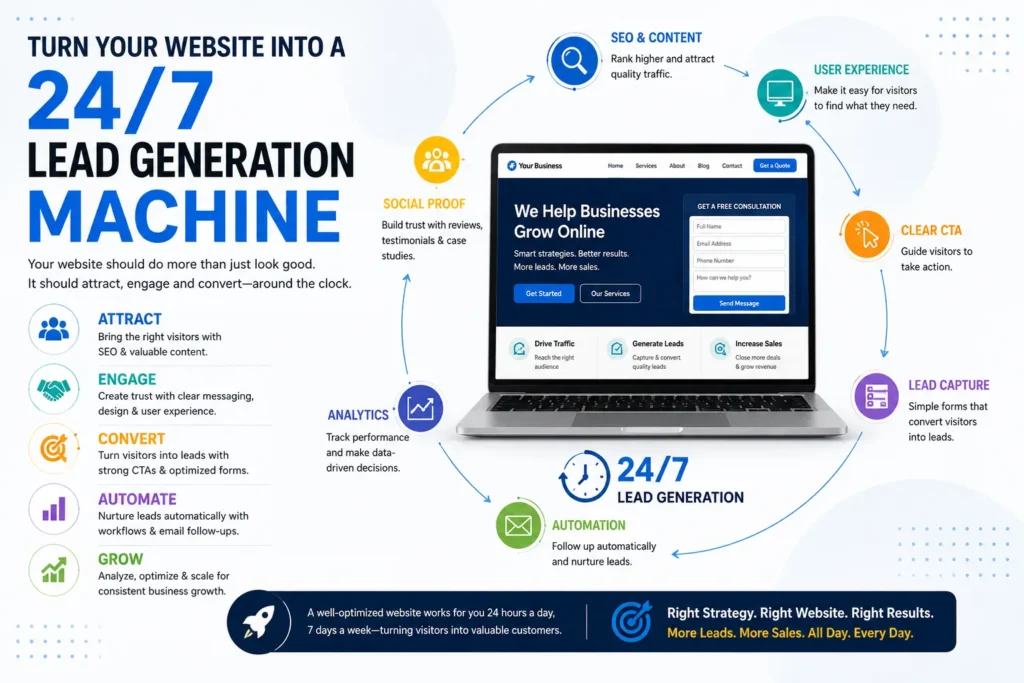
It should attract visitors through search engines, answer their questions, build confidence in your brand, and encourage them to contact you—all without someone from your team being involved.
That’s what makes a website a lead generation machine.
The interesting part is that this doesn’t happen because of one clever design trick or a flashy homepage. It happens because dozens of small decisions work together to create a better experience for your visitors.
If your website is getting traffic but very few enquiries, or if you’re investing in marketing without seeing consistent results, it may be time to rethink how your website is working for your business.
Let’s look at what actually makes the difference.
Your Website Should Guide Visitors, Not Leave Them Guessing
Imagine walking into a retail store where nobody greets you, there are no signs, and you can’t figure out where anything is. Chances are you’d leave within a few minutes.
The same thing happens online.
Many business websites overwhelm visitors with too much information or make it difficult to understand what the company actually offers. If someone has to search for your services or hunt for your contact details, you’ve already made things harder than they should be.
Visitors should immediately understand three things within the first few seconds:
- Who you are
- What problem you solve
- What they should do next
A clear headline, a simple navigation menu, and a visible call-to-action often perform far better than complicated animations or excessive design elements.
Remember, clarity converts.
Speed Matters More Than Most Businesses Realize
People are impatient online.
Even a beautifully designed website won’t generate leads if it takes too long to load. Every extra second increases the chance that a visitor will leave before exploring your services.
Fast websites don’t just improve user experience—they also send positive signals to search engines.
Simple improvements such as optimizing images, reducing unnecessary scripts, using reliable hosting, and enabling caching can make a noticeable difference.
Your visitors may never compliment your website for being fast, but they’ll certainly notice when it isn’t.
Stop Talking About Yourself
One of the most common mistakes businesses make is filling every page with “We.”
“We have 15 years of experience.”
“We provide quality services.”
“We are experts.”
While experience matters, visitors are usually thinking about something else:
“Can this company solve my problem?”
Instead of focusing entirely on your business, focus on your customer’s situation.
For example:
Instead of saying:
“We provide professional digital marketing services.”
Try saying:
“Looking for more enquiries from Google and social media? Our digital marketing strategies help businesses attract qualified customers instead of just increasing website traffic.”
It’s a subtle shift, but it changes the conversation from your business to your customer’s needs.
Helpful Content Builds Trust Before Sales Calls Do
Think about the last major purchase you made.
You probably searched Google, compared options, read reviews, and looked for answers before speaking with anyone.
Your customers behave exactly the same way.
Every useful blog, FAQ, guide, or case study on your website helps answer a question your potential customer already has.
That’s why businesses that publish helpful content consistently often generate better-quality leads.
Good content isn’t about showing how much you know.
It’s about making your audience feel that they have found someone who understands their problem.
For example, a company offering website development services could publish articles such as:
- Why Your Website Isn’t Generating Enquiries
- Common Website Mistakes That Cost Businesses Customers
- How to Improve Website Speed Without Redesigning Everything
These topics attract people who are already looking for solutions.
Every Page Should Have One Clear Goal
A surprising number of websites ask visitors to do nothing.
Someone reads an entire service page and reaches the bottom with no obvious next step.
Every important page should gently guide visitors toward an action.
That action could be:
- Request a quote
- Book a consultation
- Schedule a demo
- Contact your team
- Download a brochure
The goal isn’t to pressure visitors.
It’s simply to make the next step obvious.
People Trust PeopleNo matter how attractive your website looks, visitors will naturally ask themselves one question:“Can I trust this business?”This is where social proof becomes incredibly valuable.Real customer reviews, testimonials, successful projects, Google ratings, and client logos reassure visitors that others have already chosen your business with confidence.If possible, include genuine customer feedback that explains the result, not just the experience.Instead of:“Excellent service.”Something like this is far more convincing:“Within three months of redesigning our website, enquiries almost doubled, and we started receiving better-quality leads.”
Specific experiences always feel more authentic.Keep Contacting You Effortless
Businesses sometimes create long enquiry forms because they want more information.
Ironically, asking for too much often results in fewer enquiries.
Most visitors are comfortable sharing:
- Name
- Email address
- Phone number
- Short message
That’s enough to start the conversation.
You can always gather additional details later.
Reducing friction is one of the easiest ways to improve conversions.
Mobile Experience Is No Longer Optional
Open your own website on your phone.
Can you easily read the text?
Are buttons large enough to tap?
Does the contact form work properly?
More than half of website traffic now comes from mobile devices. A website that performs well on desktop but poorly on mobile quietly loses business every day.
A responsive design isn’t a feature anymore—it’s an expectation.
SEO Brings Visitors Long After Advertising Stops
Paid advertising certainly has its place.
But the moment you stop spending money, the traffic usually stops too.
SEO works differently.
When your website ranks well for relevant searches, people continue discovering your business without clicking on an advertisement.
This doesn’t happen overnight.
SEO is a long-term investment built on quality content, technical optimization, fast performance, and answering real customer questions.
Businesses that commit to SEO consistently often benefit from steady, sustainable traffic instead of relying entirely on paid campaigns.
Measure What Matters
Many businesses celebrate website traffic.
Traffic is encouraging, but it isn’t the goal.
A website attracting 500 qualified visitors can outperform another receiving 10,000 irrelevant ones.
Instead of focusing only on visitor numbers, monitor metrics like:
- Contact form submissions
- Phone calls
- Quote requests
- Consultation bookings
- Average time on page
- Conversion rate
These numbers tell you whether your website is actually helping your business grow.
Small Improvements Create Big Results
Some business owners believe they need a complete redesign to generate more leads.
Often, that’s not true.
Sometimes the biggest improvements come from relatively small changes:
A stronger headline.
A faster loading page.
A better call-to-action.
Simpler navigation.
Updated content.
Fresh customer testimonials.
Over time, these improvements work together to create a website that’s easier to find, easier to trust, and easier to contact.
Final Thoughts
A website shouldn’t just exist because every business is expected to have one.
It should actively contribute to your growth.
When built with your customers in mind, a website quietly works every hour of the day—answering questions, building confidence, and turning interested visitors into genuine business enquiries.
That doesn’t happen because of one magical marketing tactic. It happens through consistent attention to user experience, search engine optimization, useful content, and thoughtful design.
At Rebootiq, we believe a successful website isn’t measured by how impressive it looks—it’s measured by the opportunities it creates. Whether you’re building a new website or improving an existing one, focusing on your visitors first is the most reliable way to create a website that keeps generating leads long after it’s published.
Frequently Asked Questions
How long does it take for a website to start generating leads?
It depends on factors such as SEO, competition, content quality, and your marketing efforts. Businesses investing consistently in SEO often begin seeing meaningful improvements over several months.
Is SEO better than paid advertising?
They work best together. Paid advertising can generate immediate visibility, while SEO builds long-term organic traffic that continues delivering value over time.
What is the biggest mistake businesses make with their websites?
Many focus on aesthetics while overlooking usability. Visitors are more likely to convert when a website is fast, easy to navigate, and clearly explains how the business can solve their problem.
Do blogs really help generate leads?
Yes. Helpful, well-written blogs attract people searching for answers, improve search engine visibility, and establish credibility before a customer contacts your business.
How often should I update my website?
Review your website regularly. Refresh service pages when offerings change, publish new blog content consistently, and update testimonials or case studies whenever you achieve new results.