On-Page SEO vs Off-Page SEO: Which Matters More in 2026?
Introduction
If you’ve ever explored search engine optimization (SEO), you’ve probably encountered two essential terms: On-Page SEO vs Off-Page SEO. While both aim to improve your website’s visibility in search engines, they focus on different aspects of optimization.
Many business owners ask, “Should I focus on optimizing my website first, or should I spend more time building backlinks?” The truth is that successful SEO isn’t about choosing one over the other—it’s about understanding how both work together.
Think of your website as a business. On-Page SEO is everything you control within your business, such as the quality of your products, the organization of your store, and the experience you provide customers. Off-Page SEO is your reputation—what other people say about your business, how often they recommend it, and how much trust you have built in the industry.
In this guide, we’ll compare On-Page SEO and Off-Page SEO, explain their differences, explore their advantages, and show you how to create a balanced SEO strategy that performs well in both traditional search engines and AI-powered search platforms.
What Is On-Page SEO?
On-Page SEO refers to all the optimization activities performed within your website to improve its relevance, usability, and search engine visibility.
Everything that users and search engines experience directly on your website falls under On-Page SEO.
Key elements include:
- High-quality content
- SEO-friendly titles
- Meta descriptions
- Heading structure (H1, H2, H3)
- URL optimization
- Internal linking
- Image optimization
- Keyword placement
- Mobile responsiveness
- Page speed
- Schema markup
- User experience (UX)
These elements help search engines understand your content while providing visitors with a better browsing experience.
Why On-Page SEO Matters
Even the strongest backlink profile cannot compensate for a poorly optimized website.
When your pages are well-structured and provide valuable information, search engines can crawl, index, and rank them more effectively.
Benefits of On-Page SEO include:
- Better keyword relevance
- Improved user experience
- Higher click-through rates
- Faster page loading
- Lower bounce rates
- Better AI search understanding
- Increased conversion opportunities
Strong On-Page SEO builds the foundation for long-term organic growth.
What Is Off-Page SEO?
Off-Page SEO includes all activities that take place outside your website to improve its authority, trustworthiness, and online reputation.
Instead of changing your website itself, Off-Page SEO focuses on how other websites and online platforms interact with your brand.
Common Off-Page SEO techniques include:
- High-quality backlinks
- Guest posting
- Digital PR
- Brand mentions
- Local citations
- Google Business Profile optimization
- Social media engagement
- Influencer collaborations
- Online reviews
- Community participation
These external signals help search engines determine whether your website is trustworthy and authoritative.
Why Off-Page SEO Matters
Search engines consider backlinks and brand authority as important ranking signals.
When reputable websites mention or link to your content, it acts as a vote of confidence, indicating that your information is valuable and reliable.
Benefits of Off-Page SEO include:
- Increased domain authority
- Higher search rankings
- Greater brand visibility
- More referral traffic
- Improved online credibility
- Stronger trust signals
- Better competitive positioning
Off-Page SEO helps establish your website as a respected source within your industry.
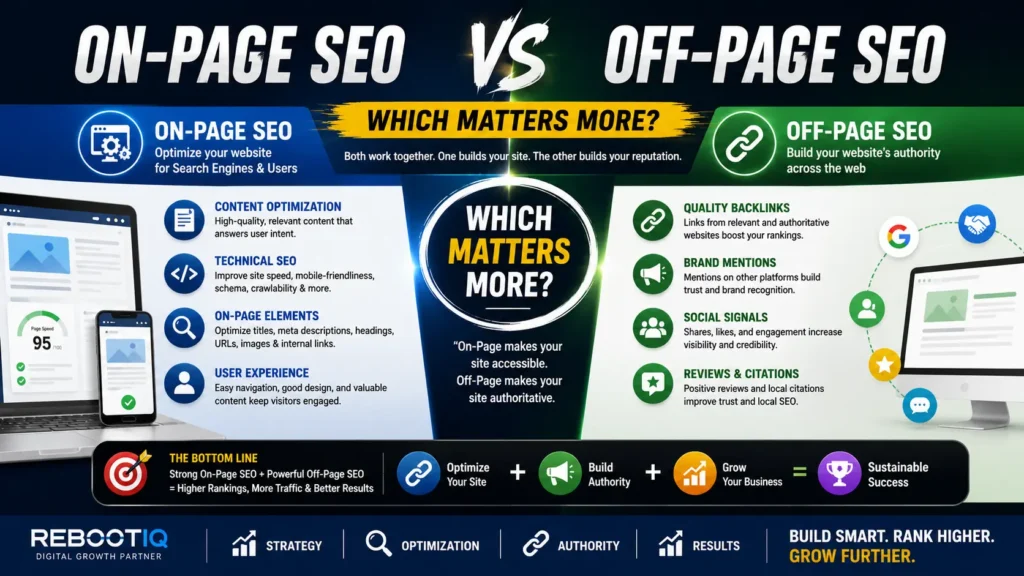
On-Page SEO vs Off-Page SEO: Key Differences
| Feature | On-Page SEO | Off-Page SEO |
|---|---|---|
| Location | Within your website | Outside your website |
| Main Goal | Improve relevance and user experience | Build authority and trust |
| Controlled By | Website owner | External websites and platforms |
| Key Activities | Content, keywords, internal links, technical optimization | Backlinks, guest posts, brand mentions, reviews |
| Impact | Helps search engines understand your content | Helps search engines trust your content |
Which Should You Focus on First?
If you’re starting a new website, begin with On-Page SEO.
Publishing valuable content, optimizing page structure, improving speed, and ensuring technical health create a strong foundation. Once your website is optimized, invest in Off-Page SEO to build authority through quality backlinks and brand mentions.
Without a solid On-Page foundation, Off-Page efforts are less effective. Likewise, without Off-Page signals, even great content may struggle to compete in competitive search results.
Complete On-Page SEO Checklist
A strong On-Page SEO strategy ensures that every page on your website is optimized for both users and search engines.
1. Optimize Your SEO Title
Your SEO title is one of the first things users notice in search results.
Best practices:
- Place the focus keyword near the beginning.
- Keep the title between 50–60 characters.
- Make it engaging and relevant.
- Ensure each page has a unique title.
Example:
On-Page SEO vs Off-Page SEO: Which Matters More in 2026?
2. Write a Compelling Meta Description
Although meta descriptions are not a direct ranking factor, they improve click-through rates.
Include:
- Focus keyword
- Clear summary
- Action-oriented language
- Around 150–160 characters
3. Create High-Quality Content
Search engines reward content that genuinely helps users.
Your content should be:
- Original
- Accurate
- Well-researched
- Easy to understand
- Regularly updated
Avoid writing solely for search engines—write for people first.
4. Use Proper Heading Structure
Organize your content using:
- One H1
- Multiple H2 headings
- Supporting H3 sections
A logical structure improves readability and helps search engines understand your content hierarchy.
5. Optimize URLs
A clean URL is easier for users and search engines to understand.
Good Example
yourdomain.com/on-page-seo-vs-off-page-seo
Avoid
yourdomain.com/page?id=7892
6. Improve Internal Linking
Internal links connect related pages across your website.
Benefits include:
- Better crawlability
- Improved user navigation
- Increased session duration
- Stronger topical authority
Example:
This article can link to:
- SEO Audit Checklist
- Technical SEO Guide
- GEO Explained
- Keyword Research Guide
7. Optimize Images
Every image should include:
- Descriptive filename
- Alt text
- Proper compression
- Responsive dimensions
- Modern formats like WebP
Image SEO improves accessibility and page performance.
8. Improve Page Speed
A fast-loading website enhances user experience and supports better rankings.
Ways to improve speed:
- Compress images
- Minify CSS and JavaScript
- Use browser caching
- Enable lazy loading
- Choose quality hosting
9. Make Your Website Mobile-Friendly
Most users browse on mobile devices.
Ensure:
- Responsive layouts
- Readable text
- Touch-friendly buttons
- Fast loading on mobile
10. Add Schema Markup
Schema helps search engines better understand your content.
Useful schema types include:
- Article
- FAQ
- Organization
- Breadcrumb
- Service
Structured data can improve search appearance and AI understanding.
Complete Off-Page SEO Checklist
While On-Page SEO improves your website itself, Off-Page SEO strengthens your online authority.
1. Build High-Quality Backlinks
Backlinks remain one of the strongest ranking signals.
Focus on:
- Relevant websites
- Authoritative domains
- Natural link acquisition
- Editorial backlinks
Avoid buying low-quality links.
2. Guest Posting
Publishing valuable articles on trusted industry websites can:
- Increase visibility
- Build authority
- Drive referral traffic
- Earn quality backlinks
Prioritize quality over quantity.
3. Build Brand Mentions
Search engines increasingly recognize unlinked brand mentions as trust signals.
Encourage mentions through:
- PR campaigns
- Industry publications
- Interviews
- Podcasts
- Social media
4. Optimize Google Business Profile
For local businesses, maintaining an optimized Google Business Profile is essential.
Include:
- Accurate contact details
- Business hours
- Photos
- Customer reviews
- Service information
5. Earn Customer Reviews
Positive reviews build trust with both users and search engines.
Respond professionally to all reviews, whether positive or negative.
6. Social Media Engagement
While social media links are generally not direct ranking factors, they help:
- Increase brand awareness
- Drive website traffic
- Encourage content sharing
- Build audience trust
7. Participate in Industry Communities
Contribute valuable insights to:
- Professional forums
- LinkedIn discussions
- Relevant online communities
- Industry webinars
Focus on helping users rather than self-promotion.
Common SEO Mistakes
Avoid these common issues:
❌ Keyword stuffing
❌ Duplicate content
❌ Slow page speed
❌ Broken internal links
❌ Missing meta descriptions
❌ Thin content
❌ Ignoring mobile optimization
❌ Low-quality backlinks
❌ Neglecting technical SEO
❌ Publishing without a content strategy
Which Delivers Faster Results?
On-Page SEO often produces improvements more quickly because you have direct control over your website. Updating titles, improving content, optimizing images, and enhancing site speed can positively impact performance in a relatively short time.
Off-Page SEO generally takes longer. Building authority through quality backlinks, brand mentions, and digital PR requires consistent effort and trusted relationships, but these signals contribute significantly to long-term rankings.
The best results come from combining both strategies rather than relying on one alone.
SEO in the Age of AI
Modern search is evolving beyond traditional ranking signals.
AI-powered search systems evaluate:
- Content quality
- Topical authority
- Clear structure
- User intent
- Expertise
- Trustworthiness
- Helpful answers
On-Page SEO helps AI understand your content, while Off-Page SEO strengthens your website’s credibility through external validation.
Websites that excel in both areas are better positioned for visibility in AI-driven search experiences.
So, Which Matters More: On-Page SEO or Off-Page SEO?
The honest answer is both.
On-Page SEO and Off-Page SEO serve different purposes, and one cannot replace the other.
Think of your website as opening a new business.
- On-Page SEO ensures your business is well-organized, informative, and provides a great experience for visitors.
- Off-Page SEO builds your reputation by earning recommendations, reviews, and trust from others.
A website with excellent On-Page SEO but no authority may struggle to rank for competitive keywords. Likewise, a website with many backlinks but poor content and technical issues will find it difficult to maintain rankings.
The strongest SEO strategy combines both.
If You’re Launching a New Website
Prioritize:
- Technical SEO
- Content optimization
- Page speed
- Mobile responsiveness
- Internal linking
- Schema markup
Once your foundation is solid, begin building authority through quality backlinks, guest posting, local SEO, and digital PR.
Expert Recommendation
At RebootIQ, we recommend treating SEO as a long-term investment rather than a checklist.
Businesses that consistently publish helpful content, optimize their websites, and build genuine authority are far more likely to achieve lasting search visibility.
With the rise of AI-powered search, success depends not only on ranking well but also on becoming a trusted source that search engines and AI systems confidently reference.
Conclusion
The debate between On-Page SEO vs Off-Page SEO isn’t about choosing a winner—it’s about understanding how both contribute to search success.
On-Page SEO helps search engines understand your website, improves user experience, and creates a solid technical foundation.
Off-Page SEO strengthens your website’s credibility, authority, and reputation across the web.
Businesses that invest in both strategies are better positioned to achieve higher rankings, attract qualified traffic, and remain competitive as search continues to evolve.
As search engines increasingly rely on AI to deliver answers, websites that combine high-quality content with strong authority signals will have the greatest opportunity to stand out.
Frequently Asked Questions (FAQs)
1. What is the difference between On-Page SEO and Off-Page SEO?
On-Page SEO focuses on optimizing elements within your website, such as content, headings, images, and technical performance. Off-Page SEO focuses on external signals like backlinks, brand mentions, reviews, and online authority.
2. Which is more important for SEO?
Both are equally important. On-Page SEO provides the foundation for search visibility, while Off-Page SEO builds trust and authority that help improve rankings.
3. Can I rank with only On-Page SEO?
You may rank for low-competition keywords with strong On-Page SEO, but competitive keywords generally require Off-Page SEO efforts such as quality backlinks and brand authority.
4. Do backlinks still matter in 2026?
Yes. High-quality, relevant backlinks remain an important ranking factor. However, search engines increasingly prioritize link quality over quantity.
5. Is internal linking part of On-Page SEO?
Yes. Internal linking is a key On-Page SEO practice that improves website navigation, distributes page authority, and helps search engines discover related content.
