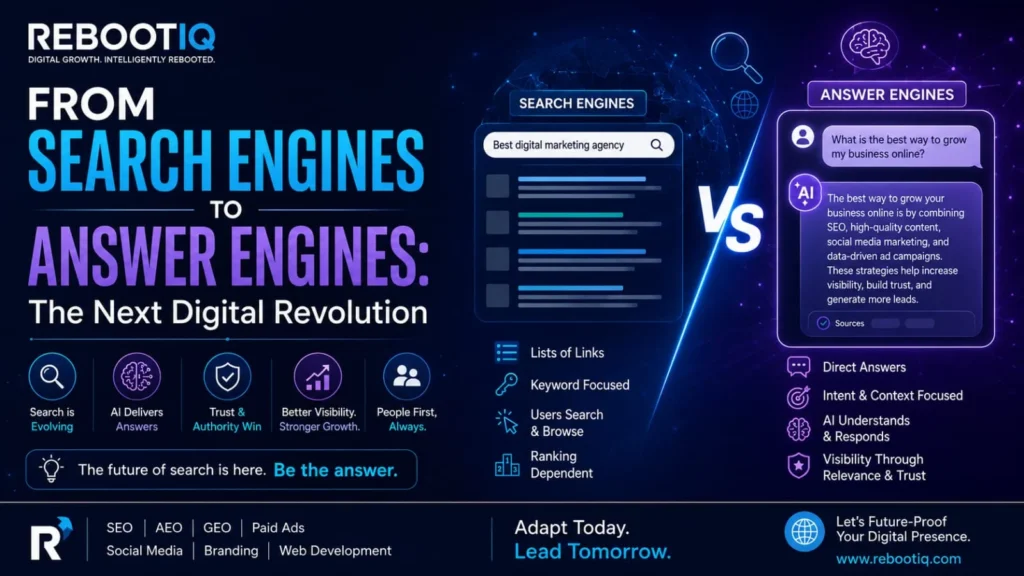
From Search Engines to Answer Engines: The Next Digital Revolution
Introduction
For more than two decades, search engines have shaped the way people access information online. Whether someone wanted to find a nearby restaurant, compare products, or learn a new skill, the process was simple: type a few keywords into a search engine and browse through a list of websites.
That experience is now changing.
Artificial Intelligence has introduced a new way of searching. Instead of providing a page filled with links, AI-powered platforms deliver direct, conversational answers. Users no longer need to visit multiple websites to find information. They simply ask a question and receive a detailed response within seconds.
This shift has given rise to Answer Engines—AI-powered systems designed to understand natural language, interpret intent, and generate meaningful responses.
For businesses, marketers, and website owners, this is more than a technological upgrade. It represents a fundamental change in how people discover information online. Companies that continue relying only on traditional SEO may gradually lose visibility as users adopt AI-powered search experiences.
Understanding this transformation is the first step toward staying competitive in the future of digital marketing.
What Are Search Engines?
Traditional search engines such as Google and Bing are designed to help users discover relevant web pages.
When someone enters a query, the search engine scans billions of indexed pages and ranks them based on factors like relevance, authority, page quality, backlinks, and user experience. The user then chooses which result to visit.
For example, if someone searches:
Best digital marketing agency for small businesses
Google displays multiple results, advertisements, maps, and featured snippets. The user still needs to compare different websites before making a decision.
Traditional search engines focus on helping users find information.
What Are Answer Engines?
Answer Engines work differently.
Instead of returning a list of links, they generate complete answers by combining information from reliable and relevant sources.
Popular examples include:
- ChatGPT
- Google AI Overviews
- Google Gemini
- Microsoft Copilot
- Perplexity AI
These platforms analyze the user’s question, understand its context, evaluate available information, and present a concise response that addresses the query directly.
Rather than asking users to search through websites, Answer Engines aim to provide immediate value.
Why Is Search Changing?
Several factors are driving this evolution.
People Want Faster Answers
Modern users expect information instantly. They no longer want to open multiple tabs or compare dozens of articles before finding an answer.
AI-powered systems reduce this effort by delivering summarized, easy-to-understand responses.
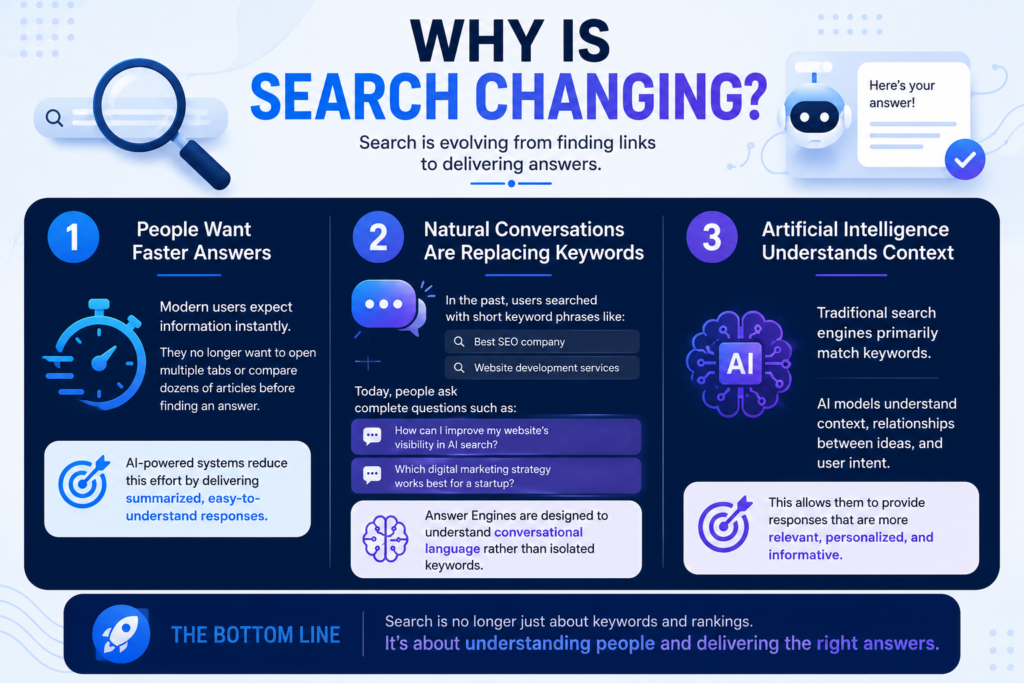
Natural Conversations Are Replacing Keywords
In the past, users searched with short keyword phrases like:
- Best SEO company
- Website development services
Today, people ask complete questions such as:
- How can I improve my website’s visibility in AI search?
- Which digital marketing strategy works best for a startup?
Answer Engines are designed to understand conversational language rather than isolated keywords.
Artificial Intelligence Understands Context
Traditional search engines primarily match keywords.
AI models understand context, relationships between ideas, and user intent.
This allows them to provide responses that are more relevant, personalized, and informative.
Search Engines vs Answer Engines
Although both technologies help users find information, they work in very different ways.
| Search Engines | Answer Engines |
|---|---|
| Display a list of web pages | Generate direct answers |
| Keyword-focused | Intent-focused |
| Users compare multiple websites | Users receive a summarized response |
| Success measured by rankings | Success measured by usefulness and relevance |
| Optimized through SEO | Optimized through Answer Engine Optimization (AEO) and high-quality content |
Businesses should view these systems as complementary rather than competing technologies.
Why This Digital Revolution Matters
The shift toward Answer Engines is changing user behavior.
Instead of spending several minutes browsing websites, users now expect answers in seconds. This affects how businesses attract traffic, build trust, and generate leads.
Websites that provide clear, structured, and authoritative information are more likely to influence AI-generated responses.
For digital marketers, this means content strategy must evolve beyond traditional SEO techniques.
Visibility is no longer determined only by where your website ranks. Increasingly, it depends on whether AI systems recognize your content as reliable enough to reference.
How Businesses Can Prepare
The future belongs to businesses that create content designed for both people and AI.
This means:
- Publishing original insights instead of generic articles.
- Demonstrating expertise through practical examples.
- Answering customer questions clearly.
- Organizing information with logical headings.
- Keeping content accurate and up to date.
- Building authority within a specific niche.
These practices improve both search engine performance and AI search visibility.
Why Traditional SEO Alone Is No Longer Enough
Search Engine Optimization (SEO) remains one of the most effective ways to improve a website’s visibility. However, the digital landscape has evolved. Ranking on the first page of Google no longer guarantees that your content will be seen first.
Today, AI-powered platforms often summarize information before users even click a website. If your content isn’t structured in a way that AI can understand and trust, it may never become part of those responses.
This doesn’t mean SEO is becoming obsolete. Instead, it means businesses must expand their strategy to include Answer Engine Optimization (AEO) alongside traditional SEO.
What Is Answer Engine Optimization (AEO)?
Answer Engine Optimization (AEO) is the practice of creating content that helps AI-powered platforms understand, evaluate, and deliver your information as a direct answer to users.
Instead of focusing only on search rankings, AEO emphasizes:
- Answering real user questions
- Writing in a conversational style
- Building trust and authority
- Structuring information clearly
- Providing complete and accurate explanations
The objective is simple: make your content valuable enough for AI systems to reference when generating responses.
How Answer Engines Choose Information
Unlike traditional search engines, Answer Engines don’t simply rank websites based on keywords.
They evaluate several important factors before using information in their responses.
Content Accuracy
AI platforms prefer information that is factual, consistent, and supported by reliable sources.
Publishing accurate and regularly updated content improves credibility.
Topical Authority
Businesses that consistently publish high-quality content around one subject are more likely to become trusted resources.
For example, if RebootIQ regularly publishes articles about SEO, AEO, GEO, AI Search, Google Ads, and Digital Marketing, AI systems begin recognizing the website as an authority in that niche
Content Structure
Well-organized articles are easier for AI systems to understand.
Use:
- Clear headings
- Short paragraphs
- Numbered lists
- Bullet points
- Tables
- FAQ sections
Proper formatting improves readability for both users and AI
User Intent
AI focuses on solving problems rather than matching keywords.
Instead of asking,
“Which keyword should I target?”
Ask,
“What question is my audience trying to answer?”
Content written with user intent in mind performs better across both search engines and Answer Engines.
Practical Strategies for Optimizing Your Website for Answer Engines
1. Answer Questions Clearly
Every article should solve a specific problem.
Start by identifying the questions your audience asks most frequently and answer them in simple, direct language
2. Publish Original Content
Avoid rewriting articles that already exist online.
Share:
- Practical experiences
- Industry observations
- Case studies
- Expert opinions
- Real business examples
Original content helps establish credibility and encourages AI systems to recognize your expertise
3. Build Content Clusters
Instead of writing unrelated articles, organize your content around core topics.
Example:
Main Topic
Answer Engine Optimization
Supporting Articles
- What Is GEO?
- How AI Search Works
- SEO vs AEO
- AI Search Ranking Factors
- Google AI Overviews Guide
- How ChatGPT Finds Information
Internal links between these articles strengthen topical authority.
4. Improve Technical SEO
Strong technical SEO supports both traditional search engines and AI platforms.
Focus on:
- Fast page speed
- Mobile responsiveness
- Secure HTTPS connection
- Optimized images
- Clean URLs
- XML Sitemap
- Schema Markup
A technically healthy website is easier to crawl, understand, and trust.
5. Demonstrate Expertise
Anyone can summarize information.
The difference comes from sharing genuine expertise.
Businesses should create content based on real experience rather than simply repeating what others have already published.
Unique insights make content significantly more valuable.
Common Mistakes Businesses Should Avoid
Many websites still rely on outdated SEO practices.
Common mistakes include:
- Writing only for search engines
- Keyword stuffing
- Publishing duplicate content
- Ignoring search intent
- Creating thin content
- Using misleading titles
- Failing to update old blogs
- Poor website navigation
These issues reduce both user experience and AI visibility.
Why Businesses Must Adapt Now
AI-powered search is growing rapidly.
People increasingly expect:
- Faster answers
- Personalized responses
- Natural conversations
- Reliable information
Businesses that continue relying only on traditional search rankings may gradually lose visibility as Answer Engines become more common.
Adapting early gives companies a competitive advantage while many competitors continue following outdated strategies.
The Future Belongs to Helpful Content
Algorithms will continue changing.
Artificial Intelligence will continue evolving.
One thing, however, remains constant:
Content that genuinely helps people will always outperform content created solely for rankings.
Businesses that educate, solve problems, and build trust will remain visible regardless of how search technology evolves.
Conclusion
The way people search for information is evolving faster than ever. Traditional search engines are no longer the only gateway to online discovery. AI-powered Answer Engines are changing how users find information by delivering direct, conversational, and context-aware responses.
For businesses, this shift presents both a challenge and an opportunity. Simply ranking on Google is no longer enough. Brands must create content that is accurate, trustworthy, well-structured, and genuinely helpful if they want to remain visible in AI-powered search experiences.
The future belongs to businesses that combine Search Engine Optimization (SEO) with Answer Engine Optimization (AEO) while continuously publishing high-quality content that solves real customer problems.
As Answer Engines continue to evolve, businesses that adapt early will strengthen their online authority, build lasting trust, and stay ahead of the competition.
The next digital revolution has already begun. The question is not whether AI search will become more important—it’s whether your business is prepared for it.
Frequently Asked Questions (FAQs)
1. What is an Answer Engine?
An Answer Engine is an AI-powered platform that provides direct answers to user questions instead of displaying a list of website links. Examples include ChatGPT, Google AI Overviews, Microsoft Copilot, Google Gemini, and Perplexity AI.
2. How are Answer Engines different from Search Engines?
Traditional search engines help users find web pages, while Answer Engines generate complete responses by understanding user intent and analyzing information from trusted sources.
3. Why are Answer Engines becoming more popular?
People prefer receiving quick, accurate answers without visiting multiple websites. AI-powered platforms save time by summarizing relevant information in a conversational format
4. What is Answer Engine Optimization (AEO)?
Answer Engine Optimization (AEO) is the process of creating content that AI systems can easily understand, trust, and use when generating answers for users.
5. Is traditional SEO still important?
Yes. SEO remains the foundation of online visibility. AEO complements SEO by helping businesses become visible within AI-generated responses as well as traditional search results.
6. How can businesses optimize for Answer Engines?
Businesses should publish original content, answer user questions clearly, improve technical SEO, implement structured data, build topical authority, and keep information updated regularly.
7. Does AI prefer long articles?
Not necessarily. AI values content that completely answers the user’s question. Quality, clarity, and relevance are more important than word count.
8. Does website authority influence AI recommendations?
Yes. Websites that consistently publish reliable, accurate, and experience-based content are more likely to be considered trustworthy by AI-powered platforms.
9. What role does schema markup play in Answer Engine Optimization?
Schema markup helps search engines and AI understand the meaning and structure of website content, improving the chances of appearing in rich search results and AI-generated responses.
10. What should businesses focus on in the future of search?
Businesses should focus on creating valuable content, improving user experience, strengthening technical SEO, and adopting Answer Engine Optimization to remain competitive as AI-powered search continues to grow.
