
CBO vs ABO: Which Meta Ads Budget Strategy Delivers Better ROI in 2026?
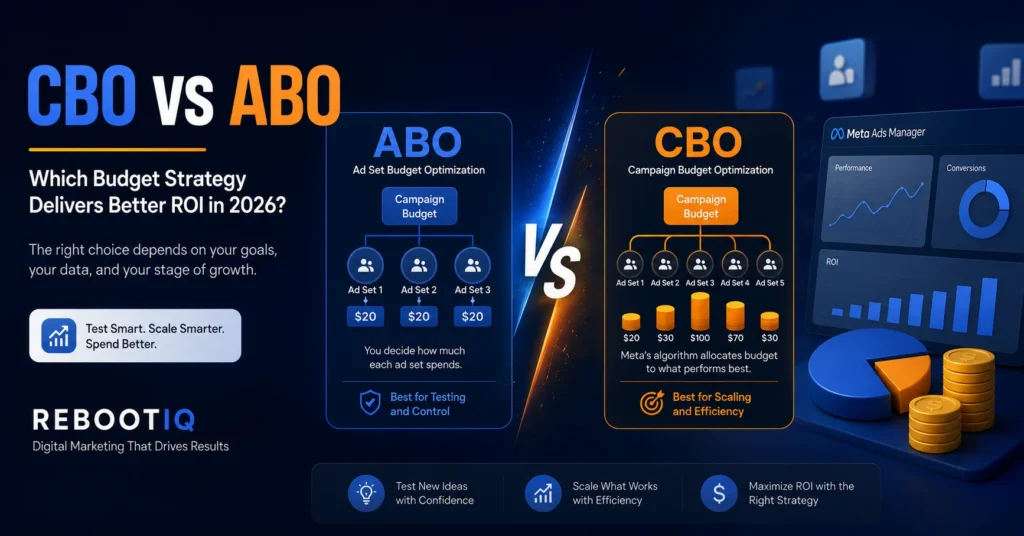
CBO vs ABO is one of those debates that never really goes away in Meta Ads, and honestly, we get asked about it constantly. Everyone wants a clean answer “just use this one, always” but that’s not really how it works, and anyone telling you otherwise is oversimplifying something that got more complicated, not less, this year.
Why CBO vs ABO Matters More in 2026 Than It Used To
Here’s what changed: earlier this year, Meta merged its manual and Advantage+ campaign flows into a single setup and made AI-driven budget optimization the default for new campaigns. So the CBO vs ABO question isn’t really “does the option still exist” anymore — it’s “when do you actually override the default Meta’s now pushing you toward.” That’s a meaningfully different question than the one advertisers were asking a couple of years ago.
What CBO and ABO Actually Do
ABO: You’re the One Deciding Where the Money Goes
Ad Set Budget Optimization fixes spend at the ad set level. Set $20 a day on three different ad sets testing different creative, and Meta spends exactly $20 in each one regardless of which one’s actually performing better. That’s the whole point. Every concept gets a fair, equal shot to prove itself, instead of getting starved early just because it took a little longer to find its audience.
CBO: Meta’s Algorithm Is the One Deciding
Campaign Budget Optimization — which Meta now runs under the Advantage+ campaign budget name lets one total budget at the campaign level and lets the algorithm shift money in real time toward whatever’s converting cheapest. Set five ad sets and a $250 daily budget, and Meta might pour $150 into the one it likes and leave the other four scraping by on almost nothing. It’s not being lazy. It’s chasing whatever it predicts will perform best, which is sometimes exactly right and sometimes leaves a genuinely strong ad set starved of the budget it needed to prove itself.
So Which One Actually Wins on ROI?
Honestly? Neither, universally. Every experienced media buyer we’ve talked to lands in roughly the same place: these are different tools for different jobs, not a permanent either/or decision. The real answer to CBO vs ABO isn’t a winner it’s knowing which situation you’re actually in.
When ABO Wins
If you’re testing genuinely distinct creative concepts, audiences, or geographies, and you need each one to get a clean, unbiased read during its own learning phase, ABO is the right call. It forces equal spend, which means you’re not letting the algorithm quietly starve a slow-starting creative before it’s had a fair shot. The tradeoff is real, though — ABO takes daily monitoring and manual adjustment. You’re the fund manager here, not the algorithm.
When CBO Wins
Once you’ve already validated what works and you’re scaling a proven concept with enough conversion volume for the algorithm to actually read a clean signal, CBO tends to win on both speed and your own time. You stop micromanaging budget splits by hand and let Meta chase efficiency across ad sets automatically. It’s also just less operator-hours, which matters a lot once an account scales past a handful of ad sets.
The Honest Middle Ground
Most healthy accounts we work with don’t pick one and stick with it forever. They run both, on different campaigns, and the split shifts week to week depending on what’s actually being tested versus what’s already proven. That’s not indecision — that’s just how CBO vs ABO plays out in practice once you stop looking for a single permanent answer.
Common Mistakes We See With CBO vs ABO
The biggest one is picking a side once and never revisiting it, even as a campaign moves from testing into scaling. A structure that made sense during creative testing can quietly become inefficient once you’re actually ready to scale a winner, and vice versa.
The second is running CBO on a genuine creative test and being confused when the algorithm dumps almost all the budget into one ad set within days. That’s not a bug — that’s exactly what CBO is designed to do, which is precisely why it’s the wrong structure for testing in the first place.
Quick FAQ: CBO vs ABO
Is CBO always better than ABO in 2026? No. CBO tends to win once you’re scaling something already proven, but ABO still wins when you’re testing distinct concepts and need each one to get a fair, unbiased read.
Which one is easier to manage? CBO, generally. It requires far less manual budget adjustment, which matters a lot as an account grows past a handful of ad sets.
Can I run CBO and ABO in the same account? Yes, and most experienced advertisers do exactly that — CBO for scaling proven winners, ABO for testing new concepts, often running side by side.
Why did Meta push everyone toward CBO recently? Meta merged manual and Advantage+ flows into one setup this year and made AI-driven budget optimization the default, meaning advertisers now have to actively choose to override it rather than simply opting into automation.
Is ABO becoming obsolete? No. It’s still genuinely useful for testing, especially when a slow-starting creative needs protection from being prematurely starved of budget by the algorithm.
How Rebootiq Approaches CBO vs ABO for Clients
At Rebootiq, we don’t default to one structure across every account — CBO vs ABO gets decided campaign by campaign, based on whether a specific ad set is being tested or scaled. Our social media and paid campaign work is built around this exact judgment call, not a one-size-fits-all playbook. We’ve also written a deeper technical breakdown of ABO vs CBO structures if you want to go further into the mechanics.
Not sure which structure your current campaigns should actually be running? Get a free campaign audit from our team. See how our approach differs across business types on our industries page. You can also check out our work on LinkedIn and Instagram.
Thanks for choosing Rebootiq InfoTech.
