
Your Meta Ads Analysis Is Probably Missing the One Number That Matters Most
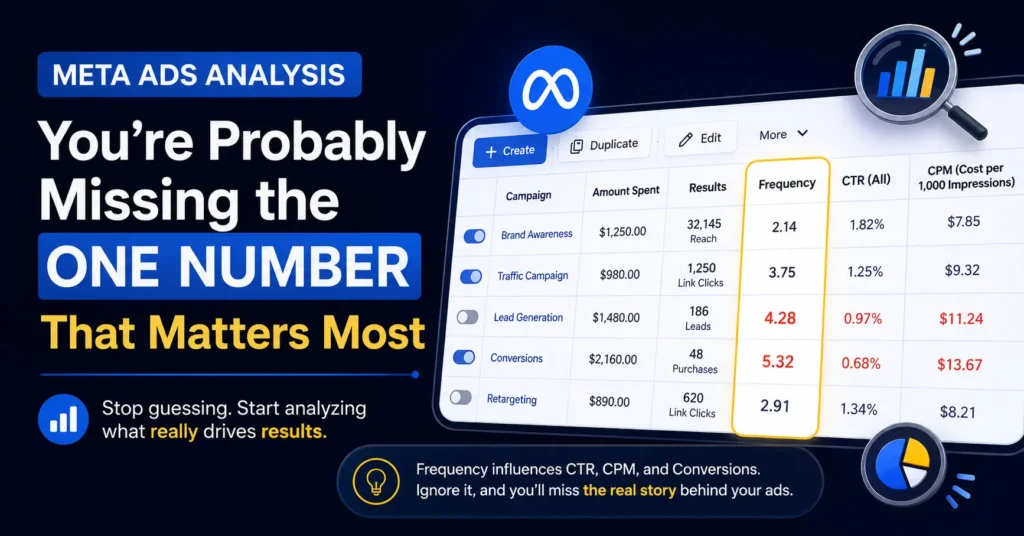
Meta Ads analysis usually starts and ends in the same two places: Amount Spent and Results. Open the dashboard, glance at those two columns, decide whether the campaign “worked,” and move on. Most advertisers do this every single week, and honestly, it’s not entirely their fault — those are the two numbers Meta puts front and center. But there’s one metric buried further down that actually explains why a campaign performed the way it did, and almost nobody checks it regularly.
The Number Everyone Skips: Frequency
Frequency tells you how many times, on average, the same person has seen your ad. It’s sitting right there in the breakdown menu, and it’s genuinely one of the most underused numbers in Meta Ads analysis. Here’s why it matters so much: every other metric you’re looking at — CTR, CPM, conversion rate — is being quietly shaped by frequency in the background, whether you’re paying attention to it or not.
Why Frequency Explains Almost Everything Else
Rising CPMs Often Trace Back to Frequency
When frequency climbs past a certain point, usually somewhere around 3 to 4, click-through rate starts dropping and cost per result starts climbing, even if nothing else about the campaign changed. People have simply seen the ad enough times that it’s stopped grabbing attention. A lot of Meta Ads analysis treats rising CPMs as a market-wide cost problem, when sometimes it’s really just frequency fatigue on one specific audience.
A “Winning” Ad Can Quietly Turn Into a Loser
An ad set that performed brilliantly in week one can look mediocre by week three, and the creative usually hasn’t changed at all — the audience has just seen it enough times that the novelty wore off. Without checking frequency, this looks like the ad “stopped working,” when really it just needs fresh creative or a bigger, less saturated audience.
Small Audiences Hit High Frequency Fast
A narrow, highly specific audience will burn through frequency far quicker than a broad one, simply because there are fewer people to show the ad to. This is one of the most common blind spots in Meta Ads analysis — a campaign with great early results on a tiny audience often just hasn’t had time to hit its frequency wall yet.
How to Actually Use Frequency in Your Analysis
Check It Weekly, Not Just When Something Breaks
Most people only look at frequency after performance has already declined. Checking it as a routine part of weekly Meta Ads analysis catches the problem before it fully tanks results, giving you time to refresh creative or expand the audience proactively.
Pair It With CTR, Not Just Alone
Frequency on its own doesn’t tell the whole story — it’s the combination with a dropping click-through rate that signals fatigue. Rising frequency with a stable CTR usually isn’t a problem yet. Rising frequency with a falling CTR almost always is.
Set a Rough Threshold and Watch for It
There’s no single universal number that applies to every account, but many advertisers start watching closely once frequency crosses 3 to 4 within a campaign’s active window. Once it does, that’s the signal to plan a creative refresh or audience expansion before performance actually drops.
What Most Meta Ads Analysis Gets Wrong
The most common mistake is treating every metric with equal weight, scanning ten numbers at once without a clear sense of which one is actually driving the others. Frequency isn’t the only metric that matters, but it’s frequently the one explaining changes in everything else, which makes it worth checking first, not last.
The second mistake is only looking at account-level averages instead of frequency by individual ad set. A healthy account-wide average can easily be hiding one specific ad set that’s already deep into fatigue, quietly dragging down overall performance while the rest of the account looks fine.
Quick FAQ: Meta Ads Analysis and Frequency
Where do I actually find frequency in Meta Ads Manager? It’s available as a column you can add to your reporting view, or under the breakdown options within a specific campaign or ad set.
What frequency number should I actually worry about? There’s no universal cutoff, but many advertisers start paying close attention once frequency crosses 3 to 4 within an active campaign window, especially if CTR is also dropping.
Does high frequency always mean a campaign is failing? Not necessarily. High frequency paired with a stable or improving CTR isn’t usually a problem. It’s the combination with a falling CTR that typically signals real fatigue.
How often should frequency be checked? Weekly is a reasonable habit for active campaigns, rather than only checking after performance has already started declining.
Does frequency matter more for small audiences? Yes. Smaller, more specific audiences hit high frequency much faster than broad ones, simply because there are fewer people to show the ad to.
How Rebootiq Approaches Meta Ads Analysis
At Rebootiq, frequency is one of the first things we check during any social media campaign review, precisely because it explains so much of what’s happening elsewhere in the account. We’ve also put together a more detailed breakdown on how to analyze Meta Ads data if you want to go deeper into the full metric set.
Not sure what your own Meta Ads analysis is actually telling you? Get a free account audit from our team. See how our approach differs across business types on our industries page. You can also check out our work on LinkedIn and Instagram.
Thank you for choosing Rebootiq InfoTech.
