Google Ads vs Meta Ads: Which Platform Is Better for Lead Generation in 2026?
Introduction
Generating quality leads is one of the biggest priorities for businesses investing in digital marketing. But with multiple advertising platforms available, one common question continues to come up:
Should you use Google Ads vs Meta Ads for lead generation?
Both platforms can generate valuable business leads, but they work in different ways.
Google Ads can connect businesses with people who are actively searching for a product or service. Meta Ads, which includes Facebook and Instagram advertising, can help businesses reach potential customers based on their interests, behavior, demographics, and engagement.
So, which platform is better for lead generation in 2026?
There is no universal winner. The right choice depends on your industry, target audience, advertising budget, customer journey, and business goals.
Let’s compare Google Ads and Meta Ads to understand which platform can work better for your business.
What Is Google Ads?
Google Ads is Google’s online advertising platform. It allows businesses to display advertisements across Google’s advertising network.
For lead generation, Google Search Ads are particularly useful because they can reach users when they are actively searching for a product or service.
For example, imagine someone searches:
“Best digital marketing agency in Bangalore”
That person is already looking for a solution. A relevant business can appear in the search results and potentially turn that search into a website visit, phone call, enquiry, or lead.
This makes Google Ads particularly valuable for businesses that provide services people actively search for.
Google Ads can be useful for:
- Digital marketing agencies
- SEO companies
- Real estate businesses
- Educational institutions
- Healthcare services
- Legal services
- Home services
- B2B companies
- Local businesses
- Professional services
What Are Meta Ads?
Meta Ads allow businesses to advertise across platforms such as Facebook and Instagram.
Unlike Google Search, users do not necessarily need to be searching for a particular service when they see a Meta advertisement.
Instead, businesses can reach relevant audiences using factors such as:
- Interests
- Demographics
- Online behavior
- Location
- Engagement
- Previous interactions
- Custom audiences
- Website activity
For example, a fitness studio in Bangalore could promote a new membership offer to people in its target location who are likely to be interested in fitness and wellness.
This makes Meta Ads particularly useful for creating awareness and generating interest among potential customers.
Google Ads vs Meta Ads: The Main Difference
The simplest way to understand the difference is:
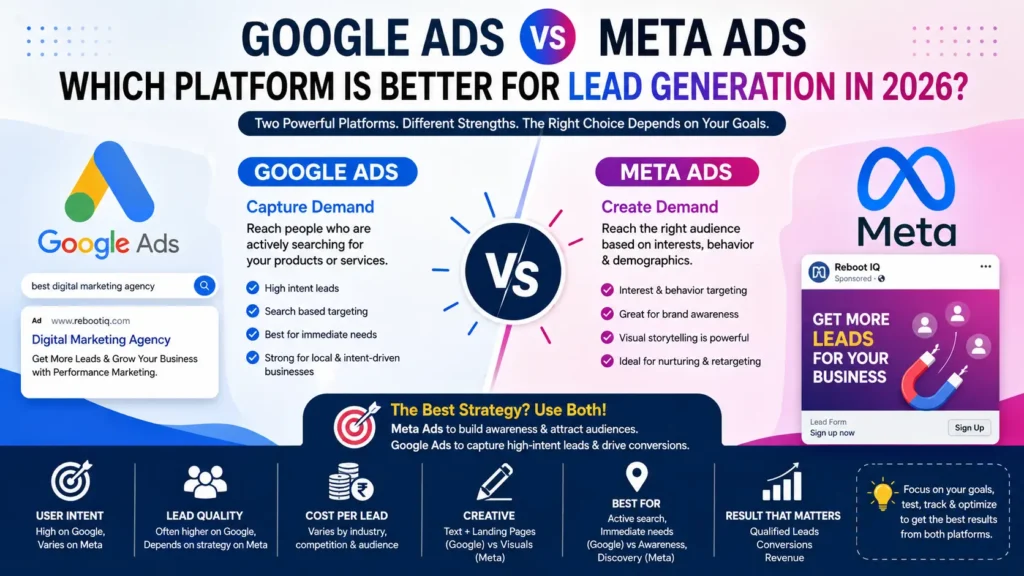
Google Ads captures existing demand.
Meta Ads helps create demand.
Someone searching Google for:
“AC repair near me”
already has a problem and is looking for a solution.
Someone scrolling Instagram may not be actively looking for an AC repair service. However, they could notice an attractive offer and become interested.
This difference in user intent is one of the biggest factors businesses should consider when choosing an advertising platform.
Google Ads vs Meta Ads for Lead Generation
1. User Intent
Google Ads
Google Search generally has a strong advantage when it comes to purchase or service intent.
A user searching for:
“Best property dealer in Bangalore”
is already expressing interest in the service.
Meta Ads
Meta Ads can reach users before they actively search for a service.
This makes the platform useful for introducing a product, service, offer, or brand to a relevant audience.
Winner for search intent: Google Ads
2. Lead Quality
The number of leads generated is not the only thing that matters.
A business may receive 100 leads but only a small percentage may actually be interested in buying.
For example:
Campaign A:
100 leads → 30 qualified leads → 8 customers
Campaign B:
150 leads → 15 qualified leads → 4 customers
Campaign B generated more leads, but Campaign A produced better business results.
Google Ads can often produce strong lead quality when people are actively searching for a service.
Meta Ads can also generate excellent leads, but results depend heavily on audience selection, creative quality, offer, campaign optimization, and follow-up.
Important metrics to monitor:
- Total leads
- Qualified leads
- Cost per lead
- Cost per qualified lead
- Conversion rate
- Customers acquired
- Customer acquisition cost
- Revenue generated
Winner: Depends on the campaign and business
3. Cost Per Lead
One of the most common mistakes businesses make is choosing an advertising platform solely because it provides a lower cost per lead.
For example:
Meta Ads: ₹200 per lead
Google Ads: ₹500 per lead
At first glance, Meta Ads appears to be the better option.
But suppose Meta generates mostly low-quality enquiries while Google generates leads that are much more likely to become customers.
In that situation, the higher Google Ads CPL may actually provide better business value.
Therefore, businesses should look beyond CPL and measure the cost per qualified lead and cost per customer.
Better question:
“How much does it cost to acquire a paying customer?”
rather than:
“How cheap is my lead?”
4. Targeting Options
Both platforms provide powerful targeting options, but the approach is different.
Google Ads focuses heavily on:
- Search queries
- Keywords
- Search intent
- Location
- Audiences
- Website behavior
- Conversion signals
Meta Ads focuses heavily on:
- Demographics
- Interests
- Behaviors
- Location
- Engagement
- Custom audiences
- Lookalike/similar audience strategies where available
- Website visitors and other first-party signals
For businesses with a very specific search demand, Google can be extremely effective.
For businesses that need to reach a defined audience and generate interest, Meta can be a strong option.
5. Ad Creatives
This is an area where Meta Ads has a major advantage.
Meta is highly visual, so businesses can use:
- Short videos
- Reels
- Images
- Carousels
- Customer testimonials
- Product demonstrations
- Before-and-after content
- Offers
- Educational content
For example, a salon can show a transformation video, while a restaurant can showcase its food through short-form video content.
Google Search Ads are more dependent on ad copy, keywords, relevance, offers, landing pages, and conversion experience.
Therefore:
Visual products and services → Meta can be highly effective.
Search-driven services → Google can be highly effective.
6. Local Lead Generation
Both platforms can work well for local businesses.
Google Ads
Google is particularly useful when local customers are actively searching for a service.
Examples:
- Dentist near me
- Salon near me
- Digital marketing agency in Bangalore
- AC repair in Bangalore
- Best interior designer near me
Meta Ads
Meta can be useful for promoting:
- Local offers
- Discounts
- Events
- New business launches
- Restaurant promotions
- Salon packages
- Fitness memberships
- Local brand awareness
A strong local marketing strategy can even use both platforms together.
7. Landing Pages Matter on Both Platforms
Even a well-optimized advertising campaign can perform poorly if the landing page does not convert visitors.
A good landing page should have:
- A clear headline
- Relevant information
- Strong value proposition
- Easy-to-understand offer
- Clear call-to-action
- Simple enquiry form
- Trust signals
- Customer reviews or testimonials
- Mobile-friendly design
For example, if a user clicks an advertisement for SEO services but lands on a generic homepage with no clear information about SEO, the chances of conversion may decrease.
The advertisement and landing page should provide a consistent experience.
8. Which Platform Is Better for B2B Lead Generation?
For many B2B businesses, Google Ads can be particularly useful because potential customers often search for specific business solutions.
For example:
“CRM software for small business”
“B2B digital marketing agency”
“cybersecurity company for businesses”
These searches indicate an existing need.
However, Meta can still support B2B marketing by building awareness, promoting educational content, retargeting visitors, and reaching relevant professional audiences.
Recommended approach:
Google Ads → Capture active demand
Meta Ads → Build awareness and nurture potential customers
9. Which Platform Is Better for E-commerce?
E-commerce businesses can benefit from both platforms.
Google Ads can help with:
- Product searches
- Shopping-related discovery
- High-intent traffic
- Brand searches
- Product-focused campaigns
Meta Ads can help with:
- Product discovery
- Visual storytelling
- Retargeting
- Offers
- New product launches
- Social engagement
For e-commerce brands, testing both platforms can provide valuable data about which audiences and campaigns generate profitable sales.
Google Ads vs Meta Ads: Which Is Better in 2026?
There is no single platform that is best for every business.
Google Ads may be better if:
- People actively search for your service.
- Your business solves an immediate problem.
- You operate in a competitive local market.
- Your customers have strong purchase intent.
- You have relevant commercial keywords.
- You have a strong landing page.
Meta Ads may be better if:
- Your product is visually appealing.
- You need to create awareness.
- Your business has strong video or image content.
- You have an attractive offer.
- Your audience can be clearly defined.
- You want to introduce your product to potential customers.
Why Using Google Ads and Meta Ads Together Can Be Powerful
Businesses don’t always have to choose one platform.
In many cases, Google Ads and Meta Ads can complement each other.
For example:
Step 1: Meta Ads
Introduce the brand to potential customers.
Step 2: Website Visit
Users learn more about the product or service.
Step 3: Retargeting
People who interacted with the brand can receive additional marketing messages.
Step 4: Google Search
When the customer later searches for the service, Google Ads can help capture that demand.
Step 5: Conversion
The user submits an enquiry, calls the business, purchases a product, or takes another desired action.
This creates a more complete digital advertising funnel.
How to Choose the Right Platform for Your Business
Before deciding between Google Ads and Meta Ads, ask these questions:
1. Are people already searching for my service?
If yes, Google Ads could be a strong choice.
2. Do I need to create awareness?
If yes, Meta Ads could be useful.
3. Is my product visually appealing?
If yes, Meta may provide strong creative opportunities.
4. Do I have strong commercial search keywords?
If yes, Google Ads may capture valuable demand.
5. Can I create engaging videos and images?
If yes, Meta Ads can take advantage of that creative strength.
6. Can my sales team follow up quickly?
This matters on both platforms because advertising can generate an enquiry, but the sales process determines whether that enquiry becomes a customer.
Final Verdict
So, Google Ads vs Meta Ads: which platform is better for lead generation in 2026?
The answer depends on your business and customer journey.
Google Ads is generally stronger for capturing users who are already searching for a solution.
Meta Ads is generally stronger for reaching potential customers, building awareness and creating demand through engaging content.
Instead of focusing only on clicks or lead volume, businesses should measure the metrics that actually affect revenue.
The most important numbers are:
Qualified Leads → Customers → Customer Acquisition Cost → Revenue → ROI
For businesses with sufficient budget and a suitable customer journey, combining Google Ads and Meta Ads can create a stronger full-funnel marketing strategy.
In simple terms:
Google Ads = Capture Demand
Meta Ads = Create Demand
Google Ads + Meta Ads = A Complete Lead Generation Strategy
The best advertising platform is ultimately the one that brings quality customers and profitable business growth, not simply the one that produces the cheapest leads
