
The Google Ads Setting Most Businesses Have Never Touched And It’s About to Matter
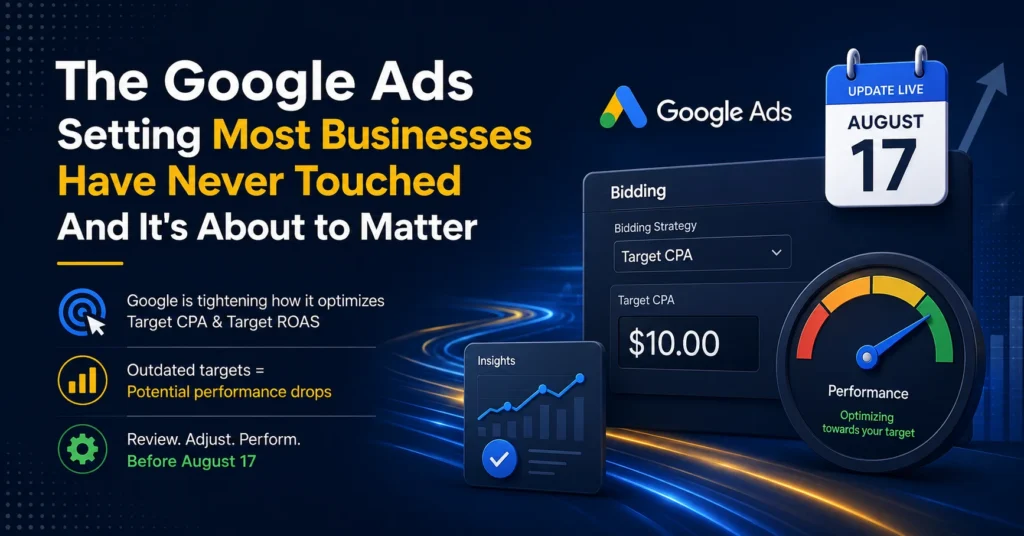
Google Ads bidding settings are one of those things almost nobody revisits once a campaign is up and running. You set a Target CPA or Target ROAS months ago, the campaign started performing, and you’ve genuinely never looked at that number again. That’s about to become a problem, and not because anything you did was wrong — it’s because Google itself is changing how it treats that number starting August 17.
What’s Actually Changing With Google Ads Bidding Settings
Here’s the quiet part nobody tells you: if a campaign is “limited by budget” and running on Target CPA or Target ROAS, Google has historically let it perform a little better than the target you originally set. Set a Target CPA of $10, and the campaign might actually be delivering results closer to $5. Nobody complained, because overperforming your own target feels like a win. Starting August 17, that gap closes. Google’s system will start optimizing tightly toward the exact number sitting in your Google Ads bidding settings, not the friendlier number it’s been quietly delivering instead.
Why the Number You Set Months Ago Suddenly Matters
The Gap You Never Noticed Is About to Disappear
If your Target CPA or Target ROAS hasn’t been touched since the campaign launched, there’s a decent chance it no longer reflects how the account is actually performing today. That mismatch didn’t matter before, because the old system let performance run ahead of the outdated target. After August 17, the campaign will get pulled back toward that stale number, which can look like a sudden performance drop even though nothing about the business changed.
This Specifically Rewards Businesses Paying Attention
Accounts with accurate Google Ads bidding settings and clean, reliable conversion tracking are the ones least affected by this. The businesses genuinely at risk are the ones running on autopilot — set once, never revisited, no regular account review. This update draws a hard line between the two.
Budgets Aren’t Changing, But Results Might Feel Like They Are
Google’s own guidance is clear that this update won’t increase your spend or override your budget caps. What changes is how consistently the system chases the target you set, which means the actual number in your Google Ads bidding settings becomes far more consequential than it’s ever been before.
How to Actually Prepare Before August 17
Pull Up Your Recent Performance First
Before touching anything, look at what your campaigns have actually been delivering over the last month or two, not what the original target says. If there’s a meaningful gap between the two, that’s the number worth addressing before the change rolls out.
Update the Target, Not Just the Budget
It’s tempting to assume adjusting budget alone fixes this, but it doesn’t. The fix lives specifically in the Target CPA or Target ROAS field itself — the actual Google Ads bidding settings — not in daily spend caps.
Use Google’s Bid Target Adjustment Tool
Google rolled out a dedicated Bid Target Adjustment Tool ahead of this change specifically to help advertisers compare current targets against recent performance and make informed updates before the rollout. It’s worth using rather than guessing at a new number manually.
Don’t Overcorrect All at Once
Shifting a target too aggressively can cause its own performance disruption. A measured adjustment based on actual recent data tends to hold up better than a dramatic overnight change made out of panic.
Which Campaigns Are Actually Affected
This change applies specifically to budget-limited campaigns running Target CPA or Target ROAS, and for Demand Gen campaigns, Target CPC. Manual CPC, Target Impression Share, and Target CPM aren’t affected. App campaigns, Video reach, and Video view campaigns are excluded too. If you’re not sure which bidding strategy a given campaign uses, that’s worth checking directly before assuming you’re in the clear.
Common Mistakes to Avoid Here
The most common mistake will be doing nothing and assuming the update won’t apply. Google isn’t adjusting targets automatically on anyone’s behalf — it’s entirely on the advertiser to review and update Google Ads bidding settings before the rollout, or the campaign simply gets pulled toward whatever number is already sitting there, accurate or not.
The second mistake is panicking and slashing every target the moment the update goes live, without giving the new system time to settle. Google itself recommends waiting through one or two conversion cycles before making major additional changes, since early post-rollout data can be noisy.
Quick FAQ: Google Ads Bidding Settings and the August 17 Update
What exactly is changing in Google Ads bidding settings on August 17? Budget-limited campaigns using Target CPA or Target ROAS will start optimizing more strictly toward the exact target set, rather than being allowed to quietly outperform it the way they have been.
Will this update increase how much I spend? No. Daily and monthly budget caps stay exactly as set. What changes is how tightly performance tracks toward the target itself, not the spending limit.
Which bidding strategies are NOT affected? Manual CPC, Target Impression Share, and Target CPM are unaffected. App campaigns, Video reach, and Video view campaigns are also excluded from this change.
What should I actually do before August 17? Compare your current Target CPA or Target ROAS against recent real performance, and update the target itself if there’s a meaningful gap, ideally using Google’s Bid Target Adjustment Tool.
What happens if I don’t touch my Google Ads bidding settings at all? Nothing gets adjusted automatically. The campaign will simply optimize toward whatever target is currently set, which could mean a visible performance shift if that number hasn’t been reviewed in a while.
How Rebootiq Helps With This
At Rebootiq, reviewing Google Ads bidding settings against actual recent performance is a standard part of every account audit we run, precisely because targets set months ago rarely still match reality without someone checking. Our Google Ads management team is already reviewing client accounts ahead of the August 17 rollout to make sure targets are realistic before the change hits.
Not sure if your own account’s targets still reflect how it’s actually performing? Get a free account audit from our team before the update rolls out. See how our approach differs across business types on our industries page. You can also check out our work on LinkedIn and Instagram.
Thanks for choosing Rebootiq InfoTech.
