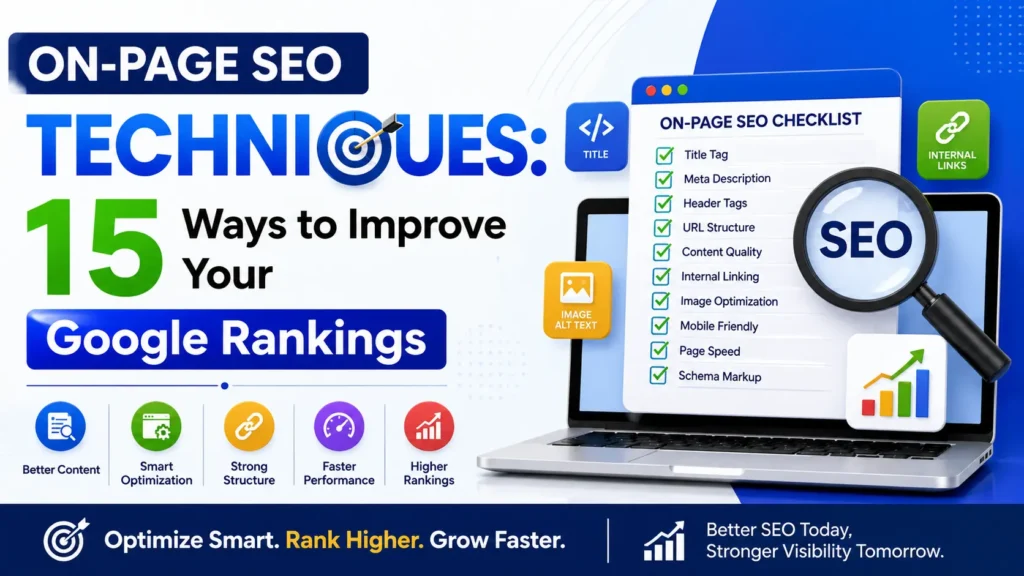
On-Page SEO Techniques: 15 Ways to Improve Your Google Rankings
If you’ve spent any time trying to grow organic traffic, you already know that great content alone isn’t enough. Google needs to understand what your page is about, trust that it’s genuinely useful, and believe it delivers a better experience than the ten other pages competing for the same spot. That’s what on-page SEO is for.
At Rebootiq, we work with businesses that want rankings built on a solid foundation — not shortcuts that disappear with the next algorithm update. Below are 15 on-page SEO techniques that still move the needle in 2026, from the fundamentals to the newer signals shaping how Google (and AI-powered search) evaluates your pages.
1. Start With Real Search Intent, Not Just Keywords
Before you write a single word, ask what someone typing that query actually wants. Are they looking to buy, compare, learn, or troubleshoot? A page that nails the intent behind a search consistently outperforms one that simply repeats the keyword. If the top-ranking pages for your target term are all listicles, a single long-form guide probably won’t outrank them — match the format Google has already decided works.
2. Build Keyword Clusters, Not Isolated Phrases
Chasing one exact-match keyword per page is outdated. Instead, group related terms and sub-questions that share the same intent, and let one comprehensive page answer all of them. This “one cluster, one page” approach signals topical depth and reduces the risk of your own pages competing against each other in search results.
3. Write Titles That Are Both Clear and Compelling
Your title tag is often the first thing a searcher sees, and it’s a strong relevance signal for Google. Keep it under roughly 60 characters, lead with the primary keyword where it reads naturally, and give people a reason to click — specificity beats cleverness here. “15 On-Page SEO Techniques to Improve Rankings” tells someone exactly what they’re getting.
4. Craft Meta Descriptions That Earn the Click
Meta descriptions don’t directly influence rankings, but they influence click-through rate, which does affect performance over time. Write a genuine, benefit-driven summary in 150–160 characters rather than stuffing it with keywords. Think of it as ad copy for your own content.
5. Use One Clear H1 and a Logical Heading Structure
Every page should have a single H1 that states what the page is about, followed by H2s and H3s that break the content into scannable sections. This isn’t just good for readers — it helps search engines (and AI systems summarizing your content) parse the structure of your page and understand hierarchy at a glance.
6. Optimize for Featured Snippets and AI Overviews
Increasingly, Google surfaces direct answers above the traditional blue links. To be eligible, answer common questions plainly near the top of a relevant section — a two- or three-sentence direct answer, followed by supporting detail. Bullet points, numbered steps, and definition-style formatting all improve your odds of being pulled into a snippet or an AI-generated summary.
7. Place Keywords Naturally, Not Forcibly
Your primary keyword should show up in the introduction, at least one heading, and scattered naturally through the body — never crammed in at the expense of readability. Google’s language models are sophisticated enough to understand synonyms and related concepts, so write for a human first and let the keyword placement follow from genuinely covering the topic.
8. Strengthen Your Internal Linking
Internal links do double duty: they help visitors find related content, and they help Google understand how pages on your site relate to each other and which ones matter most. Link out to relevant pages using descriptive anchor text (not “click here”), and make sure your most important pages are never more than a few clicks from your homepage.
9. Optimize Images for Both Users and Search Engines
Compress images so they don’t slow down your page, use descriptive file names instead of generic strings like “IMG_2031.jpg,” and write alt text that accurately describes the image for accessibility and image search. This also matters more than it used to, since AI search tools often pull in image context when generating summaries.
10. Improve Core Web Vitals and Page Speed
Loading performance, visual stability, and interactivity are measurable ranking factors, not vague suggestions. Compress assets, use lazy loading, minimize render-blocking scripts, and check your Largest Contentful Paint, Cumulative Layout Shift, and interaction responsiveness in Google Search Console. A technically fast site gives every other SEO effort room to actually work.
11. Make Sure Your Site Is Genuinely Mobile-Friendly
The majority of searches happen on mobile, and Google evaluates the mobile version of your page first. Test tap targets, font sizes, and layout on an actual phone, not just a resized browser window — small friction points that seem minor on desktop can quietly tank engagement on mobile.
12. Add Structured Data (Schema Markup)
Schema markup doesn’t change how your page looks to readers, but it gives search engines explicit, machine-readable context — product prices, review ratings, FAQs, how-to steps, and more. This increases your chances of rich results in the SERP and makes it easier for AI systems to accurately cite your content.
13. Write Content That Actually Demonstrates E-E-A-T
Experience, Expertise, Authoritativeness, and Trustworthiness aren’t a checklist you tick off — they’re a bundle of trust signals Google’s quality systems look for. Show real author credentials, cite credible sources, share original insight or data where you can, and keep information accurate and current. Generic, recycled content is exactly what these systems are designed to filter out.
14. Optimize URLs for Clarity
Short, descriptive URLs that reflect the page’s topic are easier for both users and search engines to understand. A URL like /on-page-seo-techniques communicates far more than a string of parameters or numbers, and it holds up better over time as content gets shared and linked.
15. Keep Content Fresh and Comprehensive
Thin, outdated pages lose ground even if they once ranked well. Revisit high-value content periodically, update statistics and examples, fill gaps competitors have since covered, and expand sections that leave real questions unanswered. Google rewards pages that continue to fully satisfy the query, not just ones that ranked once and were left alone.
Bringing It All Together
On-page SEO isn’t about gaming an algorithm — it’s about removing every possible reason for Google, or an AI search engine, to hesitate before recommending your page. Nail the intent, structure the content clearly, back it up with genuine expertise, and make sure the technical experience holds up on any device.
None of these 15 techniques work in isolation, and none of them are a one-time fix. Rankings respond to consistency: pages that keep getting sharper, faster, and more useful tend to keep climbing. Start with the two or three techniques above that your site is weakest on, fix those first, and build from there.
If you’d like a second set of eyes on where your pages are leaving rankings on the table, that’s exactly the kind of audit the team at Rebootiq does every day.
