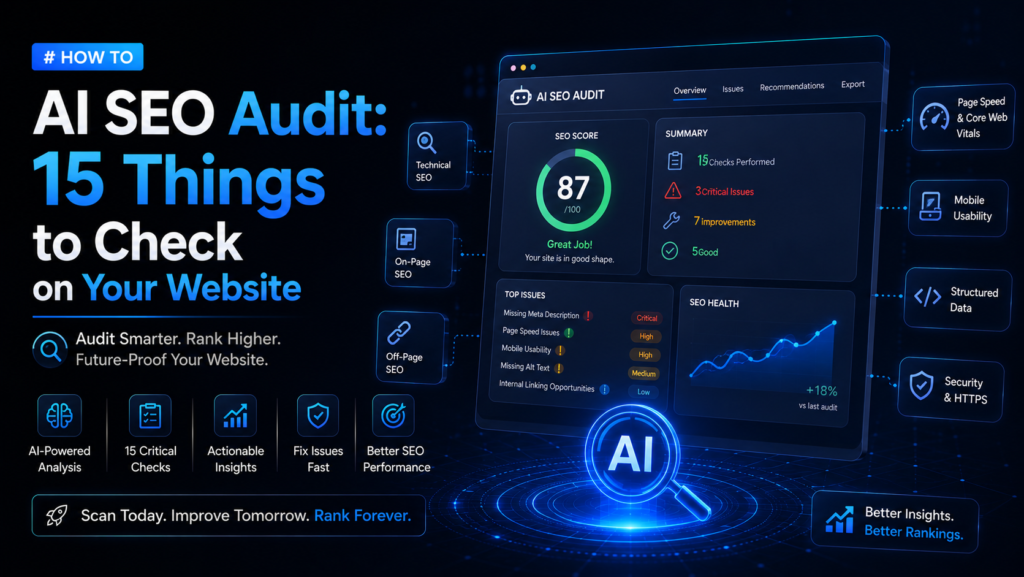
AI SEO Audit: 15 Things to Check on Your Website
Search is changing faster than most businesses realize.
People are no longer relying only on traditional Google results to find information. AI-powered search experiences such as Google AI Overviews, ChatGPT, Gemini, and Perplexity are becoming part of the research journey.
That means having a search-friendly website is no longer just about keywords and rankings. Your website also needs to be easy for search engines and AI systems to crawl, understand, trust, and interpret.
An AI SEO audit helps you identify whether your website is prepared for this changing search environment.
Here are 15 things worth checking.
1. Can Search Engines Crawl Your Website?
Start with the basics.
Make sure important pages aren’t accidentally blocked by robots.txt, noindex tags, incorrect canonical tags, or other technical issues.
If search engines can’t properly access your content, AI search visibility becomes much harder.
2. Is Your Website Indexed?
Crawling and indexing are different.
Check whether your important pages are actually appearing in Google’s index. Look for pages that are missing, unexpectedly excluded, or marked as duplicates in Google Search Console.
3. Is Your Content Actually Useful?
AI search doesn’t create a reason for people to trust weak content.
Review your important pages and ask:
Does this page genuinely answer the user’s question better than competing pages?
Remove unnecessary filler and focus on useful, original information.
4. Are You Answering Real Questions?
People increasingly search using complete questions and conversational language.
Your content should address the questions your customers actually ask.
Use FAQs, headings, comparison sections, and clear explanations where they genuinely improve the page.
5. Do You Demonstrate First-Hand Experience?
Generic information is easy to reproduce.
Experience is harder to replicate.
Where appropriate, include original examples, case studies, observations, processes, screenshots, results, or expert commentary. This gives your content more depth and credibility.
6. Are Authors Clearly Identified?
For content where expertise matters, make it clear who created it.
Author bios, professional experience, credentials, and relevant background can help establish context around the content.
Don’t create fake authors or credentials simply to appear authoritative.
7. Is Your Business Information Clear?
Your website should clearly explain:
- Who you are
- What you do
- Where you operate
- Who you serve
- What products or services you provide
- How customers can contact you
AI systems need context. Don’t make them figure out what your business does from a single homepage headline.
8. Have You Implemented Relevant Schema Markup?
Structured data can help search engines understand specific types of information on your pages.
Depending on your website, relevant markup could include Organization, LocalBusiness, Product, Article, or BreadcrumbList.
Remember: schema isn’t a shortcut to AI visibility. It should accurately describe information that exists on the page.
9. Is Your Internal Linking Strong?
Don’t leave valuable pages isolated.
Connect related articles, service pages, product pages, and supporting resources through meaningful internal links.
A well-structured internal linking system helps both users and search engines discover relationships between your content.
10. Does Your Website Have Strong Topical Coverage?
One article about a topic doesn’t necessarily establish expertise.
If SEO is an important subject for your business, for example, your website might cover technical SEO, keyword research, local SEO, content strategy, analytics, and AI search.
Build depth rather than publishing dozens of unrelated articles.
11. Are Your Pages Fast and Mobile-Friendly?
AI SEO doesn’t replace technical SEO.
Check page speed, Core Web Vitals, mobile usability, HTTPS, image optimization, and other technical fundamentals.
A great article isn’t very useful if visitors struggle to access it.
12. Is Your Content Easy to Understand?
Don’t write for algorithms.
Use clear headings, short paragraphs, descriptive titles, lists, tables where useful, and straightforward language.
Well-structured content is easier for people to scan and easier for machines to interpret.
13. Are Your Business Details Consistent Across the Web?
Check your business name, location, services, contact details, and other important information across your website and relevant external platforms.
Major inconsistencies can create confusion about your business identity.
14. Are Other Trusted Websites Mentioning You?
Authority isn’t created entirely on your own website.
Look for legitimate mentions from industry publications, news websites, professional organizations, relevant directories, partners, and other trustworthy sources.
Focus on quality and relevance, not simply the number of backlinks.
15. Are You Measuring AI Search Visibility?
This is the step many businesses overlook.
Traditional SEO metrics such as rankings, organic traffic, clicks, and conversions still matter. But you should also start monitoring whether your brand and content appear in relevant AI-generated answers where measurement is possible.
Track important questions related to your products, services, and industry and periodically assess how your brand is represented.
The Final Check: Would You Trust Your Own Website?
An AI SEO audit isn’t about adding a collection of “AI tricks” to your website.
It’s about making your website crawlable, understandable, useful, authoritative, and trustworthy.
Ask yourself one final question:
If someone asked an AI tool about my industry, would my website provide a genuinely useful answer?
If the answer is yes, you’re building the right foundation.
AI search is still evolving, so nobody can guarantee that a particular website will be cited by ChatGPT, Gemini, Perplexity, or Google’s AI features.
But businesses that invest in strong content, technical SEO, structured information, genuine expertise, and online authority will be in a much better position as search continues moving from “Where do I rank?” to “Does AI recognize and recommend my business?”
Want to know whether your website is ready for AI search? A professional AI SEO audit can identify the technical, content, and authority gaps that may be holding your visibility back.
