What Is Landing Page Experience in Google Ads? A Complete Guide
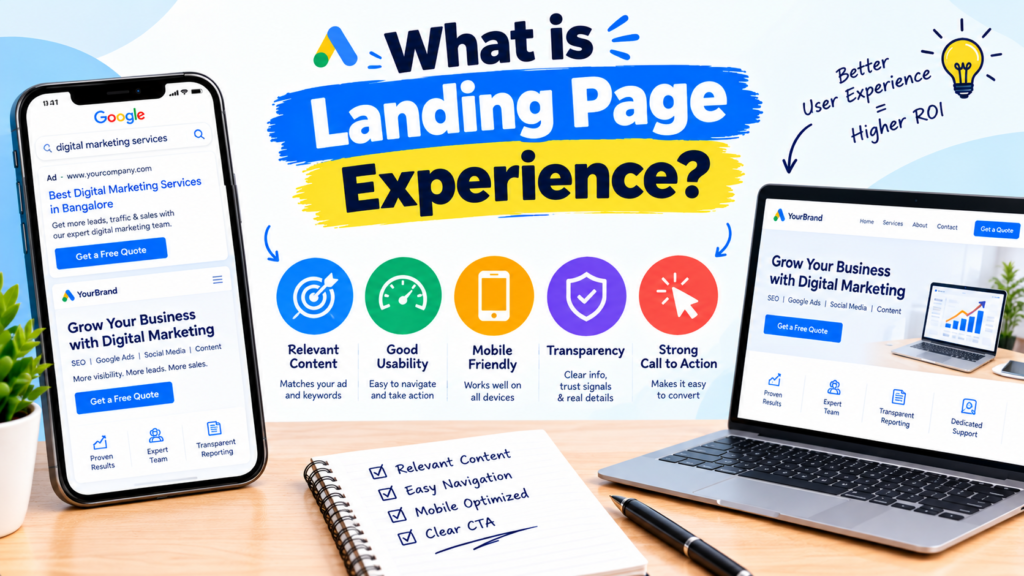
Running a successful Google Ads campaign involves more than choosing the right keywords and writing attractive ad copy. The experience users have after clicking your advertisement also plays an important role in campaign performance. This is where landing page experience in Google Ads becomes essential.
A relevant, fast, and user-friendly landing page can help visitors find the information they need and encourage them to take action, whether that means submitting a lead form, purchasing a product, or contacting your business.
In this blog, we will explain what landing page experience is, why it matters, and how you can improve it for better advertising results.
What Is Landing Page Experience in Google Ads?
Landing page experience in Google Ads refers to Google’s assessment of how relevant and useful your landing page is to people who click your advertisement.
Google considers factors such as how closely your page matches the user’s search, whether it provides useful content, how easy it is to navigate, and whether visitors can find the information promised in the ad.
Landing page experience is one of three components used to calculate Quality Score, alongside expected click-through rate and ad relevance. Google generally reports landing page experience as Above average, Average, or Below average.
A better landing page experience can support campaign performance, but it does not guarantee a higher ad position or lower cost per click.
Why Is Landing Page Experience Important?
Landing page experience matters because it connects your advertisement with the information users expect to find.
Here are some key benefits of optimizing your landing page:
- Better user experience: Visitors can quickly find relevant information.
- Improved conversion potential: A clear page layout and strong call to action can encourage enquiries and purchases.
- More relevant advertising: Consistency between keywords, ad copy, and landing page content creates a smoother customer journey.
- Potentially more efficient campaigns: Improving your landing page may contribute to better overall campaign performance.
For example, if your advertisement promotes digital marketing services in Bangalore, your landing page should explain those services, their benefits, and how potential customers can contact you.
5 Ways to Improve Landing Page Experience in Google Ads
1. Match Landing Page Content With Search Intent
Your landing page should directly address what users are searching for. If your ad promotes SEO services, the landing page should provide relevant information about SEO rather than unrelated marketing services.
Use clear headings, useful descriptions, and relevant keywords naturally throughout the content. Focus on answering users’ questions instead of repeating keywords unnecessarily.
2. Improve Website Loading Speed
A slow website can frustrate visitors and cause them to leave before engaging with your content.
To improve page speed, compress images, reduce unnecessary scripts, use browser caching where appropriate, and choose reliable hosting. Test your website using Google PageSpeed Insights to identify performance issues.
Pay particular attention to mobile performance, as many users access advertisements from smartphones.
3. Make Your Landing Page Mobile-Friendly
Your landing page should work smoothly across mobile phones, tablets, and desktop devices.
Use readable fonts, responsive layouts, easy-to-click buttons, and forms that are simple to complete. Avoid intrusive pop-ups that prevent visitors from accessing the main content.
A mobile-friendly experience makes it easier for potential customers to take action.
4. Provide Useful and Transparent Information
Your landing page should deliver what your advertisement promises. Include relevant product or service details, pricing information where appropriate, genuine contact details, and clear explanations of your offer.
For lead generation campaigns, explain what happens after someone submits a form. A privacy policy and appropriate trust signals can also help visitors feel more confident about sharing their information.
5. Use Clear Calls to Action
Every landing page should have a clear purpose. Depending on your business objective, your call to action could be “Get a Free Quote,” “Book a Consultation,” or “Shop Now.”
Place the call to action where visitors can easily find it. Keep forms straightforward and request only the information necessary to achieve your campaign goal.
How to Check Landing Page Experience in Google Ads
You can review landing page experience through the Quality Score reporting columns in your Google Ads account.
- Open your Google Ads account.
- Navigate to the relevant Search campaign and its keywords.
- Open the Columns menu and select Modify columns.
- Find the Quality Score section.
- Add the Landing page experience column.
Review the status for your keywords. If landing page experience is below average, investigate content relevance, usability, and page performance before making changes.
Conclusion
Landing page experience in Google Ads is an important part of delivering relevant and useful advertising experiences. By aligning your landing page with search intent, improving loading speed, optimizing mobile usability, providing valuable information, and using clear calls to action, you can create a better experience for potential customers.
Remember that successful Google Ads campaigns depend on more than Quality Score alone. Monitor conversions, cost per lead, and overall campaign performance to determine whether your landing page improvements are delivering meaningful business results.
