AI Search Optimization in 2026: The Shocking Reason Your Website Could Become Invisible
AI Search Optimization Is Changing How Customers Find
Remember when ranking on the first page of Google felt like winning the internet?
For years, businesses invested heavily in SEO because higher rankings meant greater visibility, more traffic, and more customers. Marketing teams tracked keyword positions, agencies focused on search rankings, and entire digital strategies revolved around getting websites to the top of Google.
And for a long time, that approach worked.
But search behavior is changing.
Today, someone looking for marketing advice might ask ChatGPT instead of opening Google. A customer comparing software solutions may rely on an AI-generated summary before visiting any website. A buyer researching products could receive recommendations directly from an AI assistant without clicking a search result.
This shift is why AI Search Optimization is becoming one of the most important digital marketing strategies for businesses heading into 2026.
The challenge is no longer simply getting found. The challenge is ensuring your brand remains visible in a world where AI increasingly influences how people discover information.
Why Search Is No Longer Just About Search Engines
Think about your own online behavior.
How often do you open ten different websites to find an answer?
Most people don’t.
Users want answers quickly, and technology is adapting to meet that expectation. Search engines and AI-powered platforms are increasingly delivering information directly within search experiences.
Today, users regularly interact with:
- AI-generated search summaries
- Featured snippets
- Voice search results
- AI assistants
- Knowledge panels
- Answer engines
In many cases, the answer appears before the click.
For businesses, this means visibility is no longer determined solely by where a website ranks. It is increasingly determined by whether your content can be understood, trusted, and referenced by AI systems.
Why Traditional SEO Isn’t Enough Anymore
Let’s be clear: SEO is not dead.
In fact, strong SEO remains one of the most valuable investments a business can make.
Technical optimization, keyword research, content creation, internal linking, and backlink building continue to play an essential role in online visibility.
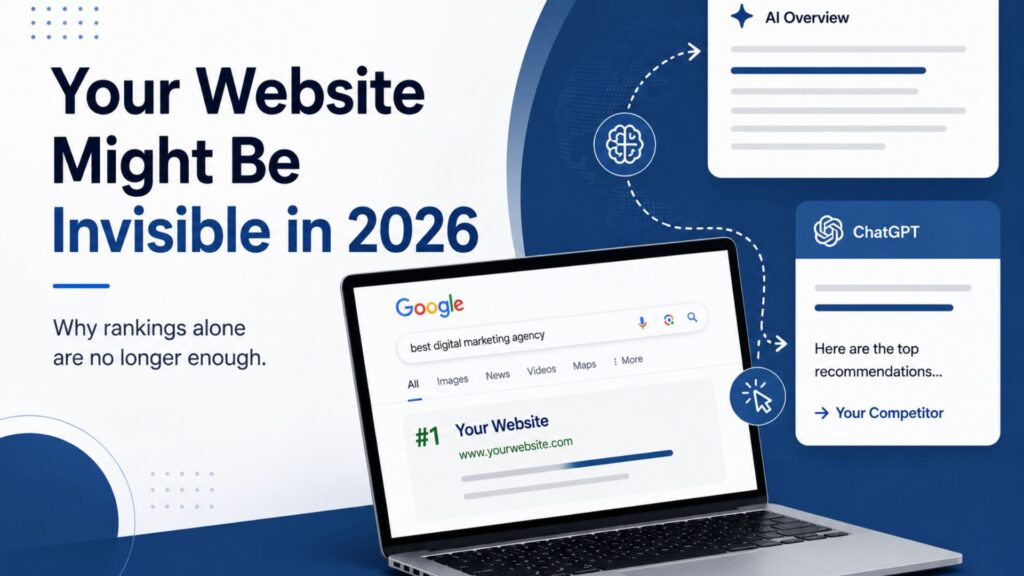
However, rankings alone are no longer enough.
A website can rank highly and still lose visibility if users receive their answers through AI-generated responses without ever clicking through to the source.
This is where many businesses risk falling behind.
The question used to be:
“Can Google find my website?”
Today, the more important question is:
“Can AI understand, trust, and recommend my content?”
That difference represents one of the biggest shifts in digital marketing over the past decade.
What Is AI Search Optimization?
AI Search Optimization is the process of improving your content so that AI-powered search platforms, answer engines, and digital assistants can easily understand and reference it.
Rather than focusing only on rankings, AI Search Optimization focuses on becoming a trusted source of information.
The goal is to ensure that when AI systems generate answers, your content has a better chance of being included, cited, or referenced.
As AI continues to shape online discovery, businesses that embrace AI Search Optimization will gain a significant advantage over competitors that rely solely on traditional SEO strategies.
The Rise of GEO and AEO
Two emerging disciplines are becoming increasingly important within AI Search Optimization.
Generative Engine Optimization (GEO)
Generative Engine Optimization focuses on helping AI-powered platforms discover and reference your content when generating responses.
The objective is not simply ranking higher on a search results page. Instead, the objective is becoming part of the answer itself.
Businesses that create authoritative, trustworthy, and well-structured content are more likely to benefit from GEO strategies.
Answer Engine Optimization (AEO)
Answer Engine Optimization focuses on creating content that directly answers user questions.
Clear explanations, structured formatting, concise answers, and well-organized information help answer engines understand and surface your content more effectively.
As users increasingly seek immediate answers, AEO plays a critical role in maintaining visibility.
Together, GEO and AEO form the foundation of a modern AI Search Optimization strategy.
Real-World Examples of AI Search Optimization
The impact of AI Search Optimization is already visible across industries.
Imagine a software company publishing detailed educational content that answers customer questions. When users ask an AI assistant about the best solutions for a specific challenge, that company has a greater chance of being referenced.
The same applies to healthcare organizations, financial services firms, e-commerce brands, consultants, and local businesses.
Companies that consistently publish useful, trustworthy information are creating assets that can be discovered by both traditional search engines and AI-powered platforms.
In many cases, potential customers may encounter a brand through an AI-generated response before they ever visit the company’s website.
This is a major shift from the traditional search journey businesses have optimized for over the last two decades.
How Businesses Can Prepare for AI Search Optimization
The good news is that businesses do not need to start from scratch.
Many of the foundations of AI Search Optimization overlap with best practices already associated with strong SEO.
To improve visibility in AI-powered search environments, businesses should focus on:
- Creating genuinely helpful content
- Answering customer questions clearly
- Building topical authority
- Publishing expert insights
- Strengthening brand credibility
- Using structured content and headings
- Maintaining accurate and up-to-date information
- Developing trust with both users and search platforms
Businesses that consistently demonstrate expertise and authority are more likely to become trusted sources within AI-generated search experiences.
The Future of AI Search Optimization Belongs to Trusted Brands
The future of search will not belong to the brands with the biggest budgets.
It will belong to the brands that become the most trusted sources of information.
As AI continues to influence how people search, discover, and make decisions, businesses must evolve beyond traditional ranking-focused strategies.
SEO remains essential.
But AI Search Optimization is becoming equally important.
The companies that succeed in 2026 will be those that combine strong SEO foundations with authoritative content, GEO strategies, AEO principles, and a commitment to providing genuine value.
Conclusion
Search is undergoing one of the biggest transformations since the rise of Google itself.
While traditional SEO remains critical, AI Search Optimization is rapidly becoming the next competitive advantage for businesses seeking long-term visibility online.
The goal is no longer simply ranking higher.
The goal is becoming the answer.
Businesses that adapt to this shift today will be better positioned to reach customers wherever they search tomorrow—whether through Google, AI assistants, answer engines, voice search, or technologies that have yet to emerge.
Because in 2026, visibility isn’t just about being found.
It’s about being trusted enough to be chosen.
