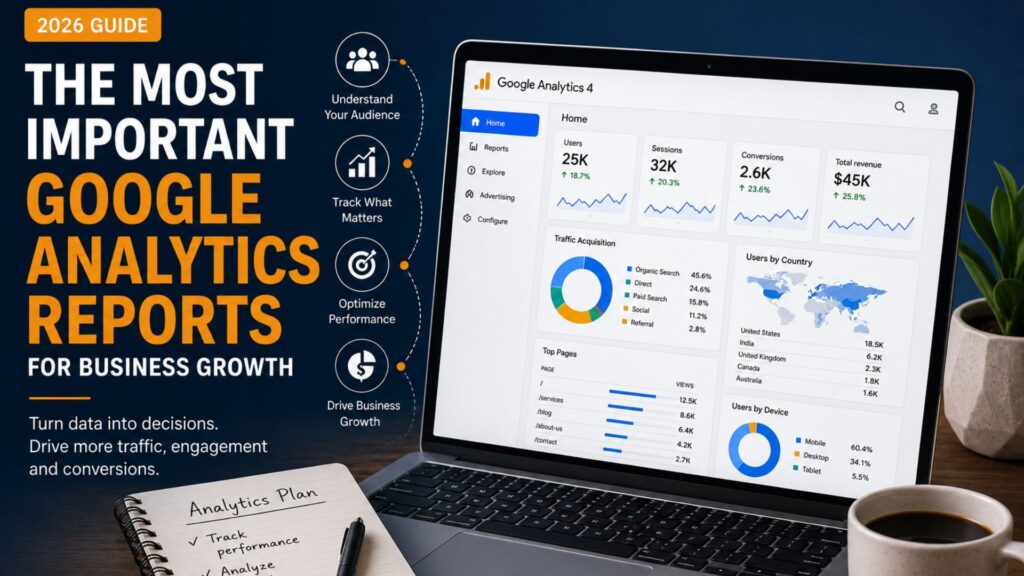
The Most Important Google Analytics Reports for Business Growth in 2026
Think back to the last marketing report you looked at.
Maybe it showed website traffic increasing by 20%. Perhaps your social media campaign generated hundreds of clicks. Or maybe your latest Google Ads campaign delivered more visitors than expected.
At first glance, those numbers look impressive.
But here’s the real question: Did any of those visitors become customers?
Many businesses collect data every day, yet very few know how to turn that data into meaningful business decisions. That’s where Google Analytics comes in.
Modern marketing isn’t about guessing. It’s about understanding how users discover your business, interact with your website, and move through the customer journey. The right Google Analytics reports help businesses identify opportunities, uncover hidden problems, and make smarter decisions based on actual user behavior.
The challenge isn’t collecting data anymore. The challenge is knowing which reports matter.
With hundreds of metrics available in Google Analytics, it’s easy to get distracted by vanity metrics that look good but don’t contribute to business growth. Expert marketers focus on a small group of reports that reveal what is actually driving revenue, engagement, and conversions.
In this guide, we’ll explore the most important Google Analytics reports for business growth and explain how each one can help improve marketing performance, customer experience, and return on investment.
Why Google Analytics Reports Matter More Than Ever
The digital landscape has changed dramatically over the past few years.
Businesses now invest in multiple channels including SEO, Google Ads, Meta Ads, email marketing, content marketing, and social media campaigns. Every channel generates data, but without proper analysis, that data becomes overwhelming rather than useful.
Google Analytics serves as the central hub where businesses can measure performance across channels and understand how users interact with their website.
The most important Google Analytics reports don’t simply tell you what happened. They help explain why it happened and what actions you should take next.
Businesses that regularly analyze Google Analytics reports can:
- Improve conversion rates
- Reduce marketing waste
- Identify top-performing channels
- Improve user experience
- Increase customer engagement
- Make better budget decisions
- Drive sustainable business growth
Let’s explore the reports that matter most.
1. Traffic Acquisition Report
One of the most important Google Analytics reports for business growth is the Traffic Acquisition Report.
This report answers a simple but critical question:
Where are your visitors coming from?
The report breaks down traffic by source and medium, helping businesses understand whether visitors are arriving through:
- Organic Search
- Paid Search
- Direct Traffic
- Social Media
- Email Marketing
- Referral Websites
Many businesses assume their marketing efforts are working equally well across all channels. The Traffic Acquisition Report often reveals a very different story.
For example, you may discover that organic search generates fewer visitors than social media but produces significantly more conversions.
This insight allows businesses to allocate resources more effectively and focus on channels that generate actual business results.
2. User Acquisition Report
While the Traffic Acquisition Report focuses on sessions, the User Acquisition Report focuses on first-time visitors.
This distinction is important because business growth often depends on attracting new customers.
The User Acquisition Report helps answer:
- Which channels attract new users?
- Which campaigns generate first-time visitors?
- How effective are awareness campaigns?
Understanding new user behavior helps businesses identify growth opportunities and evaluate the effectiveness of customer acquisition strategies.
3. Landing Page Report
Imagine spending thousands of dollars driving traffic to your website only to discover visitors leave immediately after arriving.
The Landing Page Report helps prevent this problem.
This report shows:
- Pages users enter through
- Engagement levels
- Conversion performance
- Bounce behavior
The Landing Page Report is one of the most important Google Analytics reports because first impressions matter.
High-performing landing pages often share common characteristics:
- Clear messaging
- Fast loading speeds
- Relevant content
- Strong calls-to-action
Businesses can use these insights to improve underperforming pages and increase conversions.
4. Engagement Report
Traffic alone doesn’t indicate success.
What matters is what users do after they arrive.
The Engagement Report measures how visitors interact with your content.
Key metrics include:
- Average engagement time
- Engaged sessions
- Events
- Pages per session
This report helps businesses identify whether content is genuinely capturing user attention or simply attracting clicks.
High engagement often signals stronger customer interest and higher conversion potential.
5. Conversion Report
For most businesses, conversions are the ultimate measure of success.
The Conversion Report tracks valuable actions such as:
- Form submissions
- Purchases
- Phone calls
- Newsletter signups
- Appointment bookings
This report directly connects marketing activities to business outcomes.
Without conversion tracking, businesses risk optimizing for traffic instead of revenue.
That’s why many experts consider this one of the most important Google Analytics reports available.
6. Pages and Screens Report
Every website contains pages that perform differently.
Some pages attract visitors and keep them engaged.
Others fail to deliver value.
The Pages and Screens Report identifies:
- Most viewed pages
- Highest engagement pages
- Exit-heavy pages
- Top-performing content
These insights help businesses understand which topics resonate most with their audience.
7. Demographic Details Report
Understanding your audience is essential for business growth.
The Demographic Details Report provides insights into:
- Age groups
- Gender
- Geographic regions
- Audience characteristics
These insights allow marketers to create more targeted campaigns and personalized experiences.
When businesses understand who their customers are, they can communicate more effectively.
8. Tech Details Report
Website performance depends heavily on technology.
The Tech Details Report reveals:
- Device usage
- Browser preferences
- Operating systems
- Screen resolutions
A website that performs perfectly on desktop may struggle on mobile devices.
This report helps businesses identify technical issues that could impact user experience and conversions.
9. Ecommerce Purchases Report
For online stores, the Ecommerce Purchases Report is critical.
It provides visibility into:
- Product performance
- Revenue generation
- Purchase behavior
- Shopping trends
Businesses can use this information to optimize product pages, inventory decisions, and promotional strategies.
10. Path Exploration Report
Customer journeys are rarely straightforward.
Users often visit multiple pages before taking action.
The Path Exploration Report visualizes how users move through a website.
This report helps answer:
- Where do users go next?
- Which paths lead to conversions?
- Where do users drop off?
Understanding customer journeys helps businesses remove friction and improve conversion rates.
11. Funnel Exploration Report
Every business has a conversion funnel.
The Funnel Exploration Report helps analyze each stage of that funnel.
Businesses can track:
- Product views
- Add-to-cart actions
- Checkout progression
- Completed purchases
Identifying drop-off points allows marketers to optimize the customer journey and recover lost opportunities.
12. Retention Report
Acquiring customers is important.
Keeping them is even more valuable.
The Retention Report measures how often users return to your website after their initial visit.
Strong retention often indicates:
- High customer satisfaction
- Effective content strategies
- Strong brand loyalty
Businesses focused on long-term growth should monitor retention metrics regularly.
Common Mistakes Businesses Make When Using Google Analytics Reports
Many organizations collect extensive data but fail to generate meaningful insights.
Common mistakes include:
- Focusing only on traffic
- Ignoring conversion tracking
- Looking at reports in isolation
- Not segmenting audiences
- Failing to act on findings
Data alone doesn’t create growth.
Action does.
The most successful businesses use Google Analytics reports to guide decisions, test ideas, and continuously improve performance.
Final Thoughts
The most important Google Analytics reports for business growth are not necessarily the ones with the most data.
They’re the reports that help businesses understand customers, improve marketing performance, and make smarter decisions.
As digital marketing becomes increasingly competitive, businesses that rely on assumptions will struggle to keep up. Those that leverage Google Analytics reports effectively will gain a significant advantage.
The future of marketing belongs to businesses that can transform data into action.
By focusing on the right Google Analytics reports, you can uncover opportunities, improve customer experiences, and build a stronger foundation for sustainable business growth in 2026 and beyond.
