Your #1 Google Ranking Means Nothing to ChatGPT — Here’s Proof
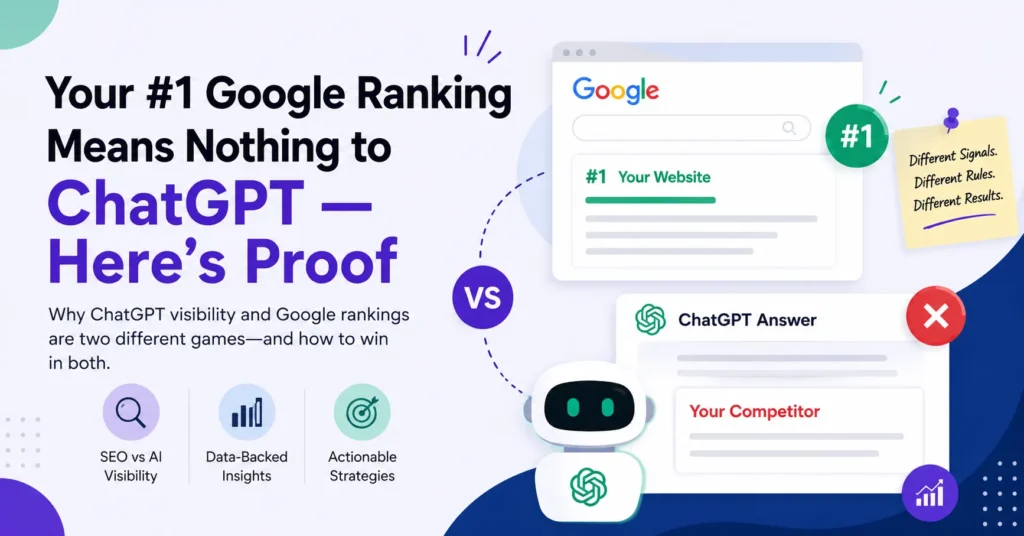
ChatGPT visibility and Google rankings turned out to be two completely different games, and most businesses haven’t caught up to that fact yet. It feels intuitive to assume that if you’re ranking #1 on Google, you’re automatically showing up when someone asks ChatGPT or Gemini a related question. That assumption is wrong, and the data backing it up is starting to become impossible to ignore.
Show Image
The Proof: Google Rank and ChatGPT Visibility Move Independently
A recent study tracking 100 SaaS brands across 10 categories compared first-page Google rankings against how often those same brands appeared in AI-generated answers. The result: the two barely correlated. In some categories, they moved in completely opposite directions a brand climbing higher on Google while becoming less visible inside AI answers, and vice versa.
This isn’t a small technical footnote. It means a business can have a genuinely strong SEO dashboard, a marketing team celebrating a top Google position, and still be completely absent from the shortlist an AI tool builds before a customer even visits a website. ChatGPT visibility runs on different signals than Google’s ranking algorithm, and treating them as the same problem is exactly why so many businesses are getting blindsided.
Why ChatGPT Visibility Doesn’t Follow Google’s Rules
AI Tools Don’t Just Pull From Top Search Results
Only a small fraction of what ChatGPT cites actually comes from Google’s top ten results. Instead, these tools pull from a much wider mix of sources — forums, comparison sites, structured data, and content that directly and clearly answers a specific question, regardless of where that content ranks in traditional search.
Zero-Click Search Changed the Starting Point
Roughly two-thirds of Google searches now end without anyone clicking through to a website at all. People are increasingly forming opinions and building shortlists inside the AI answer itself, before a brand’s website ever loads. This matters more in an environment where the AI answer has become the first — and sometimes only — impression a potential customer forms.
Authority Signals Are Different for AI
Google has long rewarded backlinks, domain authority, and technical SEO signals. AI models weigh things differently — clarity, directness, credibility signals like expert quotes or credentials, and how cleanly a piece of content answers a specific question tend to matter more than traditional ranking factors. A page built purely to rank on Google, stuffed with keywords and structured around search intent alone, often reads poorly to an AI model scanning for a clean, quotable answer.
How to Actually Build ChatGPT Visibility
Write to Be Quoted, Not Just Ranked
Content built for ChatGPT visibility needs to answer questions in clear, standalone sentences that make sense out of context — because that’s often exactly how AI tools extract and cite them. Burying the answer three paragraphs deep after a long introduction works against you here.
Show Up Where AI Actually Looks
Since AI answers pull heavily from forums, comparison content, and community discussion, genuine participation in places like Reddit or industry forums increasingly contributes to ChatGPT visibility in a way that traditional link-building alone doesn’t replicate.
Structure Content for Extraction
Comparison tables, clear definitions, and direct Q&A formatting are far easier for an AI model to pull from than long, narrative-style paragraphs. This is also exactly the kind of structure that supports strong AEO and GEO performance at the same time as traditional SEO.
What This Means for Your Marketing Strategy
Treating SEO as the only visibility metric that matters is quickly becoming an outdated strategy. A business can be investing heavily in Google rankings while its actual target customers are forming decisions inside ChatGPT, Gemini, or AI Overviews without ever encountering that business at all. ChatGPT visibility deserves its own line item in a marketing strategy, not an assumption that strong SEO automatically covers it.
Common Mistakes Businesses Make
The most common mistake is assuming AI visibility will simply follow once SEO improves. As the data shows, the two don’t move together reliably, which means content and strategy built purely for search engines can leave real gaps in how AI tools represent a business.
The second mistake is ignoring platforms and content formats that don’t feel like traditional SEO channels — forums, structured comparison content, and clearly sourced expert commentary — because they don’t fit the old SEO playbook, even though they increasingly drive ChatGPT visibility more directly than backlinks do.
Quick FAQ: ChatGPT Visibility in 2026
What is ChatGPT visibility? It refers to how often and how accurately a business or brand gets mentioned, cited, or recommended inside AI-generated answers from tools like ChatGPT, Gemini, or Google’s AI Overviews.
Does ranking #1 on Google guarantee ChatGPT visibility? No. Research comparing top Google rankings against AI answer citations found little to no correlation between the two, meaning strong SEO performance doesn’t reliably translate into AI visibility.
How is ChatGPT visibility different from traditional SEO? Traditional SEO rewards backlinks, domain authority, and search intent matching. ChatGPT visibility depends more on content clarity, direct answers, and credibility signals that AI models can easily extract and cite.
What’s the fastest way to improve ChatGPT visibility? Structuring content around clear, standalone answers to specific questions — using comparison tables, FAQs, and direct definitions — tends to perform better than long narrative content built purely for search rankings.
Should businesses stop investing in traditional SEO? No. SEO still drives real search traffic and remains essential. ChatGPT visibility should be treated as an additional strategy alongside SEO, not a replacement for it.
How Rebootiq Approaches ChatGPT Visibility and SEO Together
At Rebootiq, we build ChatGPT visibility considerations directly into every SEO engagement, rather than treating it as a separate service — because the two increasingly need to work together, not in isolation. This also connects closely with how we approach social media and content strategy, since a lot of what drives AI visibility overlaps with genuine, community-facing content. For Google’s own technical guidance on how content gets discovered and indexed, their Search Central documentation remains a solid reference point, alongside OpenAI’s own guidance on how ChatGPT search and citations work.
Not sure how visible your business actually is inside AI answers right now? Get a free website and visibility audit from our team. See how this plays out differently across business types on our industries page.
Thanks for choosing Rebootiq InfoTech.
