Schema Markup for AI Search: Does Structured Data Really Matter?
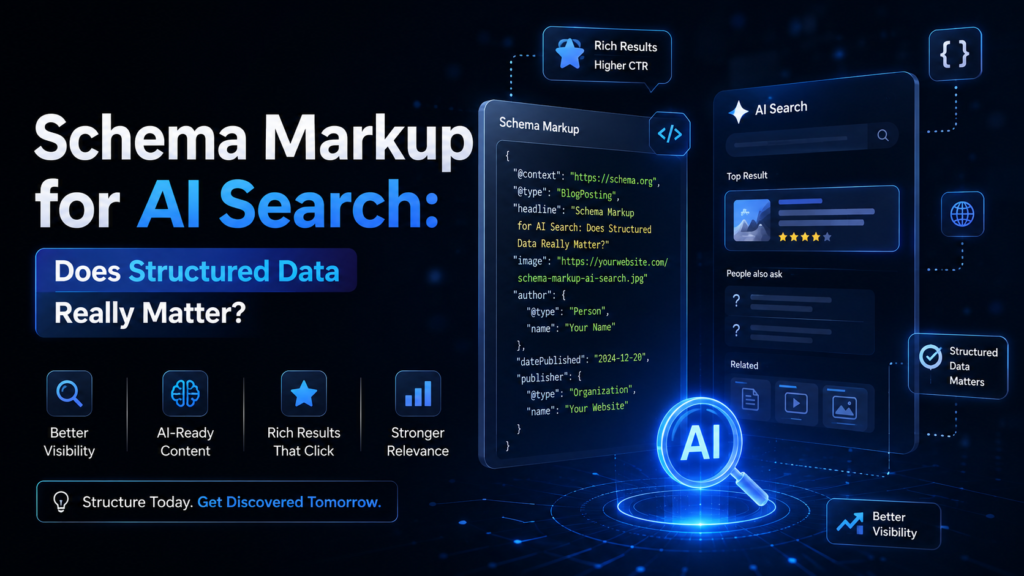
Search is no longer just about helping Google understand a webpage. Today, search engines and AI systems are trying to understand what your business is, what your content means, who created it, and how different pieces of information connect.
That is where schema markup comes in.
But there is a lot of confusion around it. Some marketers claim schema markup is the secret to getting cited by ChatGPT or appearing in AI Overviews. Others say it has become irrelevant.
The truth is somewhere in between.
What Exactly Is Schema Markup?
Schema markup, also called structured data, is a way of giving search engines additional context about the information on your website.
For example, instead of simply seeing:
Rebootiq is a digital marketing company.
Structured data can explicitly tell a search engine that Rebootiq is an Organization, provide its name, website, services, logo and other relevant information.
Most websites implement structured data using JSON-LD, which Google recommends as the preferred format.
Think of it as adding labels to your website’s information.
Your visitors see the content.
Search engines get additional context about what that content represents.
Does Schema Directly Help You Appear in AI Search?
Here is the important part: No special schema markup is required to appear in Google’s AI Overviews or AI Mode.
Google explicitly states that there is no special Schema.org markup you need to add for its generative AI search features. A page must primarily meet the normal technical and content requirements for Google Search.
So adding an “AI schema” and expecting your website to suddenly appear in ChatGPT or Google’s AI results is not a realistic SEO strategy.
But that doesn’t make schema useless.
So Why Does Structured Data Still Matter?
Because search engines need to understand entities and relationships, not just keywords.
Imagine a website selling laptops.
A product page might contain the product name, price, brand, availability, ratings and specifications. To a human, all of this is obvious.
Structured data gives search engines a clearer representation of those relationships.
Google says structured data can help it understand page content and can make pages eligible for richer search appearances.
That can indirectly support your overall search visibility by making important information easier to interpret and potentially qualify for supported search features.
Schema Should Support Your Content — Not Replace It
This is where many websites get it wrong.
Adding dozens of schema types to a page won’t compensate for weak content.
Google’s guidance for AI search emphasizes unique, useful, reliable, people-first content rather than trying to manipulate AI systems with special markup.
Your priority should therefore be:
Great content → strong technical SEO → clear entity information → relevant structured data.
Not:
Add schema → hope AI cites you.
Which Schema Should Your Website Use?
There isn’t one universal schema type that every website needs.
Depending on the business, useful types can include:
- Organization – helps describe your company or organization
- LocalBusiness – useful for eligible local businesses
- Article – helps describe editorial content
- Product – useful for ecommerce product information
- BreadcrumbList – describes website navigation
- ProfilePage – useful for appropriate profile pages
The key is relevance. Google recommends that structured data accurately represent the visible content on the page and that you use the most specific applicable type.
The Future Is About Clarity, Not Tricks
AI search is changing how people discover information, but the fundamentals haven’t disappeared.
Search engines still need to crawl your website, understand its content and determine whether it deserves to be surfaced.
Schema is one part of that communication layer.
It won’t guarantee an AI citation. It won’t magically improve poor content. And there is no “secret AI schema” that guarantees visibility.
But when implemented correctly, structured data gives search engines clearer signals about what your website and its content represent.
And as search becomes increasingly AI-driven, making your website easier for machines to understand is a smart investment.
The goal isn’t to add more schema. The goal is to make your website more understandable.
That is what makes structured data valuable in the AI-search era.
