SEO Is Evolving: Why GEO and AEO Matter More Than Ever in 2026
Imagine spending months optimizing your website, publishing content, earning backlinks, and finally securing a spot on Google’s first page.
For years, that was the ultimate goal. Higher rankings meant more traffic, more leads, and more business opportunities.
But search behavior is changing.
Today, many users no longer browse through multiple websites to find answers. Instead, they ask AI-powered platforms like ChatGPT, Gemini, Perplexity, or Google’s AI Overviews and receive instant responses within seconds.
This shift is transforming how people discover information online.
The challenge for businesses is no longer just ranking on search engines. It’s becoming visible wherever users are looking for answers.
That’s where SEO, AEO, and GEO come together.
While traditional SEO remains essential, businesses that want to stay competitive in 2026 must also understand how Answer Engine Optimization (AEO) and Generative Engine Optimization (GEO) influence online visibility.
Let’s explore why this evolution matters and how businesses can prepare for the future of search.
The Search Landscape Has Changed
For years, search engines acted as gateways to information.
A user would type a question into Google, receive a list of links, and visit several websites before finding the answer they needed.
Today, that journey is becoming shorter.
Search engines increasingly provide direct answers through AI Overviews, featured snippets, knowledge panels, and conversational AI experiences. At the same time, users are turning directly to AI assistants for recommendations, explanations, and research.
Consider a simple question:
“How much should a small business spend on Google Ads?”
A few years ago, users would click through multiple articles to compare insights.
Today, they may receive a complete AI-generated summary before visiting a single website.
As a result, visibility is no longer measured solely by rankings. Businesses must also consider whether their content is being surfaced, referenced, and trusted by AI systems.
SEO Isn’t Dead — It’s Evolving
Every few years, a new technology sparks conversations about the end of SEO.
It happened when social media became mainstream.
It happened when voice search gained popularity.
And now it’s happening again with artificial intelligence.
The reality is much simpler.
SEO is not disappearing.
Search engines still rely on websites to discover information, evaluate authority, and understand content. Keywords, technical optimization, user experience, and backlinks continue to play an important role.
What’s changing is that SEO is becoming part of a broader visibility strategy.
Today:
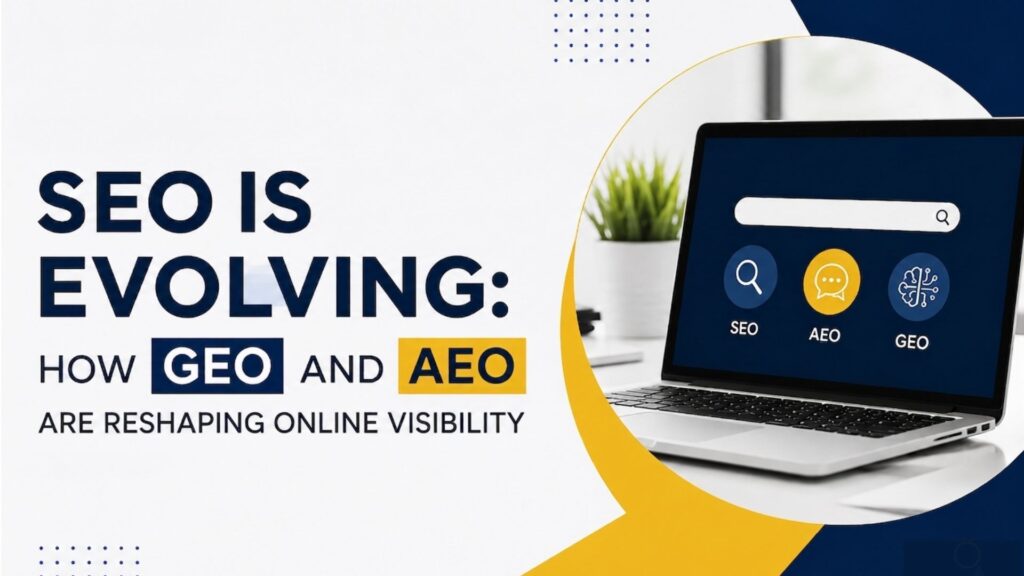
- SEO helps search engines find and rank your content.
- AEO helps answer engines understand your content.
- GEO helps AI systems trust and reference your content.
Businesses that embrace all three approaches will be better positioned to capture attention wherever users search for information.
What Is Answer Engine Optimization (AEO)?
Answer Engine Optimization focuses on creating content that directly answers user questions.
While traditional SEO often prioritizes keywords, AEO prioritizes clarity, relevance, and intent.
Think about how people interact with AI tools.
Users ask questions such as:
- What is the best CRM for small businesses?
- How much should I spend on digital marketing?
- What are the benefits of SEO?
AI systems look for content that provides clear and reliable answers.
If your content takes several paragraphs to answer a simple question, it becomes harder for answer engines to identify and surface your information.
AEO encourages businesses to create content that is:
- Clear and easy to understand
- Structured logically
- Focused on solving specific problems
- Written around real customer questions
- Supported by relevant examples and expertise
This is why FAQ pages, how-to guides, comparison articles, and educational resources are becoming increasingly valuable.
The easier it is for AI systems to understand your content, the more likely it is to be referenced.
What Is Generative Engine Optimization (GEO)?
If AEO is about providing answers, GEO is about becoming a trusted source.
Generative Engine Optimization focuses on increasing the likelihood that AI systems reference your content when generating responses.
When someone asks an AI platform:
“What are effective ways to generate leads for a small business?”
The platform doesn’t simply pull information from one source.
It evaluates multiple sources and prioritizes content that demonstrates expertise, credibility, and usefulness.
This creates a significant opportunity for businesses.
In traditional search results, larger brands often dominate due to strong authority and extensive resources.
In AI-driven search experiences, smaller businesses can earn visibility by consistently publishing high-quality, experience-based content.
GEO rewards businesses that:
- Demonstrate expertise
- Publish original insights
- Share real-world experiences
- Build authority within a specific niche
- Create genuinely useful content
The goal isn’t simply to create more content.
The goal is to create better content.
A Real-World Example
Consider two digital marketing agencies.
Agency A
Publishes generic articles optimized for keywords.
Most articles repeat information already available on hundreds of websites.
Agency B
Publishes detailed case studies, explains campaign strategies, shares lessons learned, answers customer questions, and provides actionable insights based on real experience.
Which agency is more likely to be referenced by AI systems?
Most likely Agency B.
Not because it publishes more content.
Because it provides stronger evidence of expertise and credibility.
As AI search continues to evolve, authority is becoming one of the most valuable digital assets a business can build.
Why Trust Is Becoming the New Ranking Factor
Across industries, the businesses gaining visibility are often those focused on helping rather than selling.
They:
- Share practical knowledge
- Publish expert opinions
- Answer customer questions openly
- Provide original perspectives
- Demonstrate real-world experience
Interestingly, these are many of the same principles that have always contributed to strong SEO performance.
The difference is that AI systems are becoming much better at identifying and rewarding trustworthy content.
Businesses that prioritize trust are positioning themselves for success across both traditional search engines and AI-powered platforms.
Is Your Business Ready for SEO, AEO, and GEO?
To evaluate your current strategy, ask yourself these questions:
- Does our content genuinely answer customer questions?
- Would an AI system clearly understand what our business offers?
- Are we demonstrating expertise through our content?
- Do we publish original insights based on real experience?
- Would our content deserve to be referenced by an AI platform?
Many businesses discover that their biggest challenge isn’t rankings.
It’s authority.
And authority isn’t built overnight.
It develops through consistency, expertise, and valuable content over time.
The Future of Search Belongs to Businesses That Adapt
We’re entering a new era where traditional search engines and AI assistants will coexist.
Users will continue using Google.
They will continue using AI platforms.
And new search experiences will continue to emerge.
Businesses don’t need to choose between SEO, AEO, or GEO.
The most effective strategy is to combine all three.
SEO helps people find you.
AEO helps answer their questions.
GEO helps ensure your business remains visible in an AI-first world.
Organizations that adapt early won’t simply maintain visibility—they’ll build a competitive advantage that becomes increasingly difficult for competitors to replicate.
Conclusion
SEO is not disappearing, but the way people discover information is changing rapidly.
As AI-powered search becomes more common, businesses must think beyond rankings and focus on becoming trusted sources of information.
By combining SEO, AEO, and GEO, brands can strengthen their visibility across traditional search engines and emerging AI-driven platforms.
The businesses that invest in expertise, create valuable content, and build authority today will be the ones leading the future of search tomorrow.
