Conversion Funnel Optimization: The Complete Guide to Generating More Leads in 2026
Conversion Funnel Optimization has become one of the most important growth strategies for modern businesses.
Think about the last time someone visited your website.
Maybe they clicked a Google Ads campaign. Perhaps they found your website through organic search. Or maybe they discovered your business through social media.
They landed on your website.
They explored a few pages.
And then they left.
No inquiry.
No phone call.
No purchase.
No lead.
If this sounds familiar, you’re not alone.
Most businesses spend significant time and money driving traffic to their websites, but very few focus on what happens after visitors arrive. That’s where Conversion Funnel Optimization makes all the difference.
The reality is simple. Traffic alone doesn’t grow a business. Conversions do.
The businesses generating consistent leads in 2026 aren’t necessarily attracting the most visitors. They’re converting a higher percentage of the visitors they already have.
Let’s explore how Conversion Funnel Optimization helps transform website traffic into qualified leads and sustainable business growth.
What Is Conversion Funnel Optimization?
A conversion funnel represents the journey users take from their first interaction with your business to becoming a lead or customer.
Every visitor moves through a series of stages.
They discover your business.
They evaluate your offer.
They build trust.
They take action.
Conversion Funnel Optimization is the process of improving each stage of that journey to increase the likelihood of conversion.
Rather than focusing only on attracting more traffic, businesses optimize the path users follow after they arrive.
The goal is straightforward.
Reduce friction.
Improve user experience.
Increase conversions.
Generate more qualified leads.
Why Most Businesses Lose Potential Leads
Many business owners assume they have a traffic problem.
In reality, they often have a funnel problem.
Imagine a website receiving 5,000 visitors per month.
At first glance, that sounds impressive.
But if only 20 visitors become leads, something isn’t working.
Common issues include:
- Slow-loading pages
- Confusing navigation
- Weak calls-to-action
- Poor landing page design
- Lack of trust signals
- Complicated forms
- Unclear messaging
Even small obstacles can cause potential customers to abandon the process.
Effective Conversion Funnel Optimization identifies and removes these barriers.
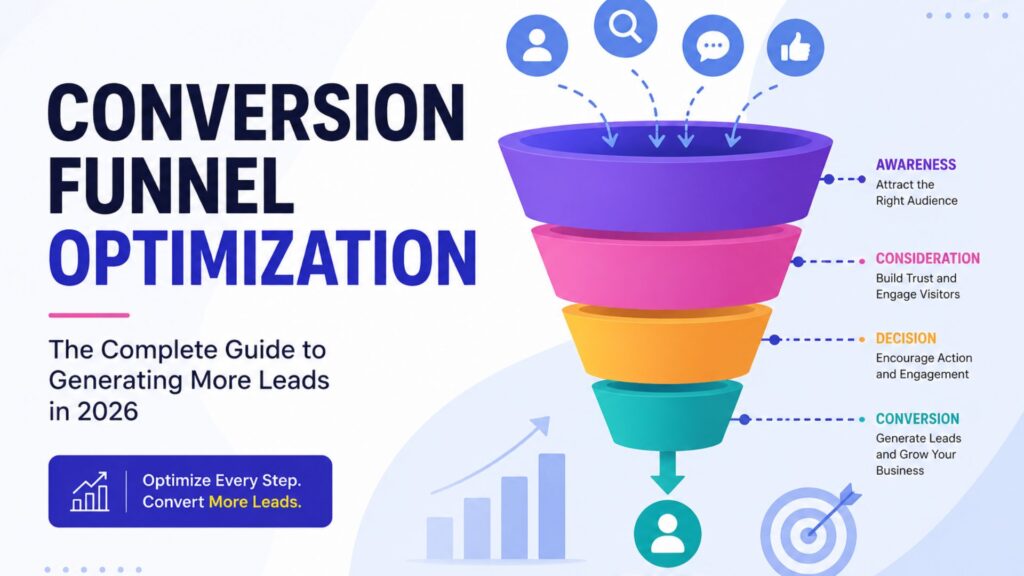
The Four Stages of a High-Converting Funnel
Understanding the customer journey is essential before making improvements.
Awareness Stage
This is where potential customers first discover your business.
They may arrive through:
- SEO
- Google Ads
- Social Media
- Referral Traffic
- Email Campaigns
At this stage, users are looking for information rather than making immediate purchasing decisions.
Your content should educate and attract attention.
Blog articles, guides, and educational resources work particularly well here.
Businesses can also leverage valuable content such as our guides on Google Analytics reports, SEO strategies, and digital marketing trends to attract users early in the funnel.
Consideration Stage
Visitors now understand their problem and are actively evaluating solutions.
They compare providers.
They research options.
They seek proof.
This is where trust becomes critical.
Case studies, testimonials, reviews, and service pages help move prospects forward.
Strong messaging during this stage can significantly improve Conversion Funnel Optimization efforts.
Decision Stage
At this point, users are ready to take action.
However, many businesses lose leads here due to poor user experience.
Visitors should clearly understand:
- What you offer
- Why you’re different
- What action to take next
Every call-to-action should be visible, compelling, and easy to follow.
Conversion Stage
This is where prospects become leads.
The process should be as simple as possible.
Long forms.
Unnecessary questions.
Complicated booking systems.
All of these reduce conversions.
The easier it is for users to contact you, the more leads you’ll generate.
Key Elements of Conversion Funnel Optimization
1. Landing Page Optimization
Landing pages play a critical role in funnel performance.
A high-converting landing page typically includes:
- Clear headline
- Strong value proposition
- Relevant visuals
- Trust indicators
- Single call-to-action
Every element should guide users toward one specific action.
2. Strong Calls-to-Action
Many businesses use generic CTAs such as:
- Submit
- Learn More
- Click Here
Effective CTAs communicate value.
Examples include:
- Get Your Free Strategy Session
- Download the Growth Guide
- Request a Custom Quote
Clear CTAs improve engagement and increase conversion rates.
3. Build Trust Early
Trust is one of the most overlooked aspects of Conversion Funnel Optimization.
Visitors are far more likely to convert when they see:
- Client reviews
- Testimonials
- Certifications
- Industry expertise
- Case studies
Trust reduces uncertainty and encourages action.
4. Improve Mobile Experience
Mobile traffic continues to dominate across industries.
A funnel that performs well on desktop but poorly on mobile will lose valuable opportunities.
Businesses should regularly review:
- Mobile page speed
- Form usability
- Navigation experience
- Button placement
Small mobile improvements often generate significant conversion gains.
Using Analytics to Improve Funnel Performance
One of the biggest advantages of modern marketing is access to data.
Businesses no longer need to guess where users are dropping off.
Tools like Google Analytics help identify:
- High-exit pages
- Low-performing landing pages
- Conversion bottlenecks
- User behavior patterns
For example, if users consistently abandon a form halfway through completion, the form may be too complex.
If a landing page receives traffic but generates few leads, the messaging may need improvement.
This is why analytics and Conversion Funnel Optimization work hand in hand.
Data reveals opportunities.
Optimization creates results.
Common Conversion Funnel Mistakes
Even experienced businesses make funnel mistakes.
Some of the most common include:
Focusing Only on Traffic
More traffic does not automatically mean more leads.
Improving conversions often produces greater results than increasing traffic.
Too Many CTAs
Multiple competing calls-to-action create confusion.
Users should always know the next step.
Ignoring User Intent
Every visitor arrives with a specific goal.
Content and offers should align with that intent.
Not Testing Changes
The most successful businesses continuously test:
- Headlines
- Forms
- CTA buttons
- Landing pages
- Content layouts
Small improvements can produce significant gains over time.
The Future of Conversion Funnel Optimization
The marketing landscape is becoming increasingly data-driven.
Artificial intelligence, predictive analytics, and behavioral insights are changing how businesses understand customers.
In 2026, successful businesses will focus on:
- Personalized customer journeys
- AI-powered recommendations
- Predictive lead scoring
- Advanced analytics
- Conversion-focused content
The goal remains the same.
Deliver the right message to the right person at the right time.
Businesses that embrace Conversion Funnel Optimization today will be better positioned to compete tomorrow.
Final Thoughts
Every business wants more leads.
The question is how to generate them consistently.
Conversion Funnel Optimization provides the framework for turning website visitors into qualified opportunities.
Instead of focusing exclusively on traffic, businesses should focus on improving the customer journey.
The most successful funnels are simple, user-focused, and data-driven.
As competition continues to increase in 2026, businesses that optimize every stage of the customer journey will gain a significant advantage.
More importantly, they’ll generate more qualified leads without constantly increasing their marketing spend.
The future belongs to businesses that don’t just attract attention.
They convert it into action.
