From Search Rankings to Search Presence: The New Definition of SEO Success
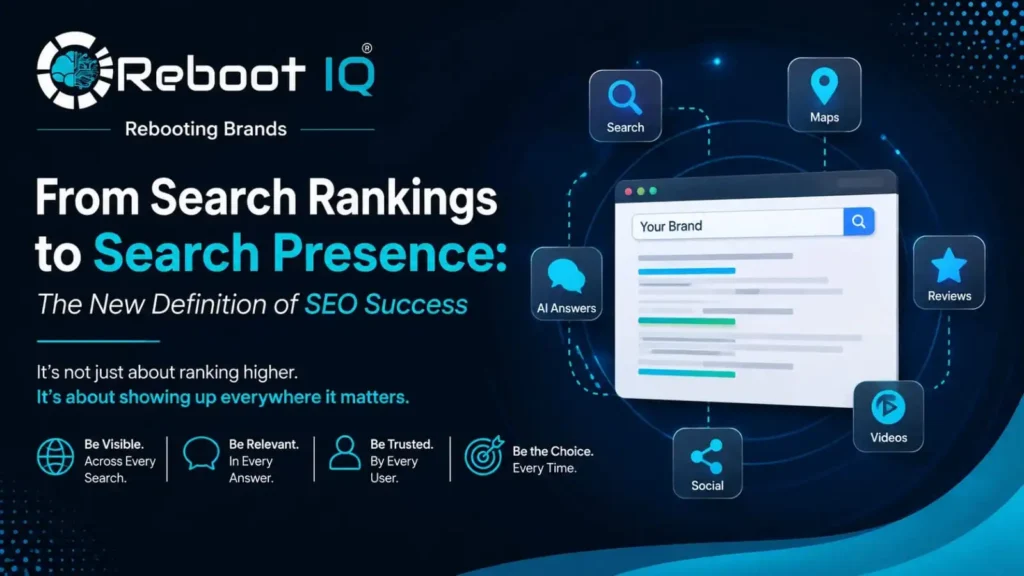
For almost two decades, SEO success meant one thing: rank #1, get the click. Businesses tracked position on a keyword list, watched blue links climb the SERP, and measured everything against that single number. It was a clean, simple model — and until recently, it worked. Search presence, not search rank, is quickly becoming the real measure of SEO success.
That model is breaking. Not because rankings stopped mattering, but because ranking #1 no longer guarantees the thing businesses actually wanted all along: to be seen, trusted, and chosen. Google now answers most queries directly on the results page. AI engines like ChatGPT, Perplexity, and Google’s AI Overviews summarize answers without sending a single click to your site. A user can encounter your brand, form an opinion about it, and make a decision — without ever visiting your website or seeing a “ranking” at all.
This is the shift from search rankings to search presence — and understanding it is quickly becoming the difference between brands that grow and brands that quietly disappear from the conversation.
Why “Rank #1” Isn’t the Win It Used to Be
Ranking first for a keyword used to almost guarantee traffic. Today, several things sit between that ranking and an actual visit to your site:
- Featured snippets and AI Overviews answer the query directly, often without the user scrolling further.
- Zero-click searches now account for a large share of all Google queries — the answer is delivered, no click required.
- AI chat tools synthesize information from multiple sources into one conversational answer, citing sources unevenly and inconsistently.
A business can rank #1 for its most important keyword and still see a decline in organic traffic, simply because the search results page itself has become the destination. Rankings still matter — they’re part of the equation — but they’re no longer the whole scoreboard.
What “Search Presence” Actually Means
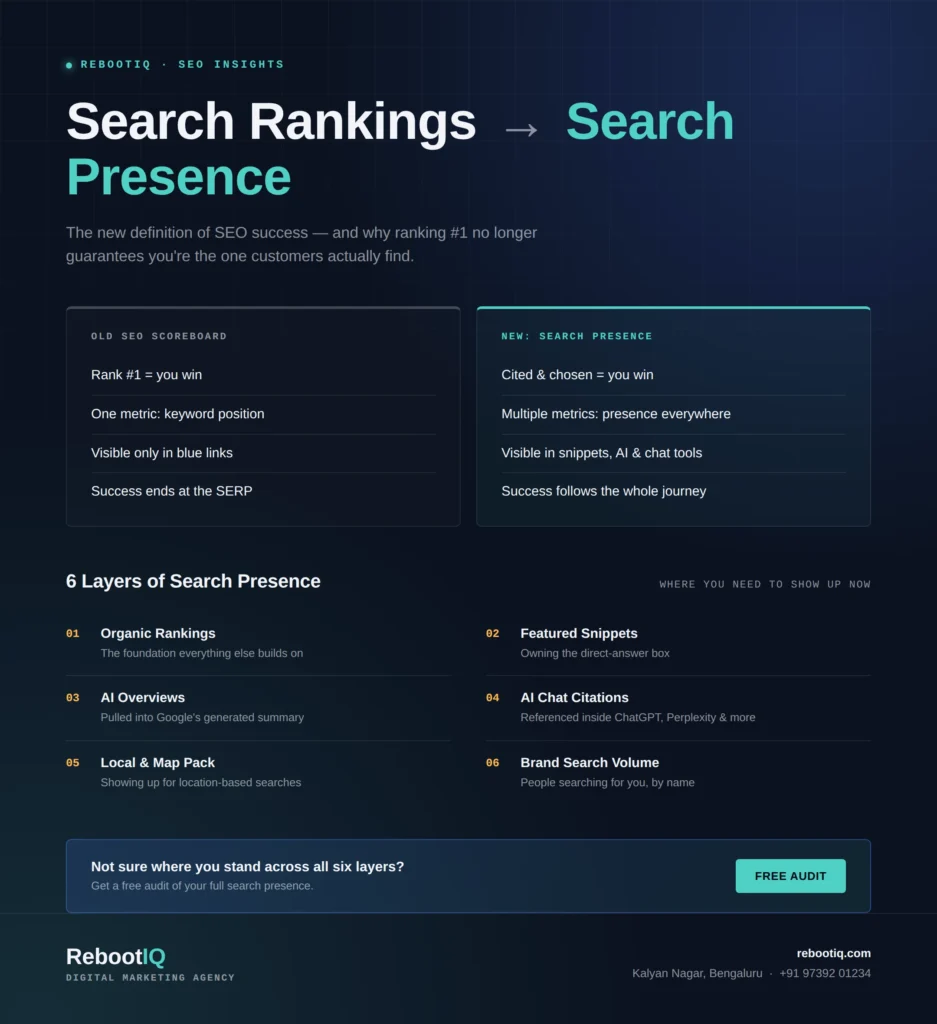
Search presence is bigger than a position on a results page. It’s the sum of everywhere and every way your brand shows up when someone is looking for what you offer:
1. Traditional organic rankings Still the foundation — visibility in classic blue-link results for the keywords that matter to your business.
2. Featured snippets and answer boxes Owning the direct-answer box means your brand is the answer, even without a click.
3. AI Overviews and generative answers Whether your content gets pulled into Google’s AI-generated summaries at the top of the page.
4. Citations inside AI chat tools Whether ChatGPT, Perplexity, Claude, or Gemini reference your brand, your data, or your expertise when answering a related question — even in a completely different app, outside Google altogether.
5. Local and map pack visibility For location-based businesses, showing up in the map pack and local AI-generated recommendations matters as much as organic rank.
6. Brand search volume and recognition When people search your brand name directly, it signals that your presence elsewhere — ads, social, word of mouth, PR — is working in tandem with SEO, not separate from it.
Search presence, in short, is about being findable and credible everywhere a decision gets made — not just clickable in one specific spot.
Why This Shift Happened
Three forces converged to make this change unavoidable:
Search engines started answering, not just linking. Google’s core mission shifted from “organize information” to “resolve the query.” Every feature added in the last five years — snippets, knowledge panels, AI Overviews — exists to keep the user on Google’s page longer, not send them away faster.
AI engines became a second search layer. People increasingly ask ChatGPT or Perplexity a question the way they’d have Googled it five years ago. These tools don’t show ten blue links — they show one synthesized answer, built from sources they trust enough to cite. If your content isn’t structured in a way these tools can parse and trust, you’re invisible in this layer entirely, regardless of your Google ranking.
Trust signals became machine-readable. Structured data, schema markup, clear authorship, and consistent factual accuracy aren’t optional add-ons anymore — they’re how both traditional search engines and AI engines decide what’s credible enough to surface. A page that reads well to a human but is unstructured for machines is increasingly disadvantaged, no matter how well-written it is.
What This Means for Your SEO Strategy
Adapting to search presence doesn’t mean abandoning traditional SEO — it means building on top of it.
Keep the fundamentals strong. Technical SEO, page speed, mobile responsiveness, and quality backlinks are still the foundation everything else is built on. None of the newer visibility channels work without this base in place.
Structure content for extraction, not just readability. Use clear headings, direct answers near the top of sections, and concise definitions — the format AI engines and featured snippets both favor when pulling content into a summarized answer.
Implement schema markup deliberately. FAQ schema, Organization schema, and Article schema give search engines and AI tools structured, unambiguous data about your content — increasing the odds you’re the one cited when an answer gets generated.
Build topical authority, not just keyword coverage. AI engines and modern search algorithms both favor sources that demonstrate depth across a subject, not just a single optimized page. A cluster of genuinely useful, interlinked content on a topic outperforms one isolated “SEO article” every time.
Track new metrics. Rankings and organic traffic still matter, but pair them with brand search volume, AI citation tracking, and share of voice in your category — the metrics that reflect actual presence, not just position.
The Businesses Getting This Right
The brands adapting fastest aren’t necessarily the ones with the biggest SEO budgets — they’re the ones treating visibility as a system rather than a single tactic. They combine solid on-page SEO with structured data, consistent content depth, and a presence across the platforms their customers actually use to search and ask questions — Google, yes, but increasingly AI tools too.
This is also why SEO and content strategy can’t sit in separate silos anymore. The content that ranks well and the content that gets cited by AI engines is, more often than not, the same content — built with clarity, structure, and genuine expertise, not just keyword density.
Frequently Asked Questions
Is traditional SEO still worth investing in? Yes. Traditional SEO — technical health, quality content, and backlinks — remains the foundation that search presence is built on. AI engines and featured snippets still draw from well-optimized, authoritative pages; they don’t replace the fundamentals, they add new layers on top of them.
What is AEO (Answer Engine Optimization) and how is it different from SEO? AEO focuses specifically on getting your content cited or surfaced as the answer inside AI tools and answer-based search features, using structured data, clear direct answers, and schema markup. SEO is the broader discipline; AEO is a growing subset of it focused on how machines extract and cite information.
How do I know if AI engines are citing my website? You can check by asking relevant questions directly in tools like ChatGPT or Perplexity and seeing whether your brand or content is referenced or linked as a source. Some SEO platforms are also beginning to offer AI-citation tracking as a dedicated metric.
Does schema markup actually make a measurable difference? Yes. Schema markup gives search engines and AI tools structured, unambiguous data about your content, which increases your chances of appearing in rich results, featured snippets, and AI-generated answers — all outcomes that are difficult to achieve with unstructured content alone.
Final Thoughts
The businesses that treated SEO as “get to #1 and stop” are the ones most exposed by this shift. The ones that treat it as an ongoing system — technical foundation, structured content, topical authority, and visibility across both traditional and AI-driven search — are the ones building a presence that’s harder to displace and harder to ignore.
Search rankings got you found. Search presence gets you chosen — on Google, in an AI Overview, or inside a conversation with ChatGPT you never even see happen.
If you’re not sure where your brand currently stands across these different layers of visibility, Rebootiq’s free website audit is a good place to start — it looks at your technical SEO, content structure, and overall search presence, not just your keyword rankings.
