The SEO Tool Every Agency Relied On Just Stopped Working Here’s Why
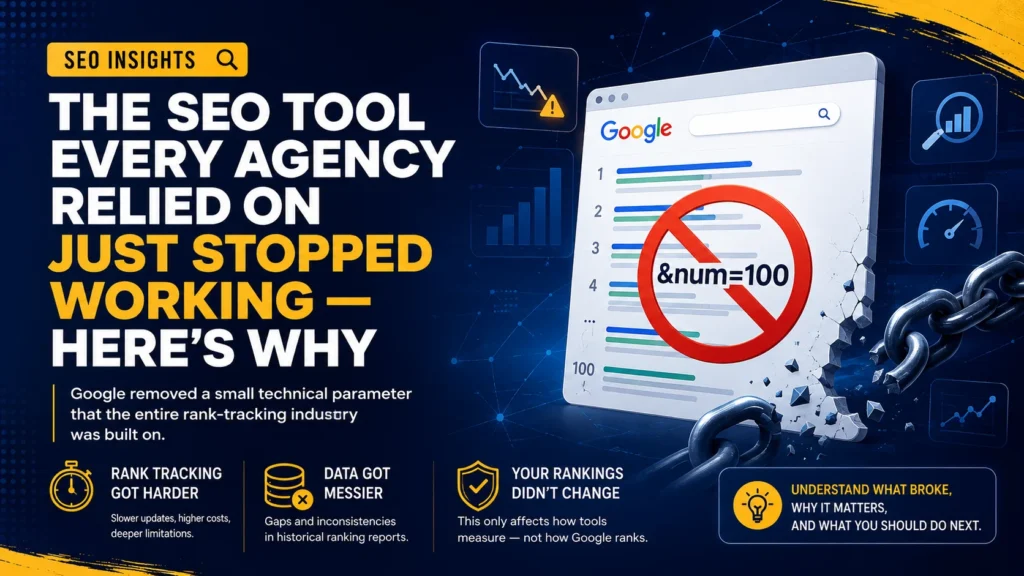
Every SEO tool that agencies and businesses have leaned on for years quietly stopped pulling accurate data at the same time, and most people didn’t understand why until they went looking. It wasn’t a bug in Ahrefs or SEMrush or any of the dozens of platforms built around tracking rankings. It was Google itself, removing a small technical parameter that the entire rank-tracking industry had been quietly built on top of for over a decade.
What Actually Broke, in Plain Terms
Google search results pages used to support a hidden parameter called &num=100, which let anyone pull up to 100 search results on a single page instead of the usual 10. Almost no regular person ever used this directly — but nearly every SEO tool on the market relied on it behind the scenes to efficiently check where a website ranked, sometimes deep into position 50 or 80, without having to load ten separate pages of results one at a time. Google removed that parameter entirely, and any SEO tool built around it simply stopped being able to pull that data the same way.
Why This Actually Matters, Beyond the Technical Detail
Rank Tracking Got Dramatically Slower and More Expensive
Without the ability to pull 100 results at once, tracking now requires far more individual requests to check the same set of keywords across the same depth of results. That means slower updates, higher operating costs for the platforms themselves, and in some cases, tools quietly reducing how deep they track rankings by default to manage the load.
A Lot of Historical Data Got Messier Overnight
Any SEO tool that had been tracking rankings down to position 50 or 100 for years suddenly had a visible gap or inconsistency in that data the moment the change hit. Businesses checking long-term ranking trends may have noticed sudden dips or missing data points that had nothing to do with actual search performance — it was the tracking method itself that broke, not the rankings.
Smaller Tools Got Hit Hardest
Larger platforms with more engineering resources adapted faster, rebuilding their tracking methods around the new limitations. Smaller or newer tools, often the ones smaller agencies and freelancers relied on specifically because they were cheaper, had a harder time adjusting quickly, which created a real gap in tool reliability across the industry for a period.
What This Means If You’re Using an SEO Tool Right Now
Check If Your Tool Has Actually Adjusted
Not every SEO tool handled this the same way or on the same timeline. It’s worth directly asking whichever platform you use how they’ve adapted their tracking methodology, rather than assuming the numbers you’re seeing are still being pulled the same way they were before.
Be Skeptical of Sudden Ranking Swings Around This Timeframe
If your reported rankings shifted dramatically around the time this change rolled out, it’s worth questioning whether that reflects a real change in search visibility or simply a change in how the tool itself is now measuring things.
Understand This Doesn’t Change Actual Google Rankings
This is a genuinely important distinction: nothing about how Google actually ranks your site changed because of this. What changed is purely how third-party tools measure and report that ranking back to you. Your actual position in search results wasn’t affected by this at all.
What This Says About the SEO Industry More Broadly
This whole episode is a reminder that a lot of the infrastructure the SEO industry runs on isn’t officially supported by Google — it’s built on workarounds and undocumented behavior that Google never guaranteed would stay available. Every SEO tool built on &num=100 was relying on something Google could remove at any time, and eventually did, without warning or announcement.
Common Mistakes Businesses Are Making Right Now
The most common mistake is panicking over a sudden ranking drop reported by an SEO tool without checking whether it’s a real drop or a tracking artifact from this change. Cross-referencing with Google Search Console, which pulls data directly from Google rather than through a workaround, is a more reliable way to confirm what’s actually happening.
The second mistake is assuming every SEO tool handled this identically. Some platforms adjusted quickly and transparently; others took longer or were less clear about what changed, which means data reliability genuinely varies more right now than it did before this happened.
Quick FAQ: The SEO Tool Disruption and Google’s Parameter Removal
What exactly did Google remove that broke SEO tools?
Google removed support for the &num=100 parameter, which previously let tools pull up to 100 search results at once instead of the standard 10 per page.
Did my website ‘s Google ranking really change ?
No This only changed the way third party tools measure and report rankings . It did not change the way Google ranks websites in search results .
How do I know if my SEO tool has adapted to this change?
Contact your tool provider directly or check their support documentation. Larger and older platforms generally adjusted quicker than smaller or newer tools.
Can I treat ranking data from pre and post-change the same?
Be careful comparing data across this change period, as the measurement method changed. A better way to verify real shifts is by cross-referencing with Google Search Console.
Is there a workaround SEO tools are using now?
Most major platforms have rebuilt their tracking methods around the new limitations, though this generally means more individual requests per keyword rather than a single efficient pull, which affects speed and cost for the tools themselves.
How Rebootiq Approaches This
At Rebootiq, we cross-reference every SEO tool’s reported rankings against Google Search Console directly, precisely because third-party tracking has always depended on methods Google doesn’t officially guarantee. This kind of disruption is exactly why relying on a single data source is risky, and it’s built into how we handle SEO reporting for every client.
Not sure if your reported rankings are actually reflecting reality right now? Get a free SEO audit from our team, and we’ll cross-check your data properly. See how our approach differs across business types on our industries page. You can also check out our work on LinkedIn and Instagram.
Thanks for choosing Rebootiq InfoTech.
