
Why Healthcare Clinics Need a Smarter Ad Strategy Than E-commerce Brands in 2026
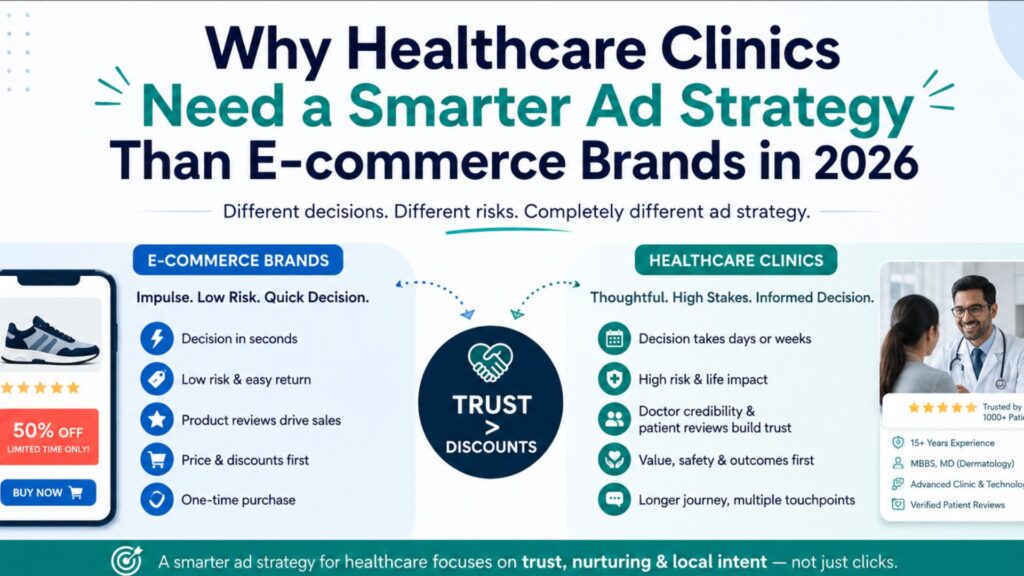
A healthcare clinic ad strategy has to work completely differently from a retail campaign, and most clinics don’t realize this until they’ve already burned through budget. Think about the last ad you clicked. Maybe it was a pair of sneakers, a skincare bundle, or a flash sale banner that popped up mid-scroll. You clicked, you bought, you moved on. Now think about the last ad you clicked for a doctor, a dentist, or a diagnostic clinic. Chances are, you didn’t book instantly. You paused. You checked reviews. Maybe you asked a friend first.
That gap is exactly why a healthcare clinic ad strategy can’t be copy-pasted from an e-commerce playbook. Yet every day, clinics run Meta and Google campaigns built on the same logic that sells t-shirts and phone cases — and then wonder why the cost per lead keeps climbing while the appointment book stays empty.
Why a Healthcare Clinic Ad Strategy Can’t Copy the E-commerce Playbook
E-commerce marketing is built on impulse, urgency, and low-risk decisions. “50% off, ends tonight” works because buying a candle is reversible and cheap. Choosing a clinic is neither. A patient is trusting someone with their body, their family’s health, or a diagnosis they’re scared to face. That single difference changes everything about how the ad, the landing page, and the funnel need to work.
Here’s where the two worlds split apart:
- Decision speed: E-commerce buyers decide in seconds. Patients research for days or weeks before booking.
- Risk level: A wrong purchase means a return. A wrong clinic choice feels personal and high-stakes.
- Trust signals: Product ratings sell items. For clinics, it’s doctor credentials, patient testimonials, and word-of-mouth that close the deal.
- Compliance: Healthcare ads are far more restricted on Meta and Google. Google’s own healthcare & medicines advertising policy limits certain claims and targeting options that retail advertisers never have to think about.
- Search intent: E-commerce keywords are transactional (“buy running shoes online”). Healthcare keywords are investigative (“best dermatologist for acne near me”, “is X treatment safe”).
Run a healthcare clinic ad strategy like a retail campaign, and you’ll get clicks — just not patients.
Building a Healthcare Clinic Ad Strategy That Actually Fills Appointments
1. Local Intent Comes First
Nobody flies across the country for a routine dental check-up. Healthcare decisions are hyperlocal, which means an optimized Google Business Profile, location-based landing pages, and “near me” search visibility matter more than broad brand awareness campaigns. If your clinic isn’t showing up in the local map pack, the ad budget upstream barely matters. Our SEO services are built around exactly this kind of local visibility work.
2. Trust-First Creative, Not Discount-First Creative
E-commerce ads lead with price. A strong healthcare clinic ad strategy leads with credibility — doctor qualifications, before-and-after outcomes (where compliant), patient testimonials, and clear, reassuring messaging. The goal isn’t “act now,” it’s “you’re in good hands.”
3. Longer, Nurture-Based Funnels
A patient might see your ad, visit your website, read reviews, check your doctors’ credentials, and only then call to book — sometimes over several days. That means retargeting, WhatsApp follow-ups, and email nurture sequences matter far more for clinics than they do for a one-click checkout store.
4. Compliance-Aware Campaign Structure
Google and Meta apply extra scrutiny to healthcare advertisers. Clinics that ignore this risk ad disapprovals, account flags, or wasted spend on campaigns that never fully launch. Our Google Ads management process for clinics is built to stay compliant from day one, rather than fixing rejected campaigns after the fact.
5. Review and Reputation Management as a Core Channel
For most e-commerce brands, reviews are a nice-to-have. For clinics, they’re often the deciding factor. A five-star Google rating with recent, detailed reviews can outperform a bigger ad budget with a shaky reputation. That’s why review generation — actively asking happy patients to leave one, and responding to every review, good or bad — deserves its own line item in the marketing plan, not an afterthought.
6. Front-Desk and Call Handling as Part of the Funnel
This is the part most agencies never mention because it’s outside their scope — but it shouldn’t be. An e-commerce funnel ends at checkout. A healthcare funnel ends when the phone gets answered, the WhatsApp message gets a quick reply, and the front desk actually books the slot. We’ve seen clinics run flawless campaigns that still underperform because a lead called in and nobody picked up for twenty minutes. A real healthcare clinic ad strategy accounts for what happens after the click, not just up to it.
7. Platform Choice Isn’t One-Size-Fits-All
E-commerce brands often default to Meta because visual, scroll-stopping product creative performs well there. Clinics need a more blended approach. Google Search captures people actively looking for a solution right now (“urgent care near me open now”), which tends to convert faster than social. Meta works better for awareness — introducing your clinic, your doctors, and your facility to people who aren’t searching yet but will be soon.
Common Mistakes That Undermine a Healthcare Clinic Ad Strategy
The biggest mistake we see clinics make is optimizing purely for cost-per-click the way an e-commerce store would. A cheap lead that never books an appointment isn’t a win — it’s wasted spend with extra steps. A real healthcare clinic ad strategy tracks cost-per-booked-appointment, not just cost-per-click, and builds the entire funnel — ad, landing page, WhatsApp follow-up, front-desk process — around that number.
The second most common mistake is copying competitor ads without understanding why they work. A clinic might see a rival running a flashy discount-style promotion and assume that’s the winning formula. But healthcare decisions rarely hinge on price the way retail does. Patients aren’t choosing a cardiologist because of a limited-time offer — they’re choosing based on trust, outcomes, and how safe the clinic makes them feel.
Quick FAQ: Healthcare Clinic Ad Strategy in 2026
Is Google Ads or Meta Ads better for clinics? Both play a role, but they do different jobs. Google Search captures people actively searching for care right now, which usually means faster conversions. Meta is better suited for building awareness and trust with people who aren’t ready to book yet but will be in the coming weeks.
How long does it take to see results from a healthcare clinic ad strategy? Because patient decisions take longer than retail purchases, clinics should expect a nurture window of days to weeks rather than instant conversions. Campaigns typically need 4-6 weeks of data before real optimization decisions can be made.
Can clinics run the same kind of discount ads as e-commerce brands? Generally, no. Many platforms restrict certain health-related claims and targeting options, and overly promotional healthcare messaging tends to erode trust rather than build it. Value-based, credibility-first messaging performs better for any healthcare clinic ad strategy.
What’s the single biggest lever for improving patient ad performance? Trust signals. Verified reviews, visible doctor credentials, and fast response times to inquiries consistently move the needle more than adjusting bids or creative alone.
Building Your Healthcare Clinic Ad Strategy with Rebootiq
At Rebootiq, we’ve worked with clinics who came to us after burning budget on generic, e-commerce-style campaigns that generated clicks but not patients. What changed the results wasn’t a bigger budget — it was a healthcare clinic ad strategy built around how patients actually make healthcare decisions: local-first targeting, trust-driven creative, compliant campaign structures, and funnels that nurture instead of rush. You can see how we approach this across different specialties on our healthcare industry page.
If your clinic’s ads are getting clicks but not calls, the problem usually isn’t the budget. It’s the playbook.
Want a free mini-audit of your current healthcare clinic ad strategy? Share your website and location with our team, and we’ll send back specific, actionable recommendations — no obligation.
Thanks for choosing Rebootiq InfoTech.
