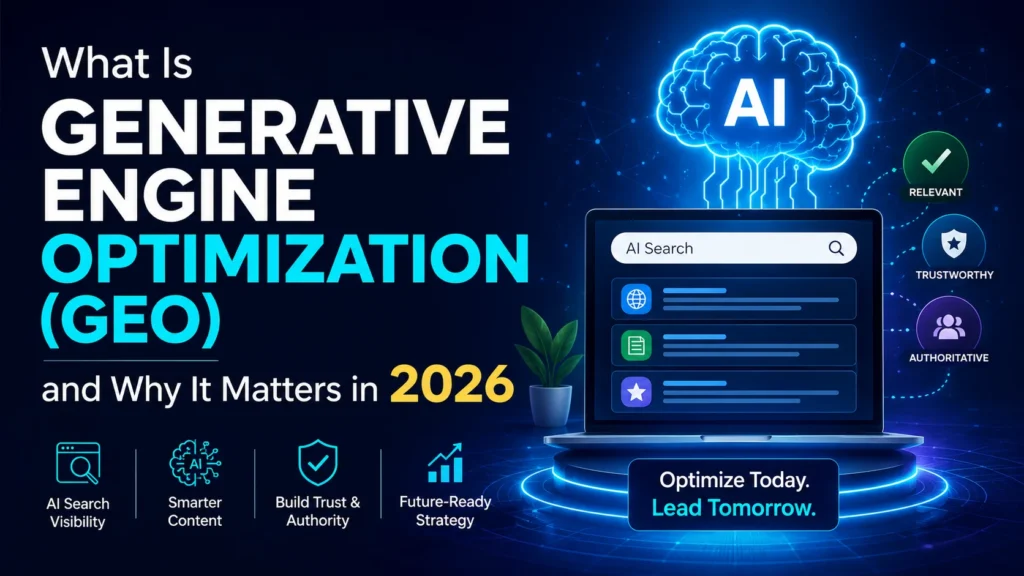
What Is Generative Engine Optimization (GEO) and Why It Matters in 2026
Introduction
Search is changing faster than ever before. For nearly two decades, businesses have relied on Search Engine Optimization (SEO) to improve their visibility on Google and attract organic traffic. The strategy was straightforward: create relevant content, optimize it for keywords, build authority through backlinks, and earn higher rankings.
Today, however, the way people discover information is evolving. Instead of scrolling through pages of search results, users are increasingly asking questions directly to AI-powered platforms such as ChatGPT, Google AI Overviews, Microsoft Copilot, Gemini, and Perplexity. These systems don’t simply display links—they generate detailed answers by understanding user intent and synthesizing information from multiple trusted sources.
This shift is transforming digital marketing and introducing a new optimization strategy known as Generative Engine Optimization (GEO).
Rather than focusing only on improving search rankings, GEO aims to make your content easier for AI systems to understand, evaluate, and reference when generating answers. As AI-powered search becomes a primary way people find information, businesses that embrace GEO early will be better positioned to maintain visibility, build authority, and reach potential customers.
What Is Generative Engine Optimization (GEO)?
Generative Engine Optimization (GEO) is the process of creating, organizing, and optimizing content so that AI-powered search platforms can easily understand and use it when generating responses to user queries.
Unlike traditional SEO, which concentrates on ranking web pages in search engine results, GEO focuses on increasing the likelihood that your content will be referenced or reflected in AI-generated answers.
Think of GEO as preparing your website for the next generation of search. Instead of writing solely for search engine crawlers, you’re creating content that helps AI systems identify reliable information and present it to users in a meaningful way.
Why GEO Matters in 2026
Artificial intelligence is no longer an emerging technology—it has become part of everyday online experiences.
Consumers now ask conversational questions such as:
- Which digital marketing strategy delivers the best ROI for small businesses?
- How can I improve my website’s AI search visibility?
- What’s the difference between SEO, AEO, and GEO?
Rather than showing ten blue links, AI platforms provide direct, summarized answers. If your website contains clear, accurate, and authoritative information, it has a better chance of influencing those responses.
This shift makes GEO an essential part of a modern digital marketing strategy.
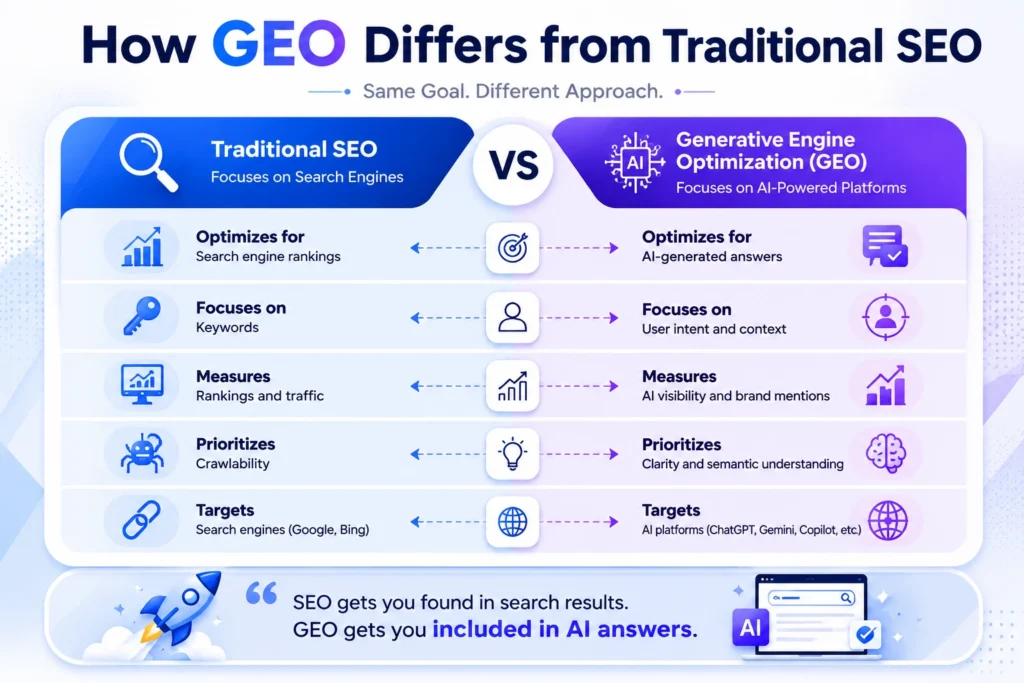
How GEO Differs from Traditional SEO
Although GEO and SEO share the goal of increasing online visibility, they achieve it in different ways.
Traditional SEO is designed to improve a website’s position in search engine results. GEO focuses on making information understandable and trustworthy enough for AI systems to include in their answers.
| Traditional SEO | Generative Engine Optimization (GEO) |
|---|---|
| Optimizes for search engine rankings | Optimizes for AI-generated answers |
| Focuses on keywords | Focuses on user intent and context |
| Measures rankings and traffic | Measures AI visibility and brand mentions |
| Prioritizes crawlability | Prioritizes clarity and semantic understanding |
The strongest digital marketing strategies combine both approaches rather than treating them as separate disciplines.
How AI Platforms Evaluate Content
AI systems don’t simply select the highest-ranking page. Instead, they assess multiple factors to determine whether information is suitable for inclusion in a response.
These factors include:
- Accuracy and factual consistency
- Clear organization and structure
- Demonstrated expertise
- Original insights
- Topical depth
- Website credibility
- Content freshness
- Positive user experience
When these signals work together, your content becomes more valuable not only for readers but also for AI-powered search systems.
The Core Principles of GEO
Write for People First
The foundation of GEO is creating content that genuinely helps users. Articles should answer real questions, solve practical problems, and explain concepts in a way that is easy to understand.
Demonstrate Expertise
Generic information is easy to find. What makes content valuable is unique knowledge, practical experience, and thoughtful analysis. Businesses should share insights that reflect their expertise rather than repeating information already available elsewhere.
Organize Content Clearly
AI systems process structured information more effectively. Use descriptive headings, concise paragraphs, bullet points, numbered lists, and FAQ sections to improve readability and comprehension.
Build Topical Authority
Publishing one excellent article is not enough. Consistently creating high-quality content around related topics helps establish your website as a trusted resource within a specific niche.
Practical Strategies to Implement GEO in 2026
Understanding GEO is only the beginning. The real advantage comes from applying it consistently across your website. Businesses that optimize their content for AI search today will be better prepared for how users discover information in the future.
Here are some practical strategies to help your website become more AI-friendly.
1. Answer Real User Questions
Generative AI is designed to solve problems, not simply display search results. That means your content should focus on answering the exact questions your audience is asking.
Instead of creating broad articles, build content around specific queries. For example, rather than writing only about “Digital Marketing,” publish articles that answer questions such as:
- What is Generative Engine Optimization?
- How does GEO improve AI search visibility?
- Can SEO and GEO work together?
- How do AI search engines find reliable information?
The more directly your content answers a question, the easier it is for AI systems to understand and reference it.
2. Publish Original Insights
One of the biggest mistakes businesses make is repeating information that already exists on hundreds of websites.
AI platforms increasingly value original perspectives.
Share:
- Client success stories
- Campaign observations
- Industry trends you’ve noticed
- Lessons learned from real projects
- Expert recommendations
Original content helps establish authority and gives AI a reason to trust your website over others.
3. Build Topic Clusters
Instead of publishing unrelated articles, organize your content around one central topic.
For example, if your primary topic is Generative Engine Optimization, related blogs could include:
- SEO vs GEO
- AI Search Optimization
- Google AI Overviews Explained
- How ChatGPT Finds Information
- EEAT and AI Search
- Schema Markup Guide
- Future of Search in 2026
Interlinking these articles helps search engines and AI understand your expertise.
4. Improve Content Readability
AI systems process structured content more efficiently.
Write using:
- Short paragraphs
- Clear headings
- Bullet points
- Tables
- Numbered steps
- FAQ sections
Readable content benefits both visitors and AI models.
5. Strengthen Technical SEO
Even the best content can struggle if your website has technical issues.
Review your website regularly for:
- Fast loading speed
- Mobile responsiveness
- HTTPS security
- Broken links
- XML sitemap
- Clean URL structure
- Image optimization
Technical SEO provides the foundation for GEO.
6. Use Structured Data (Schema Markup)
Schema Markup helps search engines understand the meaning of your content.
Useful schema types include:
- Article
- FAQ
- Organization
- Breadcrumb
- Local Business
- Review
- Service
Structured data increases clarity and may improve visibility across search experiences.
7. Keep Content Updated
AI systems prefer information that reflects current trends.
Review important articles every few months to:
- Update statistics
- Add new examples
- Remove outdated information
- Improve readability
- Expand sections when necessary
Fresh content signals reliability.
Common GEO Mistakes to Avoid
Many businesses unknowingly reduce their chances of appearing in AI-generated answers.
Avoid these common mistakes:
- Publishing duplicate content
- Writing only for keywords
- Ignoring user intent
- Using misleading headlines
- Creating thin articles with little value
- Neglecting technical SEO
- Failing to update old content
- Not linking related articles together
Instead, focus on creating helpful, accurate, and trustworthy resources.
GEO Checklist
Before publishing any article, ask yourself:
✅ Does the article answer a real user question?
✅ Is the information accurate and well researched?
✅ Does the content include original insights?
✅ Are headings clear and descriptive?
✅ Is the article easy to read?
✅ Have I added internal links?
✅ Is the page optimized for mobile devices?
✅ Have I included schema markup where appropriate?
✅ Is the information current?
✅ Would I trust this article if I were the reader?
Conclusion
Generative Engine Optimization (GEO) is more than just another digital marketing trend. It reflects how online search is evolving as AI-powered platforms become a primary source of information for millions of users.
While traditional SEO focuses on improving rankings in search engines, GEO focuses on making your content understandable, trustworthy, and valuable enough for AI systems to reference in their responses.
Businesses that continue producing helpful, well-structured, and experience-driven content while maintaining strong technical SEO will be better prepared for the future of search. Rather than choosing between SEO and GEO, the most successful strategy is to combine both.
As AI search continues to expand throughout 2026 and beyond, organizations that invest in GEO today will strengthen their online authority, improve visibility, and build lasting trust with both users and intelligent search platforms.
Frequently Asked Questions (FAQs)
1. What is Generative Engine Optimization (GEO)?
Generative Engine Optimization (GEO) is the process of creating and organizing website content so AI-powered platforms such as ChatGPT, Google AI Overviews, Gemini, Microsoft Copilot, and Perplexity can better understand and reference it when answering user questions.
2. How is GEO different from traditional SEO?
SEO focuses on improving a website’s ranking in search engine results, while GEO focuses on increasing the likelihood that AI-powered search platforms will use your content when generating answers.
3. Is SEO still important in 2026?
Yes. SEO remains the foundation of online visibility. GEO complements SEO by preparing content for AI-driven search experiences rather than replacing traditional optimization practices.
4. Why is GEO becoming important?
More people are using AI assistants to search for information instead of browsing multiple web pages. GEO helps businesses improve their visibility within these AI-generated responses.
5. Which AI platforms use GEO principles?
GEO helps optimize content for AI-powered experiences such as ChatGPT, Google AI Overviews, Microsoft Copilot, Google Gemini, and Perplexity AI.
