
Meta Removes Privacy Opt-Out Your Off-Platform Data Now Flows Freely Into Ads
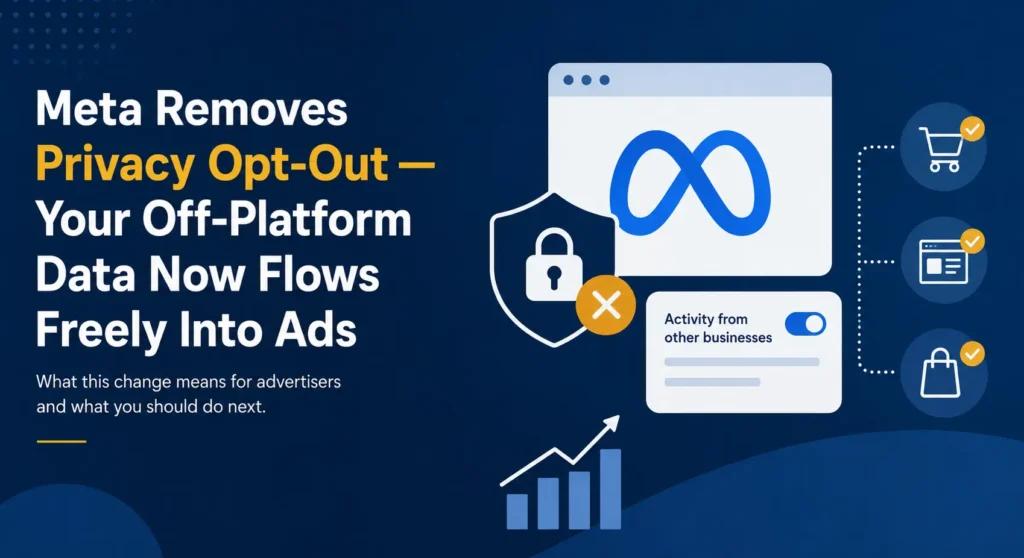
The Meta privacy opt-out that once let users disconnect their off-platform activity from their Meta accounts is going away. Starting in July 2026, Meta is removing the setting known as “Your activity off Meta technologies,” which previously gave users a direct way to stop their browsing and purchase behavior on other websites from being linked back to their personal Meta profile. In its place, Meta is introducing a single, consolidated control called “Activity from other businesses” — one that manages how this data personalizes content, but no longer lets users fully disconnect the link in the first place.
What the Meta Privacy Opt-Out Removal Actually Changes
Meta has been clear that this isn’t about collecting new data. Businesses have always shared off-platform activity with Meta through tools like the PThe Meta Privacy Opt-Out Is Being Removed: What Businesses Need to Know
The Meta privacy opt-out that once let users disconnect their off-platform activity from their Meta accounts is going away. Starting in July 2026, Meta is removing the setting known as “Your activity off Meta technologies,” which previously gave users a direct way to stop their browsing and purchase behavior on other websites from being linked back to their personal Meta profile. In its place, Meta is introducing a single, consolidated control called “Activity from other businesses” — one that manages how this data personalizes content, but no longer lets users fully disconnect the link in the first place.
Show Image
What the Meta Privacy Opt-Out Removal Actually Changes
Meta has been clear that this isn’t about collecting new data. Businesses have always shared off-platform activity with Meta through tools like the Pixel and Conversions API — that data stream itself isn’t new. What’s changing is how that existing data connects to individual user accounts, and where it gets used.
Previously, a user could opt out of having their off-platform actions — like a purchase, an add-to-cart, or a page view on another website — tied back to their personal profile. With the Meta privacy opt-out removed, that specific disconnection is no longer available. Off-platform behavioral signals will now also influence what shows up in a user’s Feed and how Meta AI responds to their queries, not just which ads they see.
Why Meta Made This Change
Meta has framed this publicly as a simplification — folding multiple, harder-to-find privacy settings into one clearer control, positioned around the idea that better personalization helps people see more relevant content while keeping services free. Consolidating settings this way does reduce complexity for the average user. But the practical effect of removing the Meta privacy opt-out is that fewer people will have a way to fully disconnect their off-platform data from ad personalization, since many users never actively used the old, more obscure setting to begin with.
What the Meta Privacy Opt-Out Removal Means for Advertisers
Retargeting Pools May Grow
If a portion of your website visitors had previously used the Meta privacy opt-out to disconnect their activity, they were effectively invisible to your retargeting campaigns. With that opt-out gone, those visitors re-enter the signal pool, which can mean larger retargeting audiences and better match quality without any changes on your end.
Stale Creative Becomes a Bigger Liability
A wider audience doesn’t automatically mean better performance. Serving the same tired creative to a larger pool of people just means more people seeing something that isn’t working. This is a good moment to refresh ad creative before the expanded audience rolls out fully.
Clean Tracking Matters More Than Ever
The value of a well-configured Conversions API setup goes up, not down, after the Meta privacy opt-out removal. Since more off-platform signal is now flowing through without interruption, outdated or inconsistent tracking setups will limit how much benefit an account actually captures from the larger data pool.
What Businesses Should Do Before the Rollout Completes
Refresh Retargeting Audiences
Confirm that your 30, 60, or 90-day website visitor audiences are active and properly connected to your Pixel or Conversions API events, so the account is ready to capture the benefit of a larger signal pool immediately.
Audit Your Conversions API Setup
The Meta privacy opt-out removal amplifies the value of clean, deduplicated conversion signals. An outdated or inconsistent Conversions API integration limits the upside significantly, so this is worth reviewing before, not after, the rollout completes.
Review Retargeting Creative Sequences
With more users potentially entering retargeting pools, it’s worth checking whether existing ad sequences still make sense, or whether they were built around a smaller, more narrowly defined audience.
Common Mistakes to Avoid
The biggest mistake is assuming this change requires no action at all. Meta handles the technical migration automatically, but businesses that don’t refresh their creative and confirm their tracking setup will miss most of the practical upside, even as their addressable audience quietly grows.
The second mistake is treating this purely as a technical update rather than something worth briefing customer-facing teams on. If your business fields questions about data privacy, it’s worth making sure the relevant team understands the name and scope of the new “Activity from other businesses” setting before customers start asking about it.
Quick FAQ: Meta Privacy Opt-Out Removal
What exactly is the Meta privacy opt-out that’s being removed?
It’s the “Your activity off Meta technologies” setting, which previously let users disconnect off-platform actions — like purchases or page views on other websites — from being linked to their personal Meta account.
Does this mean Meta is collecting new data about users?
No. Meta has stated no new data collection is involved. This changes how existing data, already shared through the Pixel and Conversions API, connects to individual accounts and is used for personalization.
When does the Meta privacy opt-out removal take effect?
The rollout begins in July 2026, starting in the US and several other countries, with additional countries following over time.
Do advertisers need to change anything in their campaigns right away?
No immediate campaign changes are required, since Meta handles the migration automatically. However, refreshing retargeting audiences and auditing Conversions API setup helps businesses capture the full benefit sooner.
What replaces the old opt-out setting?
A single, consolidated control called “Activity from other businesses,” which manages how off-platform data is used for personalization across ads, Feed content, and Meta AI responses.
How Rebootiq Helps Businesses Navigate Meta’s Privacy Changes
At Rebootiq, tracking audits are a standard part of every social media campaign we manage, alongside the account reviews we run for Google Ads. Changes like the Meta privacy opt-out removal reward businesses with clean, well-configured tracking — and quietly penalize the ones that haven’t looked at their Pixel or Conversions API setup in a while. For Meta’s own documentation on Conversions API setup, their Business Help Center is worth reviewing alongside this change.
Not sure if your Meta tracking is ready for this shift? Get a free tracking and account audit from our team. See how these changes affect different business types on our industries page.
Thanks for choosing Rebootiq InfoTech.
