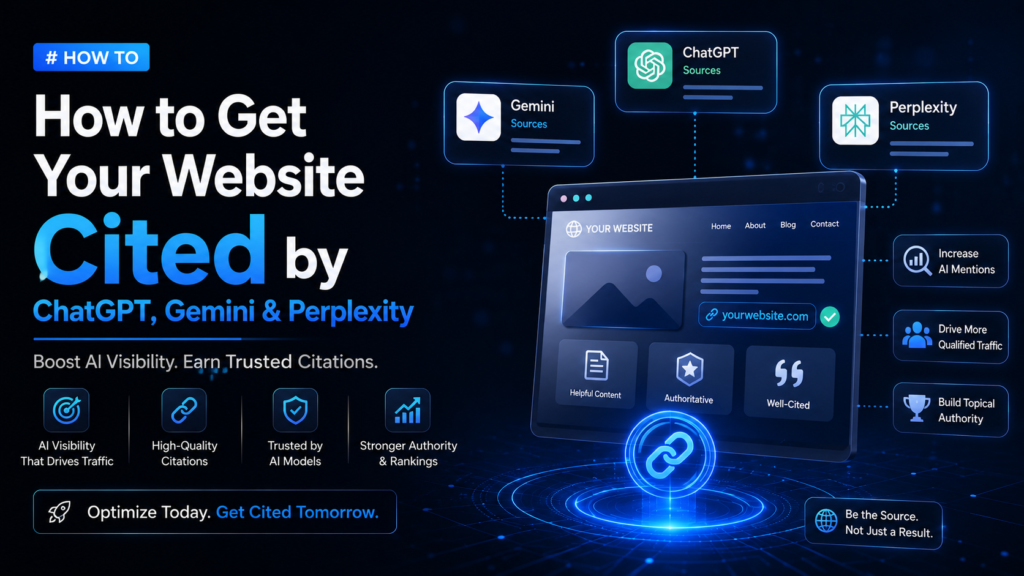
How to Get Your Website Cited by ChatGPT, Gemini & Perplexity
Search is changing.
A few years ago, the main goal of SEO was simple: get your website onto Google’s first page and earn the click. Today, people are increasingly asking AI tools such as ChatGPT, Gemini, and Perplexity to research products, compare services, find businesses, and answer questions.
That creates a new opportunity for businesses: getting your website mentioned or cited in AI-generated answers.
But there is no magic button for this. You can’t submit your website to an “AI ranking list” and guarantee a citation. Instead, you need to make your website genuinely useful, trustworthy, and easy for search and AI systems to understand.
Here’s how to approach it.
1. Start With Content Worth Citing
AI systems need reliable information to build their answers.
If your website only contains generic content that says what every competitor says, there is little reason for an AI system to reference you.
Create content that provides something useful:
- Original research
- Industry statistics
- Expert opinions
- Detailed guides
- Case studies
- First-hand experience
- Comparisons and analysis
- Clearly explained processes
For example, instead of publishing “Benefits of Digital Marketing,” a marketing agency could publish “Digital Marketing Benchmarks for Indian SMEs: What We Found From 50 Campaigns.”
The second type of content gives AI systems something more specific to understand and potentially reference.
2. Answer Specific Questions
People don’t always ask AI tools short keywords.
They ask complete questions.
Instead of searching for “SEO agency Bangalore,” someone might ask:
“What should a small business look for when choosing an SEO agency in Bangalore?”
Your content should address questions like these naturally.
Create dedicated sections that answer common customer questions directly. Avoid stuffing keywords into every paragraph. Focus on understanding the search intent behind the question.
3. Build Strong Topical Authority
One good article rarely establishes expertise.
If you want your website to become a trusted source around a subject, cover that subject comprehensively.
For example, a digital marketing agency could create interconnected content around:
SEO → Technical SEO → AI Search → GEO → Content Strategy → Local SEO → Analytics
Link these articles naturally to one another.
This helps search engines understand the relationship between your content and the broader topic.
4. Make Your Expertise Obvious
AI systems aren’t only looking at words. Your website should make it clear who is behind the information.
Add author information where appropriate. Explain the author’s experience. Include company information, contact details, client work, case studies, and other legitimate trust signals.
For businesses, maintain a clear About Us, Services, and Contact section.
The objective is simple: don’t make visitors—or machines—guess who you are.
5. Keep Your Information Consistent
Your business information should not contradict itself across the web.
Your company name, services, location, descriptions, and other important details should be reasonably consistent across your website and reputable third-party sources.
This contributes to a clearer understanding of your business as an entity.
Structured data can also help search engines understand information about your organization and content. However, schema alone doesn’t guarantee AI citations.
6. Earn Mentions From Other Reliable Websites
Your website doesn’t exist in isolation.
AI systems can use information from multiple sources when generating answers. Mentions from reputable publications, industry websites, directories, and other authoritative sources can strengthen your overall online presence.
Instead of chasing hundreds of low-quality backlinks, focus on earning relevant and meaningful mentions.
A detailed expert contribution to an industry publication can be more valuable than dozens of unrelated links.
7. Don’t Try to “Hack” AI Citations
There are plenty of claims online about secret techniques for getting ChatGPT or other AI systems to mention a particular website.
Be careful.
AI search is evolving quickly, and there is no guaranteed formula that forces a platform to cite your website.
The safer long-term strategy is to follow the fundamentals:
Useful content + genuine expertise + technical accessibility + authority + clear information.
The Goal Isn’t Just a Citation
Getting mentioned by ChatGPT, Gemini, or Perplexity can be valuable, but don’t make citations your only SEO goal.
The bigger objective is to become a trusted source of information within your industry.
When your website consistently provides useful answers, demonstrates real expertise, and is recognized across the wider web, you increase the chances of being discovered across both traditional search and AI-powered search experiences.
SEO isn’t disappearing.
It’s expanding.
And businesses that start optimizing for Being understood, trusted, and recommended not just ranked will be better prepared for the next generation of search.
