The Digital Visibility Framework (2026): How SEO, GEO, AEO & AI Search Work Together
Introduction
The way people search for information has changed dramatically. Just a few years ago, typing a few keywords into Google and browsing through a list of websites was the norm. Today, users expect instant, accurate, and conversational answers from AI-powered platforms like Google AI Overviews, ChatGPT, Microsoft Copilot, and Perplexity.
This shift has changed what it means to be visible online.
Ranking on Google’s first page is still valuable, but it’s no longer the only measure of success. Businesses now need to optimize for traditional search engines, answer engines, and AI systems simultaneously.
This is where the Digital Visibility Framework comes in.
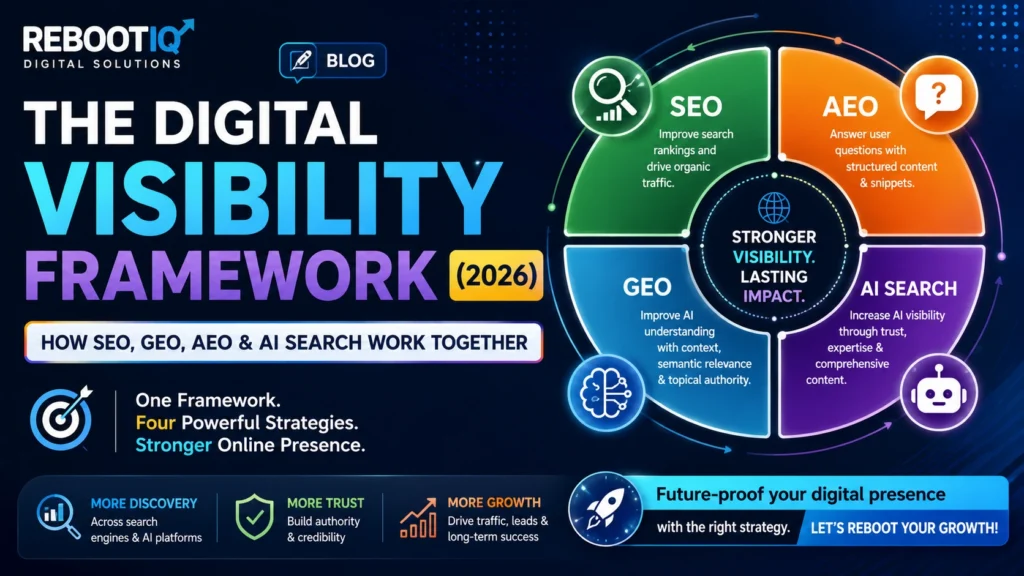
Rather than treating SEO, GEO, AEO, and AI Search as separate strategies, the framework combines them into one integrated approach. Together, they help your business improve discoverability, build authority, answer user questions effectively, and increase visibility across both search engines and AI-powered experiences.
In this guide, we’ll explain each component of the framework, how they complement one another, and how your business can prepare for the future of search.
What Is Digital Visibility?
Digital visibility is the ability of your business to be found wherever people search for information online.
Traditionally, this meant appearing in search engine results. Today, visibility extends far beyond Google.
Your brand can now be discovered through:
- Google Search
- Google AI Overviews
- ChatGPT
- Microsoft Copilot
- Perplexity AI
- Voice assistants
- Business directories
- Social media platforms
- Local search results
The more places your business appears with accurate, trustworthy information, the stronger your digital presence becomes.
Why the Old SEO-Only Approach Is No Longer Enough
Traditional SEO remains an essential part of digital marketing, but relying on SEO alone means missing opportunities in the rapidly evolving AI ecosystem.
Modern users ask complete questions such as:
- Which SEO strategy works best for startups?
- How can I improve my website’s visibility in AI search?
- What is the difference between SEO and GEO?
Instead of presenting a list of links, AI platforms often provide direct answers by combining information from trusted sources.
If your content isn’t optimized for this new environment, your website may rank in search engines yet still remain invisible in AI-generated responses.
The Four Pillars of the Digital Visibility Framework
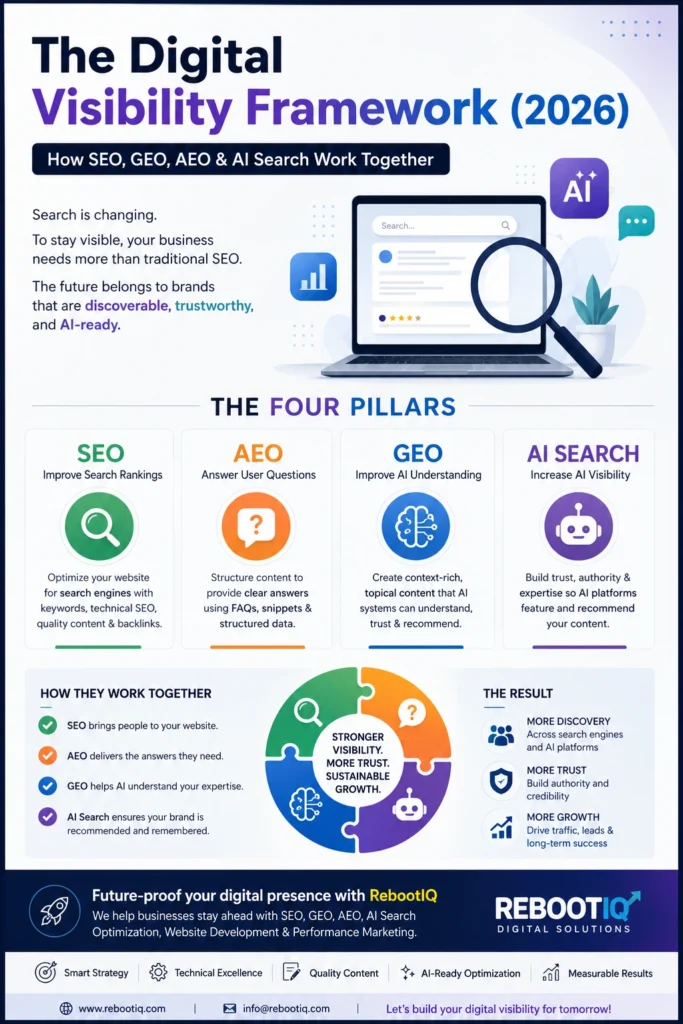
A future-ready digital strategy consists of four connected pillars.
1. Search Engine Optimization (SEO)
SEO focuses on improving your website’s visibility in traditional search engines.
It includes:
- Keyword research
- On-Page SEO
- Technical SEO
- Internal linking
- Website speed
- Mobile optimization
- High-quality content
- Backlink building
SEO helps search engines understand, crawl, and rank your website.
2. Answer Engine Optimization (AEO)
AEO focuses on optimizing content so that answer engines can easily identify and present it as a direct response to user questions.
AEO emphasizes:
- Question-based headings
- FAQ sections
- Concise answers
- Structured content
- Schema markup
- Featured snippet optimization
The goal is to provide information in a format that answer engines can quickly understand and surface.
3. Generative Engine Optimization (GEO)
GEO prepares your content for AI-powered search systems.
Instead of optimizing only for keywords, GEO focuses on:
- User intent
- Context
- Topic depth
- Semantic relationships
- Content clarity
- Expertise and trust
AI systems prefer comprehensive, well-organized content that demonstrates authority and answers user needs naturally.
4. AI Search
AI Search refers to how platforms such as Google AI Overviews, ChatGPT, Microsoft Copilot, and Perplexity generate responses using multiple trusted sources.
To improve AI visibility, your website should demonstrate:
- Expertise
- Experience
- Authority
- Trustworthiness
- Structured content
- Up-to-date information
- Strong topical relevance
Businesses that consistently publish helpful, credible content are more likely to be referenced by AI systems.
How These Four Strategies Work Together
Although SEO, AEO, GEO, and AI Search each have distinct goals, they are most effective when implemented as a unified strategy.
| Strategy | Primary Goal | Key Focus |
|---|---|---|
| SEO | Improve search rankings | Keywords, technical optimization, backlinks |
| AEO | Answer user questions | FAQs, snippets, structured content |
| GEO | Improve AI understanding | Context, semantic relevance, topical authority |
| AI Search | Increase AI visibility | Trust, expertise, comprehensive content |
Rather than replacing one another, these strategies complement each other. Together, they create a stronger and more resilient online presence.
The Future of Digital Visibility
Search has evolved beyond simply matching keywords to web pages. Today, AI systems interpret user intent, summarize information, and recommend trusted sources in real time. As this transformation continues, digital visibility will depend less on who ranks first and more on who provides the most reliable, relevant, and useful information.
Businesses that adapt to these changing expectations will gain a significant competitive advantage. Those that continue relying on outdated SEO tactics may find it increasingly difficult to reach their audience.
The future belongs to brands that combine technical excellence with meaningful content and genuine expertise.
Building a Future-Ready Digital Strategy
Preparing for the future doesn’t require abandoning traditional SEO. Instead, businesses should expand their approach to include AI-focused optimization while maintaining strong SEO fundamentals.
A future-ready strategy should include:
- A technically optimized website
- Helpful, original content
- Clear site architecture
- Consistent content updates
- Strong topical authority
- High-quality backlinks
- Structured data implementation
- AI-friendly formatting
- Excellent user experience
When these elements work together, they create a strong digital presence that performs well across search engines and AI-powered platforms alike.
Key Takeaways for Businesses
If your goal is long-term online growth, focus on these principles:
- Build your website for users first, then optimize it for search engines.
- Create content that answers real questions rather than chasing keywords.
- Cover topics in depth to establish authority.
- Keep your content accurate and regularly updated.
- Improve website speed, usability, and mobile performance.
- Invest in trust through quality, transparency, and consistency.
Digital visibility is no longer about isolated tactics—it is about creating an ecosystem of valuable content and a reliable online presence.
Final Thoughts
The digital landscape is entering a new era.
SEO remains a vital foundation, but it now works alongside Answer Engine Optimization (AEO), Generative Engine Optimization (GEO), and AI Search Optimization to shape how businesses are discovered online.
Rather than viewing these disciplines as separate strategies, successful organizations combine them into a single, integrated approach. This is the essence of the Digital Visibility Framework.
Businesses that embrace this framework will be better equipped to connect with their audience, build trust, and remain visible as search technology continues to evolve.
The objective is no longer just to appear in search results—it’s to become the trusted source that both people and AI systems rely on.
Frequently Asked Questions (FAQs)
1. What is the Digital Visibility Framework?
The Digital Visibility Framework is an integrated approach that combines SEO, AEO, GEO, and AI Search Optimization to improve a brand’s visibility across search engines and AI-powered platforms.
2. Is SEO still important in 2026?
Yes. SEO continues to be the foundation of online visibility, but it is most effective when combined with AEO, GEO, and AI-focused content strategies.
3. What is the difference between SEO and GEO?
SEO focuses on improving rankings in traditional search engines, while GEO focuses on making content understandable and trustworthy for AI systems that generate answers.
4. What is Answer Engine Optimization (AEO)?
AEO is the process of structuring content so it can provide direct, accurate answers in featured snippets, voice search, and AI-powered answer engines.
5. Why is AI Search important?
AI Search is changing how users discover information by delivering summarized answers instead of lists of links. Optimizing for AI visibility helps businesses remain discoverable in this new search environment.
