
Meta CPMs Just Hit Record Highs — Here’s Why, and What to Actually Do About It
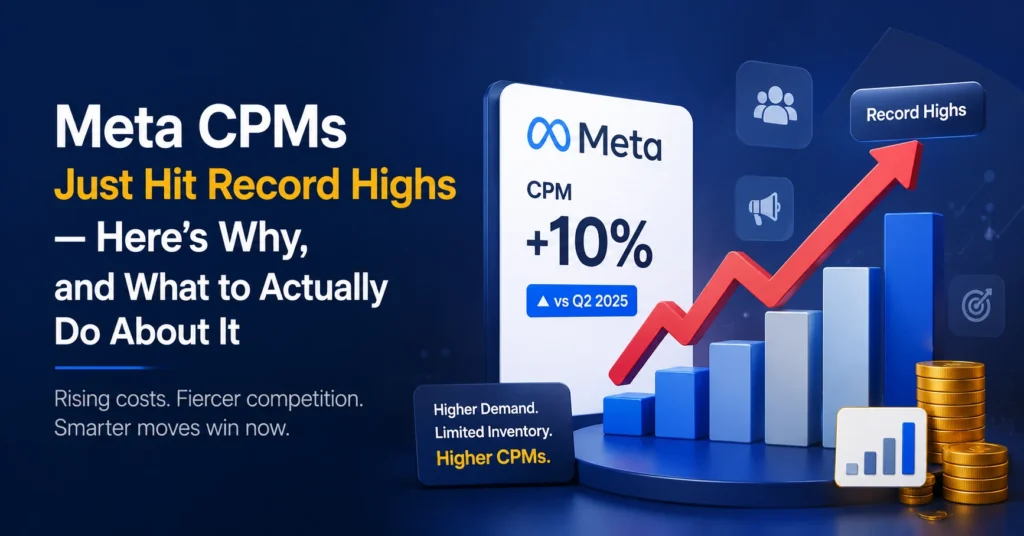
Meta CPMs are up and if your ad account feels more expensive to run than it was a year ago, that is not a feeling, it is the data. Meta’s own data shows that average CPMs were up 10% year-over-year in Q2 2026, the biggest increase the platform has seen since early 2022. Depending on what vertical you’re in, some third party benchmarks have the increase even higher, closer to 20%. The numbers differ depending on who’s measuring, but the trend line is clear: it costs more to reach the same audience on Meta than it did before, period.
Why Costs Are Climbing
A lot of it starts on Google, not Meta.
Here’s the part most people miss. AI Overviews have gutted organic click-through rates down almost two-thirds on the queries where they show up and paid search isn’t fully immune either. So advertisers are doing the logical thing: pulling budget out of Search and shifting it to Meta, where the cost per result is still lower in absolute terms. Makes sense for any one advertiser doing it. But when thousands of advertisers make the same move at once, they’re all bidding into the same auction, and that pushes Meta CPMs up for everyone including the people who never touched their Search budget in the first place.
Spend is outrunning inventory.
Meta’s Q2 2026 numbers show ad spend up 11% year-over-year, but impressions only grew 2%. That gap is really the whole story in one stat. More dollars chasing roughly the same number of available placements means the price per thousand impressions has nowhere to go but up.
And seasonality hasn’t gone anywhere.
Q4 has always run hot historically about 26% above the yearly average, with holiday CPMs spiking anywhere from 30 to 60%. That’s normal. What’s not normal is that this seasonal spike is now stacking on top of an already elevated baseline instead of a cheap one, which is why 2026 feels different from previous years even before the holidays hit.
What This Actually Means for Your Campaigns
Higher CPMs don’t automatically mean your campaigns are broken. They mean your margin for error just got smaller. A 10–20% jump in cost per thousand impressions flows pretty directly into a similar jump in cost per acquisition, assuming nothing else about the campaign changes. If you’re running on tight margins, that’s not a rounding error it hits the bottom line.
The accounts that feel this the least tend to be the ones that already had strong creative and sharp targeting going into 2026. The ones getting squeezed the hardest are usually still running the same ad sets they built two years ago, now paying a real premium to reach the exact same people they used to reach for less.
What You Can Actually Do About It
Refresh your creative more often than you think you need to.
Tired creative is expensive creative. Some benchmarks show underperforming ads pushing CPMs past $50, while strong-performing creative stays closer to $25 same platform, same auction, wildly different cost. Aim to rotate in new variations every 10–14 days rather than letting a winning ad ride until it visibly dies. It’s one of the few levers you have direct control over.
Let Advantage+ do more of the heavy lifting.
Meta’s Advantage+ Shopping campaigns are consistently landing lower CPAs than manually built campaigns in comparable categories. That’s not a coincidence automation built for a wider signal pool tends to find efficiency that tightly manual setups can’t, especially in an auction environment that’s more competitive than the one those manual setups were originally built for.
Don’t put every dollar into the channel getting more expensive the fastest.
Some brands are quietly shifting a slice of budget toward branded search and owned channels email, WhatsApp, that kind of thing where costs simply haven’t moved the way Meta’s have. This isn’t about abandoning Meta. It’s about not being 100% exposed to the one channel where prices are rising fastest.
Keep an eye on frequency.
Once frequency creeps past roughly 3.4, click-through rates tend to fall off and that compounds the cost problem, because now you’re paying more for impressions that are also converting worse. Watch it closely, especially as CPMs climb.
Two Mistakes We’re Seeing a Lot Right Now
Cutting budget the second CPMs tick up, without checking why. Sometimes higher CPMs paired with solid conversion rates still add up to a healthy ROAS. Pulling back reflexively can mean walking away from a channel that’s still doing its job just doing it at a higher price.
Assuming this fixes itself. It probably doesn’t. The forces pushing Meta CPMs higher advertisers fleeing an increasingly AI-dominated Google Search experience, plus genuine demand growth look structural, not seasonal. Building a strategy around the current cost environment makes a lot more sense than waiting for it to quietly go back to normal.
Quick FAQ
How much have Meta CPMs actually gone up in 2026?
Meta’s own reporting shows a 10% year-over-year increase in Q2 2026 the sharpest rise since early 2022. Some industry benchmarks put it closer to 20%, depending on the source and the vertical.
Why is this happening now specifically?
A mix of things landing at once: advertisers shifting budget away from Google Search as AI Overviews eat into organic and paid CTR, spend growing faster than available impressions, and the usual seasonal demand layering on top.
Should I just cut my Meta spend?
Not automatically. Check your actual CPA and ROAS first. Rising CPMs alongside strong conversion performance can still mean a healthy return the cost going up isn’t the same as the channel not working.
Will this come back down later in the year?
There’s no real signal pointing that way right now. This looks more structural than seasonal, so it’s worth planning around the current environment rather than banking on a correction.
What’s the single fastest thing I can do about it?
Refresh your creative. Fatigued ads are one of the biggest drivers of inflated CPMs at the individual campaign level, and it’s the lever you can pull the fastest.
How Rebootiq Helps
We track Meta CPMs and broader cost trends across every social campaign we manage, and adjust creative cadence and budget allocation as the auction shifts under us. If you’re feeling pressure on both Meta and Google ads at once, our team looks at the full picture where your budget is actually working hardest right now, not just where it used to be cheapest.
Not sure if your rising costs are a platform-wide trend or something specific to your account? Get a free campaign audit from our team. See how these cost trends play out differently by business type on our industries page. And you can follow our latest case studies and updates on Instagram and LinkedIn.
Thanks for choosing Rebootiq InfoTech.
