The SEO Trick That Works Even When Google’s Algorithm Doesn’t Know What to Do With It
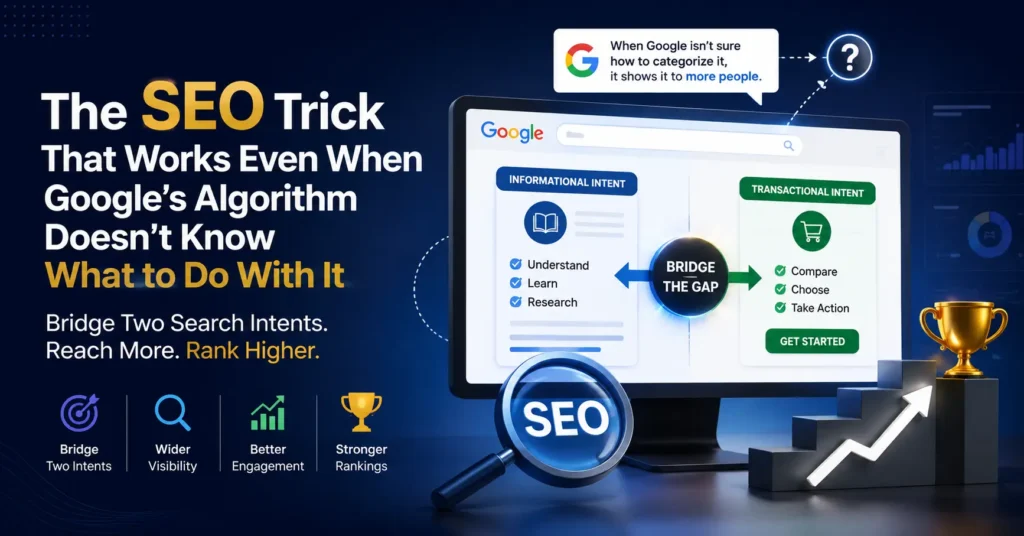
SEO usually gets talked about like a formula hit these signals, satisfy these checkboxes, and the algorithm rewards you accordingly. Most of the time, that’s roughly true. But there’s a specific situation where the usual rules don’t quite apply, and where a piece of content can actually perform well precisely because Google’s own systems aren’t entirely sure how to categorize it. It sounds counterintuitive, but it’s a real, repeatable pattern worth understanding.
Where This Trick Actually Comes From
Google’s algorithm has to make constant judgment calls about content it hasn’t seen a clean pattern for before — a new format, an unusual structure, content that blends two intents at once. When the algorithm genuinely isn’t confident about how to classify something, it tends to show it more broadly and let user behavior signals decide the outcome, rather than filtering it down aggressively based on rigid pattern-matching. This is the gap this SEO tactic quietly exploits, not through manipulation, but through structure.
The Tactic: Deliberately Bridging Two Search Intents
Why Single-Intent Content Gets Boxed In
Most content is built around a single, clear search intent informational, transactional, or navigational because that’s what conventional SEO wisdom teaches. The problem is that single-intent content also gets easily categorized and slotted into a predictable competitive bracket, competing against everything else optimized the exact same way.
What Happens When Content Deliberately Bridges Two Intents
A page that genuinely serves two intents at once say, both explaining a concept thoroughly (informational) and helping someone act on it immediately (transactional) doesn’t fit neatly into either bucket. Google’s algorithm has to decide which SERP feature or ranking treatment applies, and in that uncertainty, well-structured content bridging both intents often ends up surfaced for a wider range of queries than a narrowly optimized single-intent page would ever reach.
This Only Works With Genuine Structure, Not Confusion
This isn’t about writing vague or unfocused content and hoping for the best that fails for entirely different reasons. It’s about deliberately structuring a page so both intents are served clearly and separately within the same piece, using distinct headers, a clean logical flow, and content that genuinely satisfies someone at any stage of their search, not a muddled attempt to please everyone at once.
How to Actually Build This Into Your SEO Strategy
Start With the Core Question, Then Widen It
Identify the primary question your content answers, then deliberately ask what the next question would be for someone who just got that answer. Structure the page to answer both, clearly separated, rather than assuming the reader only wants one or the other.
Use Headers That Signal Both Intents Clearly
Google’s algorithm reads header structure as a strong signal of what a page actually covers. A page with headers spanning both “what this is” and “how to actually do it” gives the algorithm clean signals for both intents, rather than forcing a single classification.
Don’t Sacrifice Depth for Breadth
The temptation with this approach is to cover everything shallowly. That defeats the purpose. Each section still needs to be genuinely thorough enough to satisfy someone who landed specifically for that intent the goal is covering two things well, not many things poorly.
Why This Works Especially Well Right Now
Search itself has gotten messier. People increasingly search with compound, layered questions rather than simple keyword phrases, and AI-powered search features are already summarizing content that bridges multiple related questions into a single, more complete answer. Content built with this dual-intent structure tends to be exactly what these newer systems are already looking to extract from, on top of whatever traditional ranking benefit it gets.
Common Mistakes When Trying This
The most common mistake is confusing “covers two intents” with “covers everything vaguely.” Genuinely bridging two intents requires more structure and clarity, not less sloppy, unfocused content doesn’t get this benefit, it just performs poorly across the board.
The second mistake is abandoning single-intent content entirely. This tactic works best as one tool in a broader SEO strategy, not a replacement for straightforward, single-purpose content where that’s genuinely what a search deserves.
Quick FAQ: SEO and Google’s Algorithm Ambiguity
Does this tactic work for every type of content? No. It works best for topics that naturally have both an explanatory and an actionable dimension a concept someone needs to understand before acting on it, not every piece of content fits that pattern.
Is this the same as keyword stuffing or trying to rank for everything at once? No, and that distinction matters. This is about genuine structural depth serving two related intents clearly, not vague, unfocused content trying to rank broadly without actually satisfying anyone.
How does this connect to Google’s algorithm specifically? When the algorithm can’t confidently classify content into a single narrow bucket, it often relies more heavily on user engagement signals to decide ranking outcomes, which well-structured dual-intent content tends to perform well against.
Should this replace a normal SEO strategy? No. It’s a complementary tactic, useful for specific topics that genuinely span two related questions, not a wholesale replacement for standard search engine optimization practices.
Does content structure actually matter this much to Google’s algorithm? Yes. Clear headers and logical flow are consistently strong signals the algorithm uses to understand what a page covers and who it’s actually useful for.
How Rebootiq Approaches SEO Strategy Like This
At Rebootiq, we build content structures that go beyond simple keyword targeting, because a well-structured page can genuinely reach further than one narrowly optimized for a single intent. Our SEO services focus on this kind of structural thinking, and it often pairs well with our content and social strategy work, since the same content built this way tends to perform across multiple channels too.
Curious whether your current content is built to take advantage of this? Get a free content and SEO audit from our team. See how our approach differs across business types on our industries page. You can also check out our work on LinkedIn and Instagram.
Thanks for choosing Rebootiq InfoTech.
