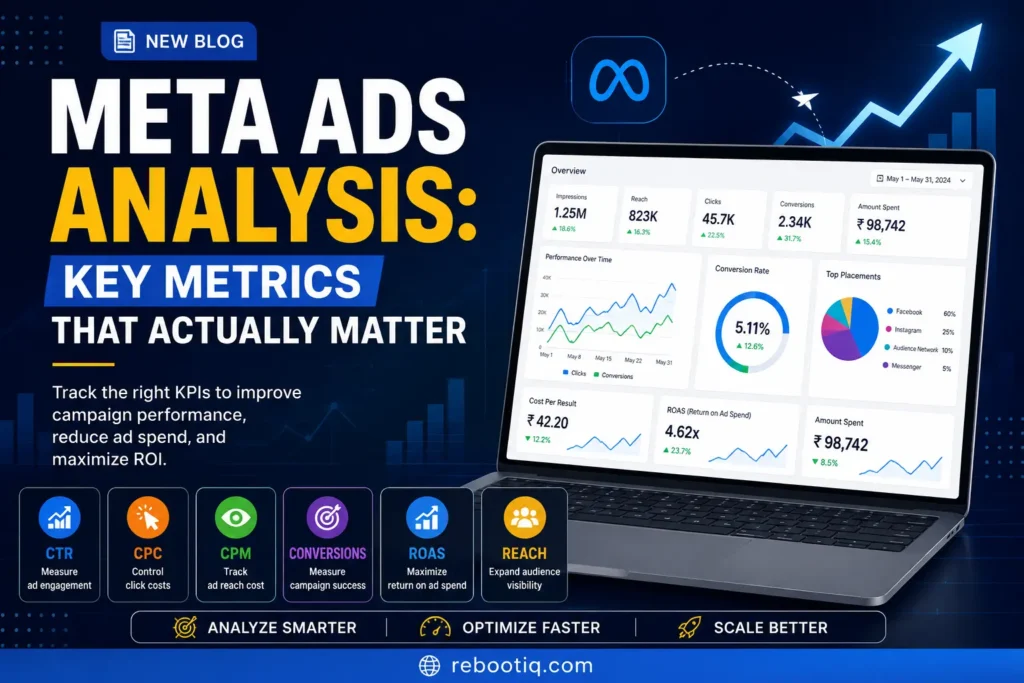
Meta Ads Analysis: Key Metrics That Actually Matter for Better Campaign Performance
Introduction
Running successful Meta Ads is about more than launching campaigns and watching impressions grow. To maximize your advertising budget, you need to understand what your campaign data is actually telling you.
Many advertisers focus on vanity metrics such as reach and likes while overlooking the performance indicators that directly influence leads, sales, and return on investment (ROI). Without proper analysis, it’s difficult to identify what’s working, what’s underperforming, and where your budget should be allocated.
Whether you’re running Facebook Ads, Instagram Ads, or campaigns across Meta platforms, understanding the right metrics helps you make smarter decisions, improve campaign performance, and achieve better business outcomes.
In this guide, we’ll break down the key Meta Ads metrics that actually matter, explain what each one means, and show you how to use them to optimize your campaigns for long-term success.
Why Meta Ads Analysis Is Important
Meta Ads Manager provides hundreds of metrics, but not every number deserves equal attention.
Effective campaign analysis helps you:
- Measure campaign performance accurately.
- Optimize your advertising budget.
- Identify high-performing audiences.
- Improve ad creatives.
- Increase conversions.
- Reduce wasted ad spend.
- Make data-driven marketing decisions.
Instead of reacting to every metric, focus on the ones that directly support your campaign objective.
1. Impressions
Impressions represent the total number of times your ad is displayed, regardless of whether users click on it.
A single user can generate multiple impressions by seeing the same ad more than once.
Why It Matters
Impressions indicate how often your campaign enters Meta’s ad auction and how widely your ads are being delivered.
Improve Impressions By
- Increasing campaign budget.
- Expanding audience size.
- Improving Ad Quality.
- Using Advantage+ placements.
2. Reach
Reach measures the number of unique people who saw your advertisement.
Unlike impressions, each person is counted only once.
Why It Matters
Reach helps determine how effectively your campaign is introducing your brand to new audiences.
If your objective is brand awareness, reach is one of the most important metrics to monitor.
3. Click-Through Rate (CTR)
CTR measures the percentage of users who clicked your ad after seeing it.
Formula
CTR = (Clicks ÷ Impressions) × 100
Why It Matters
A high CTR generally indicates that:
- Your creative attracts attention.
- Your copy is relevant.
- Your audience targeting is effective.
How to Improve CTR
- Write stronger headlines.
- Use better creatives.
- Add clear calls to action.
- Test multiple ad variations.
- Refine audience targeting.
4. Cost Per Click (CPC)
CPC measures how much you pay each time someone clicks your advertisement.
Why It Matters
Lower CPC allows you to generate more website visitors within the same budget.
Improve CPC By
- Increasing CTR.
- Improving ad relevance.
- Optimizing audience targeting.
- Testing different creatives.
5. Cost Per Mille (CPM)
CPM is the cost of 1,000 ad impressions.
Why It Matters
A rising CPM may indicate:
- High competition.
- Narrow targeting.
- Seasonal advertising demand.
- Lower ad quality.
Monitoring CPM helps you understand how competitive your advertising environment is.
6. Frequency
Frequency measures the average number of times each person sees your ad.
Why It Matters
Very high frequency may lead to:
- Ad fatigue.
- Lower engagement.
- Higher CPC.
- Reduced conversions.
7. Landing Page Views
Many advertisers measure clicks, but Landing Page Views provide a more accurate picture of campaign quality.
A click only tells you someone selected your ad. A Landing Page View confirms that the destination page actually loaded.
Why It Matters
If you have many clicks but very few Landing Page Views, your website may have:
- Slow loading speed
- Redirect issues
- Broken links
- Poor mobile performance
How to Improve It
- Improve website speed.
- Optimize your landing page for mobile devices.
- Reduce unnecessary redirects.
- Ensure your landing page loads within 2–3 seconds.
8. Cost Per Result (CPR)
Cost Per Result shows how much you’re paying for each desired action, such as:
- Lead
- Purchase
- Website Conversion
- Message
- App Install
Why It Matters
CPR helps determine whether your campaign is profitable.
For example:
- ₹150 per qualified lead may be excellent.
- ₹1,500 per lead may require optimization.
Always compare CPR with your business goals and customer acquisition cost (CAC).
How to Improve CPR
- Improve audience targeting.
- Optimize ad creatives.
- Refine landing pages.
- Test different campaign objectives.
9. Conversion Rate
Conversion Rate measures the percentage of visitors who complete your desired action after clicking your ad.
Formula
Conversion Rate = (Conversions ÷ Landing Page Visitors) × 100
Why It Matters
A high CTR with a low Conversion Rate usually indicates a problem after users click the ad, such as:
- Weak landing page
- Poor offer
- Complicated form
- Slow website
Improve Conversion Rate By
- Creating dedicated landing pages.
- Simplifying lead forms.
- Strengthening your value proposition.
- Adding trust signals such as reviews and testimonials.
10. Return on Ad Spend (ROAS)
ROAS measures the revenue generated for every rupee spent on advertising.
Formula
ROAS = Revenue ÷ Ad Spend
Example
- Ad Spend: ₹10,000
- Revenue: ₹60,000
ROAS = 6X
Why It Matters
ROAS is one of the most important metrics for businesses focused on profitability.
Higher ROAS means your advertising budget is generating better returns.
Improve ROAS
- Focus on high-converting audiences.
- Retarget previous visitors.
- Improve product pages.
- Optimize your checkout process.
11. Engagement Rate
Engagement includes:
- Likes
- Comments
- Shares
- Saves
- Post reactions
Why It Matters
High engagement signals that your content is relevant and valuable.
Although engagement isn’t always tied directly to sales, it often improves overall campaign performance and brand visibility.
Improve Engagement
- Ask questions.
- Use carousel ads.
- Publish short-form videos.
- Include strong visual storytelling.
- Encourage user interaction.
12. Video Performance Metrics
If you’re running video ads, monitor:
- Video Views
- 3-Second Views
- ThruPlays
- Average Watch Time
- Video Completion Rate
Why It Matters
These metrics help you understand whether viewers are engaging with your content or dropping off early.
Best Practices
- Capture attention within the first three seconds.
- Keep videos concise and focused.
- Include captions for silent viewing.
- End with a clear call to action.
13. Quality Ranking
Meta compares your ad quality against competing ads targeting similar audiences.
A lower Quality Ranking may result in:
- Higher CPC
- Higher CPM
- Reduced delivery
Improve Quality Ranking
- Use high-quality visuals.
- Write relevant ad copy.
- Match your message to user intent.
- Test multiple creative variations.
14. Budget Spend vs. Results
Spending more doesn’t always produce better outcomes.
Review whether increased spending leads to:
- More conversions
- Better ROAS
- Lower Cost Per Result
- Higher-quality leads
If costs rise without improved results, reassess your targeting, creative, or bidding strategy.
15. Attribution and Conversion Tracking
Accurate tracking is essential for measuring campaign success.
Ensure that:
- The Meta Pixel is installed correctly.
- Conversion events are configured.
- Event Match Quality is optimized.
- Conversions API (CAPI) is implemented where appropriate.
Reliable tracking enables better optimization and more informed decision-making.
Common Meta Ads Analysis Mistakes
Avoid these common errors:
Not reviewing campaign performance regularly
Focusing only on likes and comments
Ignoring ROAS and Cost Per Result
Making decisions too early without sufficient data
Not comparing metrics across campaigns
Failing to test different creatives
Overlooking audience performance
Ignoring attribution settings
Frequently Asked Questions (FAQs)
What is Meta Ads analysis?
Meta Ads analysis is the process of reviewing campaign performance using key metrics such as CTR, CPC, CPM, conversions, ROAS, and Cost Per Result to improve advertising performance and maximize return on investment.
Which Meta Ads metrics are the most important?
The most important metrics depend on your campaign objective, but generally include:
- Click-Through Rate (CTR)
- Cost Per Click (CPC)
- Cost Per Result (CPR)
- Conversion Rate
- Return on Ad Spend (ROAS)
- Landing Page Views
- Frequency
- Reach
What is a good CTR for Meta Ads?
A “good” CTR varies by industry, campaign objective, audience, and creative. Instead of comparing against a single benchmark, monitor your own campaigns over time and aim to improve CTR through better targeting, stronger creatives, and compelling ad copy.
Why is ROAS important?
ROAS (Return on Ad Spend) shows how much revenue your advertising generates for every amount spent. It helps businesses evaluate campaign profitability and make informed budgeting decisions.
What does a high CPM mean?
A high CPM (Cost Per 1,000 Impressions) can indicate increased competition, narrow audience targeting, seasonal demand, or lower ad quality. Reviewing targeting and creative performance can help improve efficiency.
How often should I analyze Meta Ads?
Review campaign performance regularly. Daily monitoring is useful for active campaigns, while weekly and monthly analyses help identify trends, optimize budgets, and improve long-term performance.
Grow Your Business with Data-Driven Meta Ads Management
At Rebootiq, we help businesses maximize their advertising performance with customized Meta Ads strategies focused on measurable growth.
Our Meta Ads services include:
- Facebook & Instagram Ads Management
- Lead Generation Campaigns
- E-commerce Advertising
- Remarketing Campaigns
- Audience Research & Targeting
- Creative Testing (A/B Testing)
- Meta Pixel & Conversions API Setup
- Performance Reporting & Optimization
- ROI & ROAS Analysis
Whether your goal is to generate qualified leads, increase online sales, or build brand awareness, our team creates data-driven campaigns designed to deliver measurable business results.
Ready to improve your Meta Ads performance?
Visit: https://rebootiq.com/
