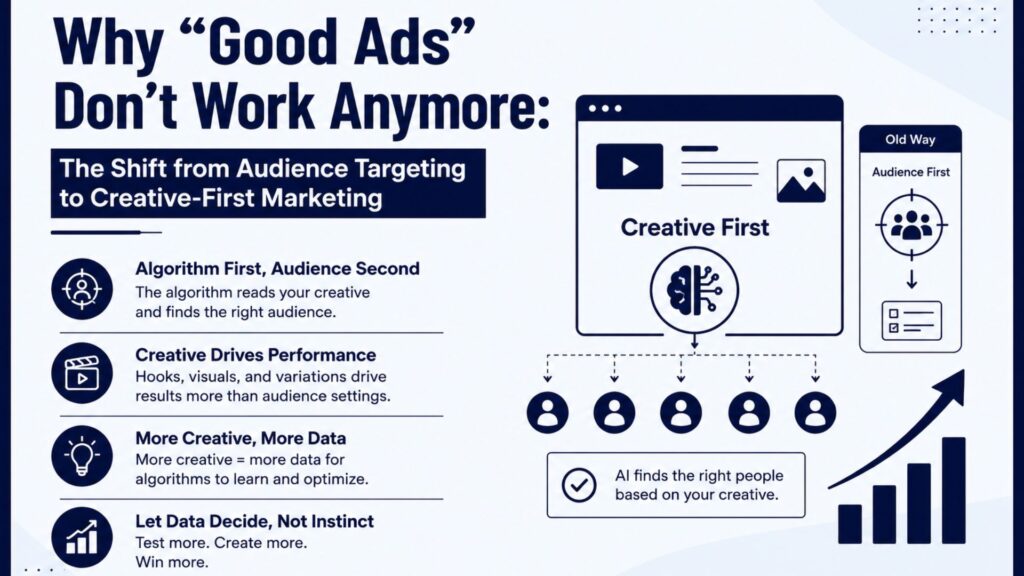
Why Good Ads Don’t Work Anymore: The Shift from Audience Targeting to Creative-First Marketing
Type / to choose a Creative-first marketing is quietly replacing one of the oldest habits in digital advertising: picking an audience before writing the ad. For over a decade, “good ads” meant narrowing down interests, behaviors, and demographics until you found the perfect slice of people to show your creative to. Pick the right audience, write a decent ad, and the algorithm would do the rest. That formula built entire agencies, entire careers, entire ways of thinking about paid media.
In 2026, that formula is breaking down — not because targeting got worse, but because the platforms stopped needing it the way they used to.
What Changed: The Algorithm Stopped Asking You Who to Target
Meta’s ad system now runs on an AI model that reads your creative first and figures out the right audience second. Instead of an advertiser manually selecting interests like “yoga” or “home renovation,” the algorithm studies the images, video, copy, and pacing of the ad itself and uses that to decide who is most likely to respond. In practice, this means two advertisers running the exact same interest targeting can get completely different results — because the deciding factor isn’t the audience settings anymore, it’s the creative.
Google has moved in a similar direction on the search side. Broader, AI-assisted matching now expands beyond the exact keywords an advertiser bids on, using context, intent signals, and the quality of ad assets to decide when and where an ad shows. In both cases, the platforms are telling advertisers the same thing in different words: stop trying to out-target the algorithm, and start out-creating it.
Why Creative-First Marketing Is Winning Right Now
1. The Algorithm Has More Creative to Learn From Than Ever
Modern ad platforms don’t just show one static ad to one audience anymore. They test dozens, sometimes hundreds, of creative combinations — different hooks, different visuals, different calls to action — and let performance data decide what survives. Brands that only produce one or two ad variations are giving the algorithm almost nothing to learn from. Creative-first marketing treats this like a numbers game: more raw creative material means more chances for the system to find what actually converts.
2. Audience Settings Are Becoming a Ceiling, Not a Lever
Narrow, hand-picked audiences used to be a competitive advantage. Now they often work against advertisers, because they restrict the pool the algorithm has to learn from. Broader targeting, paired with strong creative, frequently outperforms tightly restricted audiences — a complete reversal from how paid social worked just a few years ago. This is one of the hardest habits for experienced marketers to unlearn.
3. Hooks Matter More Than Headlines
In a creative-first marketing environment, the first two seconds of a video or the first line of ad copy carries more weight than the offer itself. The algorithm is optimizing for engagement signals long before it gets to conversion signals, which means an ad that fails to hook attention immediately never gets the chance to prove it converts well.
What This Means for Your Ad Strategy
Build a Creative Pipeline, Not a Single Campaign
The businesses winning with creative-first marketing treat content production like a factory, not a one-off project. That means templated but flexible formats, quick turnaround on new variations, and a steady stream of raw footage or design assets to draw from — rather than a single polished ad running for months.
Let Data Decide, Not Instinct
It’s tempting to keep running the ad you personally like best. But under creative-first marketing, the system’s performance data is a better judge than gut feeling. The role of the marketer shifts from “picking the right audience” to “feeding the system enough good options and getting out of the way.”
Don’t Abandon Targeting Entirely
Creative-first marketing doesn’t mean targeting is dead — it means targeting is no longer the primary lever. Broad demographic and geographic guardrails still matter, especially for businesses with real constraints like service areas or age-restricted products. The shift is about priority, not elimination.
Rethink How You Measure Success
Under the old model, marketers judged an ad primarily by who it reached. Under creative-first marketing, the more useful question is what the ad made people do — watch longer, click faster, convert cleaner. That means shifting reporting habits away from audience-level breakdowns and toward creative-level performance: which hooks, formats, and messages are actually driving results, independent of who technically saw them.
Where Businesses Get This Wrong
The most common mistake is treating this shift as a one-time creative refresh instead of an ongoing process. A brand redesigns its ads once, sees a short-term lift, and then goes quiet for months — missing the entire point of creative-first marketing, which rewards continuous testing, not occasional bursts of new content.
The second mistake is chasing production value over authenticity. Overly polished, ad-like creative often underperforms rougher, more native-feeling content, particularly on platforms like Instagram and Facebook Reels, where users are scanning for content that doesn’t look like an ad at all.
The third mistake is assuming this only applies to large brands with big production budgets. Creative-first marketing rewards volume and iteration far more than polish — a smaller business shooting quick, authentic variations on a phone can outperform a bigger competitor running one expensively produced ad, simply because the algorithm has more to learn from.
Quick FAQ: Creative-First Marketing in 2026
Does creative-first marketing mean I should stop using audience targeting completely? No. Broad targeting still needs sensible guardrails like location and age where relevant. The change is that creative quality and variety now do more of the targeting work than manual audience selection used to.
How many ad variations do I actually need to run? There’s no fixed number, but businesses seeing strong results under creative-first marketing typically run far more variations than they used to — often testing multiple hooks, formats, and lengths simultaneously rather than one “hero” ad.
Is this shift the same on Google as it is on Meta? The mechanics differ, but the direction is the same. Both platforms increasingly use AI to expand beyond narrow, manually defined targeting, relying more on the quality and relevance of ad assets to decide who sees what.
What’s the fastest way to adapt an existing campaign to creative-first marketing? Start by auditing how many distinct creative variations are currently running. If it’s one or two, that’s usually the first and biggest gap to close before touching audience settings at all.
How Rebootiq Approaches Creative-First Marketing
At Rebootiq, we’ve restructured how we run social media and paid campaigns around this exact shift — treating creative volume and testing cadence as core strategy rather than an afterthought to audience targeting. On the search side, our Google Ads management work leans into the same principle: strong, varied ad assets consistently outperform narrow keyword lists alone. You can see how this plays out differently across sectors on our industries page.
If your ads are still built around the old playbook — one polished creative, one tightly defined audience — it’s worth asking whether the algorithm is even seeing enough from you to perform well. For more on how both platforms currently evaluate ad assets, Meta’s own Business Help Center and Google’s Ads Help Center are useful starting points before rebuilding a campaign from scratch.
Want a free audit of how your current ads are performing under this shift? Share your account details with our team, and we’ll show you exactly where creative-first marketing could be working harder for you.
Thanks for choosing Rebootiq InfoTech.block
